Stand on any dock for five minutes and you will hear it: sailors talking fast, using words that sound like a different language, while you nod along and quietly wonder what a jib is and why nobody will just say left or right. This guide fixes that, with the terms beginners actually hear, in plain English, plus what a first taste of sailing really costs.
Quick answer
Sailing has its own words because left and right change depending on which way you face, and “pull that rope” is not precise enough when a dozen ropes do different jobs. Learn the parts of the boat, port and starboard, the points of sail, and the handful of moves first. The rest clicks once you are on the water.
The parts of the boat
The hull is the body of the boat, the part that sits in the water and keeps you afloat. A clean hull matters because barnacles and slime slow the boat down. The deck is the flat top surface you walk on, often narrow, wet, and sloped on smaller boats, so move slowly and keep one hand free. The cockpit is the sunken seating area near the back where the crew sits and where the helm is. The bow is the front of the boat and the stern is the back. Learn those two words first, because you will hear them constantly.
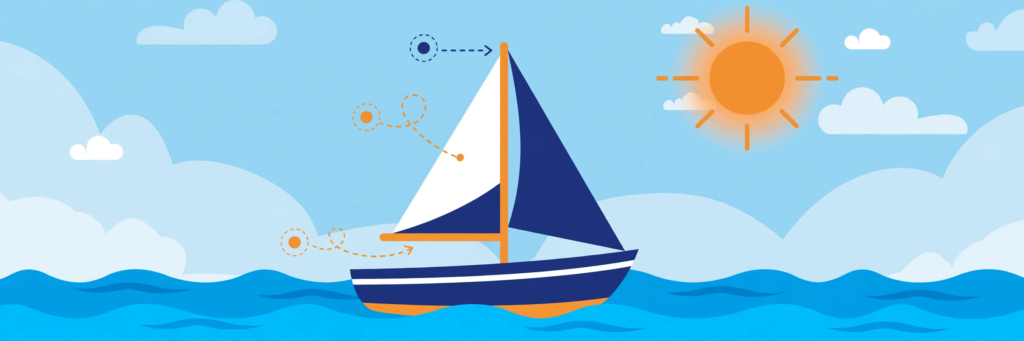
The mast is the tall pole that holds the sails up, kept upright by wires called rigging. The boom is the horizontal pole sticking out from the bottom of the mast toward the stern, and the bottom edge of the mainsail is attached to it. The boom swings across the cockpit at head height when the boat changes direction, which is why every instructor repeats the same warning: watch the boom. The mainsail is the large sail on the mast and boom, the main engine of the boat. The jib is the smaller front sail, and a genoa is simply a larger jib that overlaps the mainsail. The keel is the weighted fin under the hull that stops the boat sliding sideways and keeps it upright. The helm is the steering position. On smaller boats you steer with a tiller, a handle connected to the rudder, and pushing it one way turns the boat the other way. On larger boats you steer with a wheel, like a car, but slower and gentler.
Direction words that never change
Port is the left side of the boat when you face the bow. Starboard is the right side. Sailors use these words instead of left and right because left and right change depending on which way you face, while port and starboard never change. Forward means toward the bow, aft means toward the stern, and abeam means directly to the side. Windward is the side the wind comes from, also called upwind. Leeward, pronounced “loo-ard,” is the side the wind blows toward, also called downwind. The windward side sits higher when the boat heels, and the leeward side is lower and wetter.
Wind and points of sail
True wind is the wind you would feel standing still. Apparent wind is the wind you actually feel on a moving boat, a mix of true wind and the wind from your own forward motion. A point of sail is the angle of the boat relative to the wind. Close hauled means sailing as close to the wind as possible, roughly 45 degrees off it, sails pulled tight, boat heeling over. You cannot sail directly into the wind, so boats zigzag upwind instead. A beam reach means wind from directly abeam, often the fastest and most comfortable point of sail. A broad reach means wind from behind and to the side, and running means wind from directly behind, which needs extra care because an accidental jibe is more likely. In irons means the boat turned too far into the wind and stalled, sails flapping, no forward drive. Luffing means a sail flapping because it is not trimmed right for the wind angle.
The moves you will actually do
Tacking, also called coming about, is changing direction by turning the bow through the wind. The skipper usually calls “ready about” and then “tacking,” so the crew knows to duck. As a beginner your job is simple: stay low, watch the boom, and move to the other side when told. Jibing, also spelled gybing, is changing direction by turning the stern through the wind, so the sails switch sides from the back. Jibes need more care because the boom can swing across quickly and with force, especially in strong wind. Trimming means pulling a sail in tighter, and easing means letting it out. Halyards are the ropes used to raise and lower sails, while sheets are the ropes that control a sail’s angle once it is up. A winch is a drum that helps you pull a rope with far more force than your hands alone, and a cleat is a fitting you wrap a rope around to hold it. Reefing means reducing sail size when the wind gets strong, like changing to a lower gear. Good sailors reef early, before the boat feels out of control.
Safety and the rules of the road
The boat that should keep course and speed is the stand-on vessel, and the boat that should change course to avoid a collision is the give-way vessel. As a rough beginner rule, a sailboat under sail generally has right of way over a powerboat, but there are many exceptions, including large ships and fishing boats. Never assume another boat has seen you, and never insist on right of way if doing so would cause a collision. Safety beats being right. Heeling is the boat leaning to one side under wind pressure. A little heel is normal and part of the fun. A knot is one nautical mile per hour, so 10 knots is roughly 11.5 miles per hour on land, and most cruising sailboats travel at 5 to 8 knots in a decent breeze. A PFD, a personal flotation device, is what most people call a life jacket. Wear one, especially if you are new, the weather is rough, or you sail at night. “Man overboard” is the call if someone falls in: point at the person continuously, throw a flotation aid, and start the recovery drill the skipper briefed.
What sailing costs in 2026: a beginner money guide
Sailing has a reputation for being only for the wealthy, but the entry point is far more affordable than most people expect. The prices below are estimates based on typical 2026 listings and school pricing, not verified quotes, and they vary by location, season, and boat size. A short introductory sailing experience, often two to three hours with an instructor on board, typically costs in the range of $75 to $200 per person as an estimate. A full beginner course, such as a two-day basic keelboat course, often runs from about $400 to $800 as an estimate, and many schools include the boat, fuel, and safety gear.
A bareboat charter, where you rent the boat without a crew and sail it yourself, usually requires experience or a qualification, and a week on a mid-sized monohull often costs from roughly $2,000 to $5,000 as an estimate, before food, fuel, and marina fees. Gear for a beginner is modest: budget sailing gloves cost roughly $20 to $40 as an estimate, a basic waterproof jacket roughly $50 to $150, and deck shoes roughly $40 to $100. Buying a boat is a different decision entirely. Annual running costs, including marina fees, insurance, maintenance, and storage, are often estimated at around 10% of the boat’s value per year as a rough rule of thumb. That is why many beginners start with lessons and charters, and only buy once they know how often they will really sail.
Example: pricing a first weekend on the water
Take a beginner who wants a real first taste without buying anything big. An introductory three-hour sail at the middle of the typical range costs about $150. Add budget gloves at about $30, a basic waterproof jacket at about $100, and deck shoes at about $70. The total comes to about $350 for a first weekend that leaves you with gear you will reuse on every sail after it.
Common mistakes
Standing up during a tack or jibe, right when the boom is swinging across, is the classic beginner error. Stay low until the move is finished. Another is buying a full wardrobe of sailing clothing before a first lesson. A third is assuming right of way means safety, since a large ship or a fishing boat may not be able to move for you. A fourth is treating the posted charter price as the total cost, since food, fuel, and marina fees sit on top of the weekly rate.
Pros and cons of learning to sail
The pros are real: sailing teaches practical skills fast, a first lesson is genuinely affordable, and the progression from day sail to charter to ownership is clear. The cons are real too: the vocabulary feels like a barrier at first, weather can cancel plans, and ownership costs run year after year even when the boat sits unused.
Frequently asked questions
Do I need to know all these terms before my first lesson?
No. A good instructor explains each term as it comes up, and you learn fastest by doing. Reading this guide beforehand simply means fewer surprises and more confidence on the day.
What is the hardest sailing term for beginners?
For most people it is port and starboard, simply because it replaces left and right. The four-letter trick, port and left, solves it for most learners within a day.
Is sailing hard to learn?
The basics are not hard. Most people can steer, trim a sail, and tack a boat after a weekend course. Sailing well in strong wind, at night, or over long distances takes longer, which is why qualifications are built in stages.
Sailing has its own language because it needs one. Once you know the words in this guide, you will understand instructions faster, feel safer on board, and enjoy the sail more. For more on the money side of boating, see our guides on boat insurance costs, fishing kayaks, and Jones Act rights for injured seamen. The US Sailing and American Sailing Association sites are good places to find courses and qualifications near you.