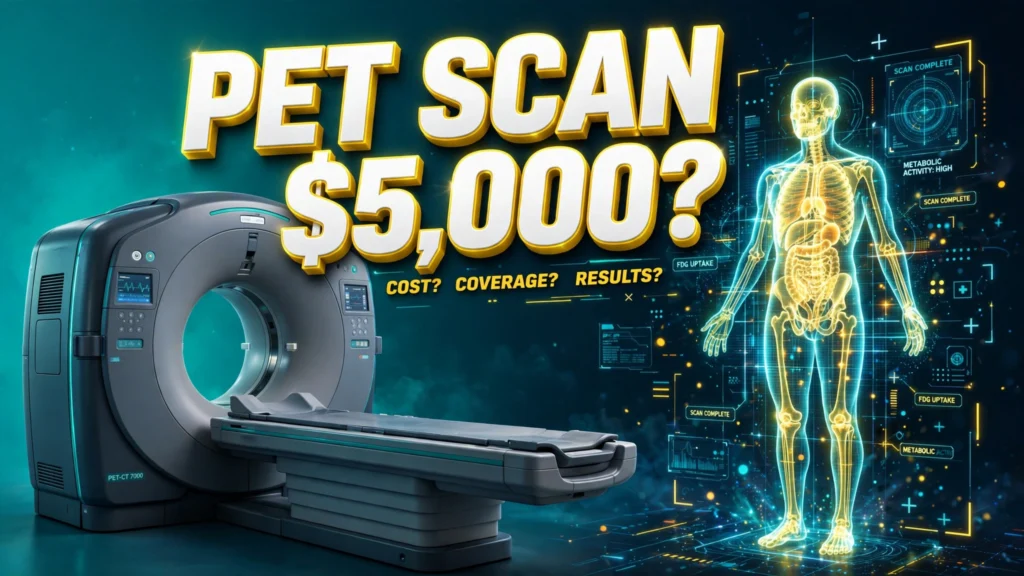
The Short Answer: $3,000–$6,000, Averaging Around $5,000
A PET scan without insurance typically costs $3,000 to $6,000, with a national average around $5,000. It is one of the most expensive common imaging tests — pricier than MRI or CT — because the radioactive tracer injected before the scan is costly to produce and has a short shelf life.
But the sticker price is only half the story. The same PET scan can cost three times more at a hospital outpatient department than at a freestanding imaging center — the exact same facility-fee gap that makes MRIs and CT scans so wildly variable. Where you get scanned matters as much as what you get scanned for.
PET Scan Cost Breakdown (Self-Pay)
| Setting | Typical cost without insurance | Notes |
|---|---|---|
| Hospital outpatient | $4,500–$8,000+ | Facility fees drive the price; most expensive option |
| Freestanding imaging center | $1,500–$3,000 | Same technology, far less overhead |
| PET/CT combo (most common) | $3,000–$6,000 | The standard oncology scan; priced as one procedure |
| PET scan with contrast | Add $200–$500 | Contrast dye billed as a separate line item |
| Radiologist interpretation | $200–$600 | Sometimes bundled, sometimes billed separately — ask |
A cash-pay patient who shops around can realistically land a PET/CT in the $1,800–$3,000 range at an independent center — versus $6,000+ at the hospital across the street.
Why the Price Swings So Much
- Facility fees: hospitals tack on facility fees that independent centers do not. This single factor explains most of the 3× gap.
- The radiotracer: the FDG tracer used in most PET scans is produced in a cyclotron and decays within hours — supply logistics add real cost, and it is priced into every scan.
- Geography: major metro hospitals charge the most; prices in smaller markets and at independent centers run substantially lower.
- Urgency: a scan scheduled next week at an imaging center costs less than a “we need it tomorrow” hospital slot.
- Bundled vs. itemized billing: some quotes include the tracer, scan, and interpretation; others itemize each. Compare all-in totals, not headline numbers.
The Hospital vs. Imaging Center Gap
This is the same pattern behind MRI and CT pricing: hospitals charge 2–3× what freestanding centers charge for equivalent imaging. The machines are comparable, the radiologists reading the scans often overlap, and for a standard PET/CT the diagnostic quality is equivalent.
When your doctor orders a PET scan, the order usually names a specific facility — often the hospital system they are affiliated with. You are allowed to take that order elsewhere. Ask for a copy of the imaging order and call two or three independent centers for cash quotes. The 15 minutes of phone calls routinely saves $2,000–$4,000.
Insurance Denials and Appeals
PET scans are among the most prior-authorized procedures in medicine — insurers frequently deny the first request, especially for initial diagnosis rather than cancer staging or treatment monitoring. If your scan is denied:
- Get the denial reason in writing. “Not medically necessary” is the common label; the letter must cite the specific policy criteria.
- Have your doctor file a peer-to-peer review. A 10-minute doctor-to-doctor call overturns a large share of imaging denials.
- File a formal appeal. You generally have 180 days from the denial. Include the ordering physician’s letter explaining why alternatives (CT, MRI) are insufficient.
- Request an external review if the internal appeal fails — independent reviewers overturn insurer denials at meaningful rates.
- Meanwhile, get a cash quote. A $2,000 cash price at an imaging center may beat your deductible + coinsurance anyway — do the math before assuming insurance is the cheaper path.
Ways to Pay Less
- Go freestanding: the single biggest lever — independent imaging centers typically charge one-third to one-half of hospital prices.
- Ask for the cash price: many centers offer 30–60% self-pay discounts off their chargemaster rates. The discount exists whether or not you have insurance — ask even if you are insured but facing a big deductible.
- Get the quote itemized: tracer, scan, contrast, and interpretation should be separate lines. Mystery “miscellaneous” charges are negotiable.
- Compare 2–3 centers: cash prices vary enormously even among independents. One round of calls is worth thousands.
- Ask about off-peak scheduling: some centers discount early-morning or late-evening slots.
- Check for financial assistance: nonprofit hospitals must offer charity-care applications — if your income qualifies, the bill can shrink dramatically or disappear.
- Use FSA/HSA funds: diagnostic imaging is an eligible expense; pre-tax dollars effectively discount the scan by your tax rate.
PET Scan vs. Other Imaging: When Each Is Ordered (and What Each Costs)
Doctors choose imaging by clinical question, but the price ladder is worth knowing — because when two tests could answer the question, the cheaper one usually gets ordered first:
| Test | Typical self-pay cost | What it shows |
|---|---|---|
| X-ray | $100–$500 | Bones, chest basics |
| Ultrasound | $150–$500 | Soft tissue, organs, blood flow |
| CT scan | $500–$2,500 | Detailed anatomy, fast |
| MRI | $800–$3,500 | Soft tissue detail, no radiation |
| PET/CT | $3,000–$6,000 | Metabolic activity + anatomy |
PET sits at the top because nothing cheaper answers its question: is this tissue metabolically active like cancer? When a doctor jumps straight to PET, it is usually because CT or MRI already raised a question only metabolic imaging can answer — which also strengthens your case if insurance pushes back.
Radiation and Safety: The Question Everyone Asks
A PET/CT exposes you to more radiation than a CT alone — roughly equivalent to several years of natural background radiation in one scan. In context: for cancer staging and treatment monitoring, the diagnostic value overwhelmingly outweighs the radiation risk, which is why oncologists order them routinely. The tracer itself leaves your body within hours (mostly through urine — hydrating after the scan helps flush it).
The money relevance: do not let radiation anxiety push you into repeating cheaper scans that cannot answer the question. One $2,500 PET/CT that settles the diagnosis beats a $1,200 CT plus a $900 MRI plus, eventually, the PET/CT anyway.
Getting a Second Opinion on the Images
PET/CT interpretation is genuinely difficult — and consequential. If the report will drive cancer treatment decisions, a second read is cheap insurance:
- Subspecialty second opinions from academic medical centers typically cost $200–$500 for a remote re-read of your existing images — no new scan needed.
- Your images are portable: request the DICOM files on disc or via the patient portal. Facilities must provide them; a small copying fee ($0–$25) is normal.
- When it matters most: ambiguous findings (“indeterminate uptake”), a diagnosis that does not match your symptoms, or a recommended treatment with major side effects.
A $300 second read that downgrades a finding can save tens of thousands in unnecessary treatment — the highest-ROI $300 in the entire diagnostic chain.
PET Scan Cost FAQ
What is a PET scan used for?
Most commonly cancer detection, staging, and treatment monitoring — PET shows metabolic activity, revealing fast-growing cells. It is also used for some heart and brain conditions (epilepsy, Alzheimer’s evaluation).
How long does a PET scan take?
Plan on 2–3 hours door to door: about an hour of quiet rest after the tracer injection (so it distributes), then 20–40 minutes in the scanner. The scan itself is painless.
Is a PET scan the same as a CT scan?
No — a CT shows anatomy (structures), while PET shows function (metabolic activity). Most oncology scans are PET/CT combos: the CT provides the anatomical map, the PET highlights suspicious activity on it.
Why is a PET scan so expensive?
Three cost drivers: the short-lived radiotracer, the specialized scanner, and — the biggest one — facility fees at hospital settings. The tracer and machine explain the $1,500 floor; facility fees explain everything above it.
The Bottom Line
Budget ~$5,000 as the national average for a PET scan without insurance — but never pay the first quote. Take the imaging order to freestanding centers, ask for itemized cash pricing, and expect to land in the $1,800–$3,000 range. If insurance denies the scan, appeal while getting cash quotes in parallel; the cash price often beats your deductible anyway.