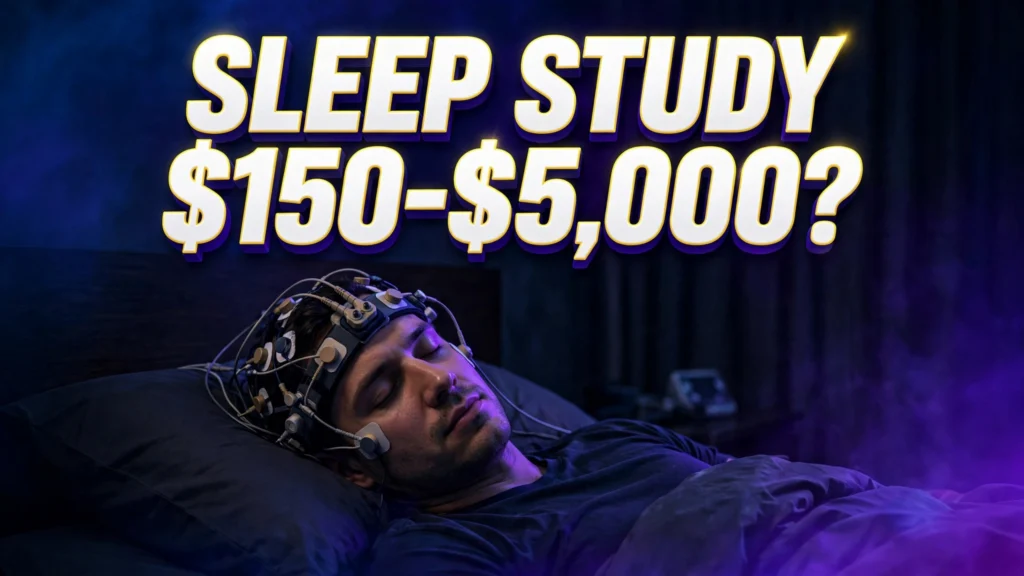
The Short Answer: $1,000 to $5,000 In-Lab, $150 to $500 at Home
A sleep study without insurance typically costs $1,000 to $5,000+ for an in-lab polysomnography — the overnight test at a sleep center with sensors everywhere. A home sleep apnea test (HSAT) typically costs $150 to $500 and is sufficient for most straightforward suspected sleep apnea cases. The single biggest money decision in this whole process is which test you actually need — many people who are quoted the in-lab price could have started with the home test. Ask your doctor explicitly whether a home test is appropriate for your symptoms.
In-Lab vs. Home Sleep Test: Cost and What You Get
| In-lab polysomnography | Home sleep apnea test (HSAT) | |
|---|---|---|
| Typical cost without insurance | $1,000–$5,000+ | $150–$500 |
| Where | Sleep center, overnight | Your own bed, 1–3 nights |
| What it measures | Brain waves, eye movement, muscle tone, heart rhythm, breathing, oxygen, leg movements — the full picture | Breathing effort, airflow, oxygen levels, heart rate — focused on apnea |
| Best for | Complex cases: suspected narcolepsy, parasomnias, treatment-resistant apnea, other sleep disorders | Straightforward suspected obstructive sleep apnea in otherwise healthy adults |
| Accuracy for sleep apnea | Gold standard | Very good for moderate-to-severe apnea; can miss mild cases |
The home test cannot diagnose every sleep disorder — it is essentially an apnea detector. If your symptoms point beyond apnea (acting out dreams, severe daytime sleepiness despite treatment, restless legs), the in-lab study is the right tool and worth the money. For classic loud-snoring-plus-daytime-fatigue, the home test is where to start.
The Hidden Add-Ons: What Else Gets Billed
The study fee is not always the whole bill. Ask whether the quote includes:
- Facility fee: hospital-based sleep labs can add $500–$2,000+ in facility charges on top of the professional fee. Independent sleep centers are often dramatically cheaper for the same test.
- Physician interpretation: $200–$600 for the sleep doctor to read and report the results. Sometimes bundled, sometimes separate.
- Follow-up visit: $150–$400 to discuss results and next steps with the ordering doctor.
- Titration study: if the first study diagnoses apnea, a second overnight ($1,000–$3,000+) may be ordered to calibrate CPAP pressure — though many providers now use auto-titrating CPAP machines that skip this step.
- DME (durable medical equipment): the CPAP machine itself, typically $500–$1,000+ without insurance, plus masks and supplies.
A “$2,000 sleep study” that becomes $4,500 after the facility fee, interpretation, and follow-up is the norm at hospital labs, not the exception. Get the all-in number.
The Insurance Math: Usually Covered, If You Follow the Steps
Sleep studies are one of the better-covered diagnostics: most health insurance plans cover them when medically necessary, which usually means a doctor’s referral documenting symptoms (snoring, witnessed apneas, daytime sleepiness) and often a prior authorization. Skip the prior auth and the claim can be denied even for a covered test — confirm it is approved before your overnight, not after.
Without insurance, or with a high deductible you will not meet, the move is to negotiate the cash price upfront. Sleep centers routinely offer self-pay discounts of 30–60% off the billed rate — but usually only if you ask before the test, not when the bill arrives. Ask for the “self-pay” or “cash” rate specifically, and get it in writing.
Cheaper Paths to the Same Diagnosis
- Start with the home test. At $150–$500, it diagnoses the most common condition (obstructive sleep apnea) for a tenth of the in-lab price. If it comes back negative but symptoms persist, then escalate to the lab.
- Choose an independent sleep center over a hospital lab. The test is the same; the facility fee is not. This single choice can save $1,000–$2,000+.
- Ask for the cash-pay rate before booking. Self-pay discounts are standard in this industry. The billed rate is a starting number, not a price.
- Ask about split-night studies. If apnea shows up early in the night, some labs diagnose and titrate CPAP in a single overnight — one bill instead of two.
- Check employer wellness programs. Some employers subsidize home sleep tests through wellness benefits, since untreated apnea drives their health costs too.
- Price the CPAP separately. If diagnosed, the machine ($500–$1,000+), masks ($50–$200), and supplies add up. Online DME suppliers are often cheaper than the sleep center’s own equipment arm — but confirm the prescription requirements first.
What the Diagnosis Is Worth: The Cost of Untreated Apnea
The money case for getting tested is stronger than it looks. Untreated sleep apnea is associated with higher risks of hypertension, heart disease, stroke, and type 2 diabetes — each of which is catastrophically more expensive than a sleep study. There are also immediate financial risks: drowsy driving, and for commercial drivers, a DOT medical certification can hinge on apnea screening. A $300 home test that catches severe apnea is one of the highest-value purchases in self-pay medicine. This is not a test to skip because the in-lab price scared you — it is a test to get cheaply.
Do You Even Need the In-Lab Study? The Decision Flow
- Classic apnea symptoms (loud snoring, witnessed breathing pauses, unrefreshing sleep, daytime fatigue) in an otherwise healthy adult: home test first. It is cheaper, more comfortable, and sufficient.
- Home test negative but symptoms persist: in-lab study next. Home tests can miss mild apnea and cannot see other disorders.
- Complex symptoms (sleepwalking, acting out dreams, narcolepsy-like sleep attacks, severe insomnia mixed with apnea signs): go straight to in-lab — the home test cannot answer these questions.
- Heart failure, COPD, or neurological conditions: in-lab is usually indicated because breathing patterns in these patients need the full sensor array.
Your primary care doctor or a sleep specialist makes the call, but knowing this flow keeps you from paying $3,000 for an in-lab study when a $300 home test would have done the job.
Frequently Asked Questions
How do I prepare for a sleep study?
For an in-lab study: avoid caffeine after noon, skip naps that day, wash your hair (sensors stick better), and bring your usual sleepwear and medications. For a home test: the provider shows you how to wear the sensors — usually a chest belt, a finger probe, and a nasal cannula — then you sleep normally and return or mail back the device.
Will I actually be able to sleep with all those wires on?
Most people sleep worse than at home but well enough for a valid study — technicians see this every night and the scoring accounts for it. If you truly cannot sleep, tell the tech; some labs offer a repeat night rather than scoring a useless study.
How long until I get results?
Typically 1–2 weeks: the data is scored by a technologist, interpreted by a sleep physician, and sent to your ordering doctor, who discusses next steps with you. Ask at the study who will contact you and when, so the results do not sit in a queue.
Can a home test really replace the lab?
For diagnosing moderate-to-severe obstructive sleep apnea in uncomplicated adults, yes — clinical guidelines support it. It cannot diagnose narcolepsy, parasomnias, or central sleep apnea reliably, and it can underestimate mild apnea. It is a first step, not a universal substitute.
What happens if I’m diagnosed with sleep apnea?
The standard treatment is CPAP: a machine ($500–$1,000+ without insurance) that keeps your airway open with gentle air pressure. Mild cases may be managed with positional therapy, weight loss, or oral appliances ($500–$2,000 custom-fitted). Your doctor will walk through options at the follow-up visit — which is another reason to confirm that visit’s cost upfront.
The Bottom Line
A sleep study without insurance is either a $150–$500 home test or a $1,000–$5,000+ lab night, and the right choice depends on your symptoms — not on which one the first scheduler offers you. Start with the home test when the picture is classic apnea, pick an independent center over a hospital lab, and negotiate the cash rate before you book. Untreated apnea is far more expensive than any version of this test, so the goal is never to skip it — it is to pay the small price instead of the big one.