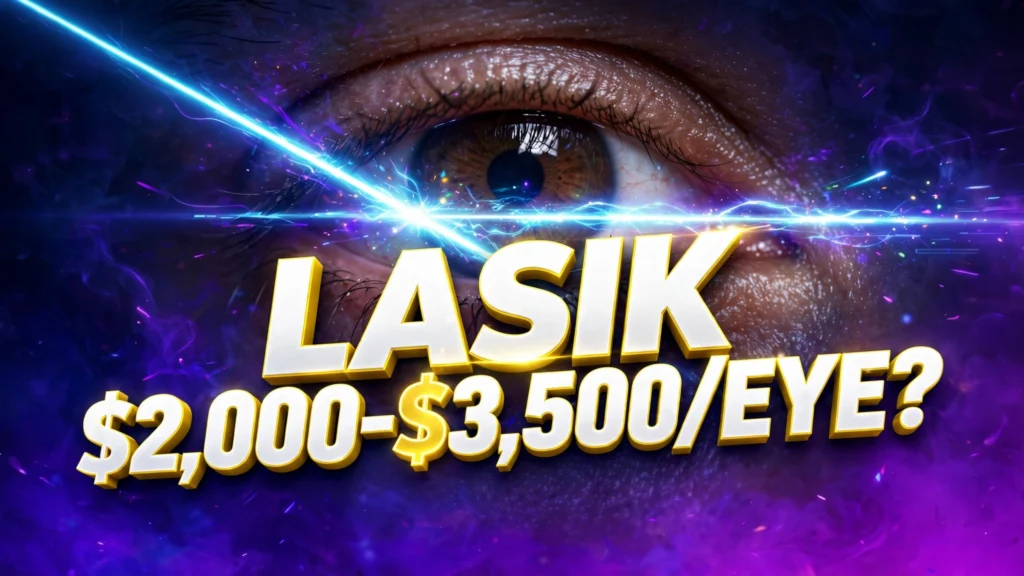
The Short Answer: $2,000 to $3,500 Per Eye
LASIK without insurance typically costs $2,000 to $3,500 per eye — so $4,000 to $7,000 for both eyes. The price depends on the technology used, the surgeon’s experience, and your city. The “$250 per eye” prices you see advertised are bait: they apply to a tiny fraction of patients with the mildest prescriptions, using older technology. For a typical patient with moderate nearsightedness, the real number starts around $2,000 per eye. Get the quote for your eyes, in writing, before you compare.
LASIK Cost by Technology (Self-Pay, Per Eye)
| Procedure / technology | Typical cost per eye | Notes |
|---|---|---|
| Standard LASIK (microkeratome blade) | $1,000–$2,000 | Older technique; the “$250/eye” ads usually mean this, for mild prescriptions only |
| All-laser LASIK (bladeless, femtosecond) | $2,000–$3,000 | The current standard at most reputable centers |
| Custom wavefront LASIK | $2,500–$3,500 | Maps your eye’s unique imperfections; best for night vision and complex prescriptions |
| PRK | $1,500–$2,500 | No corneal flap; longer recovery, preferred for thin corneas and contact sports |
| SMILE | $2,500–$3,500 | Newer minimally invasive option; not offered everywhere |
Most patients in 2026 are quoted all-laser or custom wavefront LASIK — that is the $2,000–$3,500 per eye range. Comparing a $999/eye quote for standard LASIK against a $2,800/eye quote for custom wavefront is not a real comparison. Ask which technology each quote covers.
What’s Included vs. What’s Extra
A reputable quote should bundle the whole episode of care. Ask specifically whether these are included:
- Pre-op consultation and measurements: $0–$300. Many centers apply it to the surgery if you proceed; some charge it separately.
- Post-op visits (typically 3–4 over a year): should be included. If they are billed separately, add several hundred dollars.
- Enhancement / touch-up policy: the big one. Many centers include free enhancements for 1–2 years if your vision regresses; others charge $500–$1,500 per eye. Get the policy in writing.
- Post-op drops and medications: $50–$200 out of pocket, rarely included.
- Lifetime commitment plans: some centers sell these for a premium. Read the fine print — they usually require annual eye exams at that center to stay valid.
Two quotes that look $1,000 apart can be identical once you add the excluded extras to the cheaper one. The all-in number is the only number that matters.
The Insurance Math: Discounts, Not Coverage
Vision insurance (VSP, EyeMed, Davis Vision) almost never covers LASIK — it is classified as elective. But most vision plans negotiate 5–15% discounts through partner LASIK networks, and some employers add a flat LASIK allowance. That is real money on a $5,000 procedure, so check your vision plan before paying cash.
Health insurance covers laser eye surgery only when it is medically necessary — for example, correcting vision after cataract surgery or an injury — which is rare for standard LASIK. The bigger tax play is the FSA or HSA: LASIK is an eligible expense, so paying with pre-tax dollars saves whatever your marginal tax rate is — typically 20–30% in real terms. If your employer offers an FSA, time the surgery early in the plan year: you can spend the full annual election before you have contributed it.
Cheaper Paths to the Same Surgery
- Shop 2–3 surgeons, not ads. Prices for the same technology vary widely by market and surgeon. A consultation is usually free or cheap — get multiple all-in quotes for the same procedure type.
- Use your vision plan’s discount network. Even without coverage, the 5–15% contracted discount beats most cash negotiations.
- Pay with FSA/HSA dollars. The pre-tax savings are the single biggest legitimate discount available — often $1,000+ on both eyes.
- Ask about cash-pay pricing. Some centers discount for paying upfront rather than financing. It never hurts to ask; the worst answer is no.
- Consider PRK if you qualify. It is often $500–$1,000 less per eye than custom LASIK, with equivalent long-term results — the trade-off is a longer, more uncomfortable recovery week.
- Finance carefully. 0% APR plans for 12–24 months are common through CareCredit and similar. Read the deferred-interest clause: miss the payoff deadline and retroactive interest applies to the whole balance.
- Ignore the $250/eye ads. They are priced for the mildest prescriptions on the oldest lasers, and almost nobody qualifies. A bait quote that doubles at the consultation wasted your time, not just your money.
LASIK vs. Glasses vs. Contacts: The Lifetime Math
Lifetime cost is where LASIK often wins, and it is worth doing the arithmetic for your situation:
- Glasses: $200–$600 per pair, replaced every 2–3 years, plus prescription sunglasses. Over 20 years: roughly $2,000–$6,000.
- Contacts: $250–$700/year for lenses plus $100–$200/year in solutions and annual exams. Over 20 years: roughly $7,000–$18,000.
- LASIK: $4,000–$7,000 once, with a possible enhancement ($0–$1,500) down the road.
For a contact lens wearer, LASIK typically breaks even within 5–10 years — and that is before counting the convenience. For someone happy in cheap glasses with a stable mild prescription, the financial case is thinner. Run your own numbers with your actual annual eyewear spending.
Candidacy and Red Flags: When Not to Buy
No price is good if you are not a candidate. Common disqualifiers include corneas too thin for a safe flap (PRK may still work), unstable prescriptions (your glasses prescription should be stable for at least a year), severe dry eye, and certain corneal conditions like keratoconus. A reputable surgeon turns away 15–25% of consultations — a center that approves everyone is a red flag, not a bargain. Other red flags: pressure to decide the same day, quotes that cannot be put in writing, and enhancement policies that expire suspiciously fast.
Frequently Asked Questions
Does LASIK hurt?
The procedure uses numbing eye drops, so most people feel pressure but not pain during the 10–15 minutes it takes. Afterward, expect a gritty, burning sensation for a few hours — often described as having an eyelash in your eye. Most people are comfortable by the next morning.
How long do LASIK results last?
The corneal reshaping is permanent, and most people enjoy good vision for 10–20+ years. But LASIK does not stop your eyes from aging — presbyopia (needing reading glasses in your 40s) still happens, and some people’s distance vision regresses slightly over the years, which is what enhancement policies are for.
Can both eyes be done on the same day?
Yes — same-day bilateral LASIK is the standard practice now. Some surgeons still offer one-eye-at-a-time for anxious patients or complex cases, but it doubles the recovery logistics without a medical benefit in routine cases.
Is there an age limit?
You generally need to be 18+ with a stable prescription. There is no strict upper limit, but patients over 40 should discuss presbyopia: LASIK corrects distance vision, so you may still need readers. Some surgeons offer monovision (one eye for distance, one for near) — trial it with contacts first.
What if my vision changes years later?
Minor regression happens. This is exactly why the enhancement policy matters more than the headline price — a center offering free enhancements for two years is selling you something meaningfully different from one that charges $1,500 per eye for the same touch-up.
The Bottom Line
LASIK without insurance is a $4,000–$7,000 decision for both eyes, and the spread between quotes is mostly about technology tier and what is bundled — not about one surgeon being magically cheaper. Ignore the bait ads, get all-in written quotes for the same procedure, check your vision plan’s discount and your FSA/HSA, and read the enhancement policy like it is part of the price — because it is. Done right, it is one of the few elective procedures that can pay for itself.