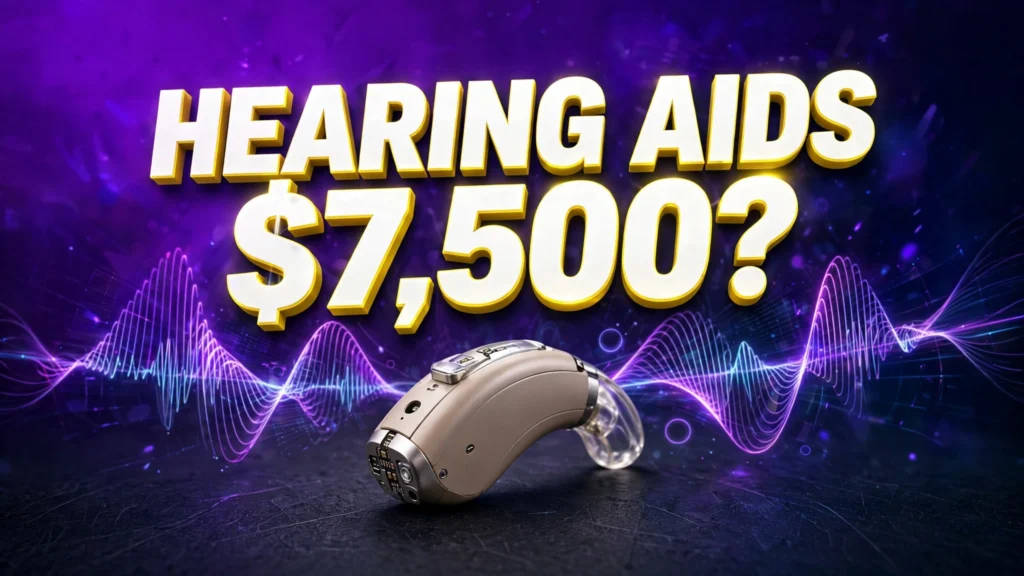
The Short Answer: $1,000 to $7,500+ Per Pair
Hearing aids without insurance typically cost $1,000 to $7,500+ per pair — one of the widest price ranges in all of healthcare. The spread exists because “hearing aid” covers two completely different products now: over-the-counter devices starting around $100 per pair, and prescription in-clinic devices running $3,500–$7,500+ per pair.
And here is the kicker most shoppers discover late: Original Medicare pays $0 toward hearing aids. No Part A, no Part B coverage — hearing aids, fittings, and exams are explicitly excluded. If you are budgeting for a parent (or yourself), assume you are paying out of pocket unless you have a specific plan that says otherwise.
OTC vs. Prescription Hearing Aids: The Two Markets
Since the FDA authorized over-the-counter hearing aids in 2022, the market split in two. Know which one you are shopping in:
| OTC hearing aids | Prescription (in-clinic) hearing aids | |
|---|---|---|
| Typical price (pair) | $100–$2,000 | $3,500–$7,500+ |
| Who it fits | Adults with mild-to-moderate hearing loss | Moderate-to-severe or complex loss |
| Hearing test | Self-assessment via app | Licensed audiologist exam |
| Fitting & tuning | DIY via smartphone app | Professional fitting + follow-up visits |
| Where to buy | Pharmacies, electronics stores, online | Audiologist or hearing clinic |
If your hearing loss is mild to moderate, starting with a well-reviewed OTC pair is the rational first move — you can always upgrade to prescription devices if they are not enough.
What You’re Actually Paying For at the Clinic
The $5,000 clinic price tag is not just the device. In-clinic pricing is usually bundled, and the bundle includes:
- The hearing aids themselves (often $1,500–$3,000 of the total in actual hardware cost)
- The audiologist’s hearing exam and fitting
- Follow-up tuning visits (typically 1–3 years of adjustments)
- Warranties and loss/damage coverage (usually 1–3 years)
- Cleaning supplies and batteries or chargers
Always ask for an unbundled quote — device price separated from service fees. Some clinics will sell the aids alone and charge per visit, which can save hundreds if you need minimal follow-up.
The Medicare Gap (and the Exceptions)
Original Medicare (Parts A and B) explicitly excludes hearing aids, hearing exams for fitting, and related services. This surprises nearly everyone. The exceptions:
- Medicare Advantage (Part C): some plans include a hearing benefit — typically an allowance of $500–$2,000 toward aids every few years, sometimes with a network of providers. Check the plan’s Evidence of Coverage; benefits vary wildly.
- Medicaid: coverage varies by state — some states cover hearing aids for adults, others cover only children. Check your state’s plan.
- VA benefits: veterans enrolled in VA healthcare can often get hearing aids at no cost if hearing loss is service-connected or meets clinical criteria.
- Employer plans: a minority of private plans include a hearing benefit, often $1,000–$3,000 every 3 years. Call and ask specifically — it is frequently buried in the fine print.
Ways to Pay Less
- Start with OTC: for mild-to-moderate loss, a $300–$800 OTC pair may do the job of a $5,000 clinic pair. The technology gap has narrowed fast.
- Warehouse clubs: big-box hearing centers famously sell quality prescription-style aids around $1,500 per pair including fitting — a fraction of private-clinic prices.
- Refurbished and previous-generation models: last year’s flagship technology at 40–60% off. Hearing aid tech improves incrementally, not revolutionarily.
- FSA/HSA funds: hearing aids are eligible expenses — paying with pre-tax dollars effectively discounts the price by your marginal tax rate.
- State programs: many states run vocational-rehabilitation or assistive-technology programs that subsidize hearing aids for working-age adults.
- Nonprofits: organizations like the Hearing Loss Association of America maintain lists of financial-assistance resources; some Lions Clubs chapters help fund aids.
- Negotiate the bundle: ask what the price is without the 3-year service package, or whether they will match a competitor’s quote. Margins are large enough that discounts happen.
The Real Lifetime Cost
Hearing aids last roughly 3–7 years. At $5,000 per pair replaced every 5 years, a 65-year-old with average life expectancy is looking at $20,000–$30,000 in lifetime hearing-aid spending — plus batteries, domes, wax guards, and repairs along the way. That lifetime math is exactly why the OTC-first strategy and unbundled quotes matter: small savings per cycle compound into five figures.
The Hidden Ongoing Costs
The sticker price is not the total cost of hearing. Budget these recurring lines too:
- Batteries: disposable batteries run roughly $30–$100/year per pair; rechargeable models eliminate this but the charger is part of the upfront price.
- Domes, wax guards, and filters: roughly $50–$150/year — small parts that protect the expensive electronics.
- Repairs: out-of-warranty repairs typically run $150–$400 per aid. Extended warranties ($200–$500) can make sense given the replacement cost.
- Loss and damage: hearing aids are tiny and losable. Manufacturer loss/damage coverage (often 1 year, sometimes extendable) typically carries a $250–$400 deductible per claim — still far cheaper than buying a replacement at retail.
- Follow-up visits: bundled for the first 1–3 years at most clinics, then $75–$200 per visit for reprogramming as your hearing changes.
Add it up and the true annual cost of ownership for a $5,000 clinic pair is roughly $1,100–$1,600/year amortized — which reframes the OTC math even more favorably for mild loss.
How to Test Your Hearing Before You Spend
Do not buy on suspicion alone. Cheaper ways to establish what you actually need:
- Free screenings: many clinics, warehouse hearing centers, and community health events offer free basic screenings — enough to confirm whether loss is present.
- App-based tests: several well-regarded smartphone apps run pure-tone hearing tests with calibrated earbuds. Not a diagnosis, but a solid directional signal.
- Full audiologist exam: typically $75–$250 without insurance — worth it before a $5,000 purchase, since the audiogram determines whether OTC devices can even work for your loss pattern.
Bring the audiogram results when shopping: it lets you compare devices against your actual loss curve instead of marketing claims, and it is required documentation if you later pursue insurance or VA coverage.
When to Repair vs. Replace
At year four, when one aid starts crackling, the repair-or-replace math matters:
- Repair ($150–$400) makes sense when the aids are under 5 years old, the technology still suits your loss, and only one unit is failing.
- Replace the pair when both are aging out, your hearing has changed significantly (requiring reprogramming beyond the old aids’ range), or repair quotes approach half the price of new OTC alternatives.
- Replace one, not both: if the other aid works fine, a single replacement ($500–$3,500 depending on tier) is legitimate — but mismatched technology generations can sound uneven, so test the pairing before committing.
Keep the old working aid as a backup regardless. A backup pair turns a “my hearing aid died” crisis into a minor inconvenience — and it is free, since you already own it.
Hearing Aid Cost FAQ
Why do hearing aids cost $7,000?
Mostly the bundled-service model and low sales volume per clinic, not the hardware — the actual electronics in a premium pair cost a fraction of the retail price. Unbundled and OTC options expose how much of the price is service and markup.
Are OTC hearing aids any good?
For mild-to-moderate loss, yes — the best-reviewed OTC devices now include directional microphones, noise reduction, and app-based tuning that rival mid-tier prescription aids from a few years ago. For severe loss, see an audiologist.
Does insurance ever cover hearing aids?
Sometimes. A minority of employer plans and some Medicare Advantage plans include hearing benefits ($500–$3,000 allowances). Original Medicare never does. Always verify in writing before you buy — verbal promises from sales staff do not count.
How long do hearing aids last?
Typically 3–7 years. Moisture, earwax, and battery contacts are the usual failure points — all manageable with basic maintenance, which extends device life and delays the next $5,000 purchase.
The Bottom Line
Do not walk into a clinic and pay the first quote. Start with an honest assessment of your hearing loss, try the OTC tier if it fits, get an unbundled quote if you need prescription devices, and pay with pre-tax FSA/HSA dollars. The gap between the smart path and the default path is easily $3,000–$5,000 per pair — every five years, for the rest of your life.