If you want a fish that is fun to catch, good to eat, and forgiving for a beginner, start with crappie. Crappie fish travel in schools, bite on simple tackle, and live in lakes and slow rivers across much of the United States. You do not need a fancy boat, a wall of expensive gear, or years of experience to catch your first one. You need a basic setup, a plan for where crappie are likely to be, and a little patience while you learn to read the water.
This guide covers what crappie are, where to find them through the seasons, which baits and lures work best, the techniques that catch fish consistently, and what it really costs to get started. Prices are estimates based on typical 2026 retail ranges, and they vary by state, store, and brand. Fishing rules also vary by state and by lake, so always check your local regulations before you keep a fish.
Quick answer
Crappie are schooling panfish that bite simple tackle, making them one of the best beginner fish in the United States. Fish brush, docks, and creek channels, match your depth to the season, and start with a jig or a live minnow under a bobber. A bank starter kit costs roughly $70 to $175 including a license.
What is a crappie?
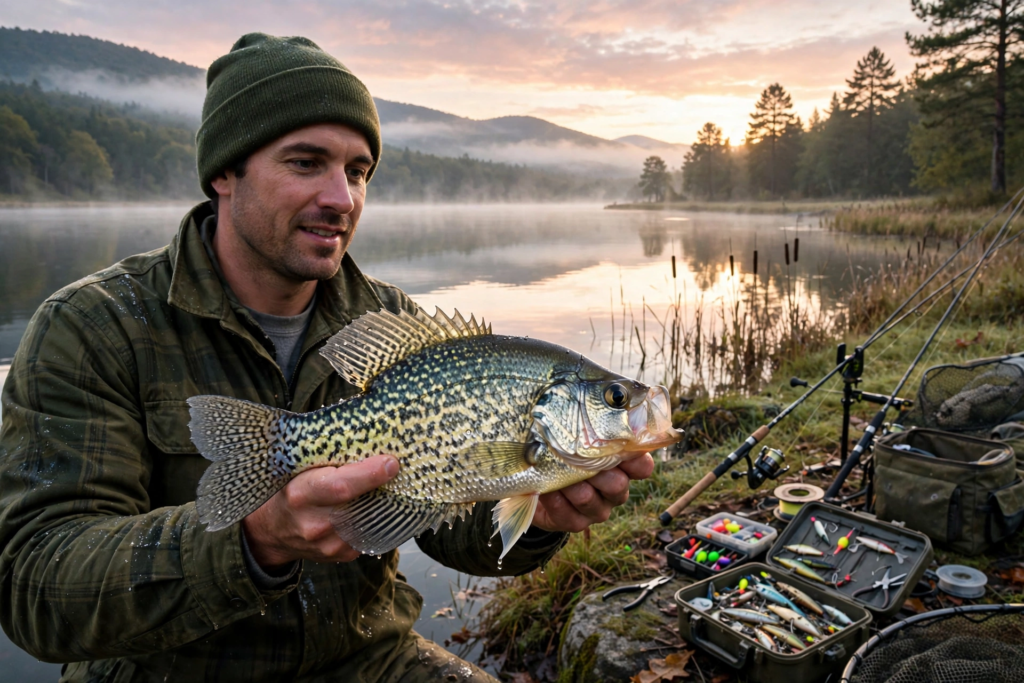
Crappie are freshwater panfish in the sunfish family. Most anglers meet two kinds: black crappie and white crappie. Both are deep-bodied fish with large mouths for their size, and both are excellent table fare when handled well.
Black crappie tend to have dark, irregular blotches across a silvery green body. They often favor clearer water, vegetation, and wood cover. White crappie tend to have vertical bars rather than random spots, and they often tolerate murkier water and more open areas. In practice, the two species overlap a lot, and many lakes hold both. You do not need to identify every fish perfectly to enjoy the trip, but knowing the difference helps you choose water: if a lake is clear and weedy, black crappie are a strong bet, while a stained reservoir with brush piles may hold more white crappie.
Most crappie you catch will weigh well under two pounds. A one-pound crappie is a solid fish, and a two-pound crappie is a trophy in many waters. That modest size is part of the appeal. You can fish with light tackle, feel every bite, and bring home enough for a family meal without needing heavy gear or a huge livewell.
Crappie are also social fish. Where you find one, you often find ten. That schooling habit means a slow morning can turn fast once you locate an active group. Mark a productive spot in your mind, or on your electronics if you have them, and work it carefully instead of racing past it.
Where crappie live
Crappie live in lakes, reservoirs, ponds, and slow-moving rivers. They relate to structure and cover more than to open water for most of the year. Structure is a change in the bottom, such as a creek channel, a drop-off, a hump, or a submerged roadbed. Cover is something in the water that gives fish shelter, such as brush piles, fallen trees, standing timber, docks, and weed edges.
Think of it this way: crappie want food, shelter, and comfortable water temperature. Cover gives them ambush points and protection from larger predators. Structure gives them a travel route and a place to stage as seasons change. Baitfish gather around the same places, which is why crappie follow.
Good starting spots include brush piles and fallen trees in 8 to 20 feet of water, dock pilings, creek channels and their bends, standing timber in a flooded creek arm, weed edges and lily pads in spring, riprap banks and bridge pilings, and submerged humps near deeper water. If a lake has a lot of standing timber, start there. If it is a farm pond, fish the deepest weed edge and any brush you can find. If you are on a river, look for backwaters, sloughs, and eddies where the current slows down. Crappie avoid strong current when they can.
Depth matters, but it is not a fixed number. In spring, crappie may be in three feet of water. In summer, they may suspend 15 feet down over 30 feet of water. The key is to fish at the depth where fish are holding on that day, not the depth where you caught them last month. A simple depth finder helps a lot. Without one, you can still learn by counting down a jig, fishing different depths under a bobber, and paying attention to where bites happen.
Crappie by season
Season is the single biggest factor in crappie fishing. Follow the fish through the year, and your catch rate will improve more than any lure change will.
Spring is the most popular crappie season. As water warms into the 50s and 60s Fahrenheit, crappie move shallow to spawn. Males often arrive first, picking nesting areas near wood, weeds, or gravel in protected bays and creek arms. Females follow, and for a few weeks the fish are close to shore and eager to bite. In early spring, fish the mouths of creeks and the first deep cover near shallow spawning flats. As water warms further, move shallower and fish visible cover: laydowns, stumps, dock posts, and weed beds. A jig under a bobber is hard to beat here, because you can hold the bait at one depth and keep it in the strike zone. After the spawn, crappie slide back toward deeper water, but they often pause on the first good cover outside the spawning flat.
In summer, crappie move deeper and often suspend in open water near structure. They may hold over a creek channel, around a brush pile in 15 to 25 feet of water, or near standing timber. On hot days, the best bite is often early in the morning, late in the evening, or at night under lights. Summer fishing rewards vertical presentations. Lower a jig or a live minnow straight down beside a brush pile, a dock piling, or a tree, and hold it still or move it very slowly. Crappie often bite on the fall, so watch your line closely as the bait sinks. Night fishing is a summer specialty: submerged lights attract baitfish, and crappie follow. If your lake allows it and you fish safely with proper lights and life jackets, a calm summer night over a brush pile can be excellent.
Fall is an underrated crappie season. As water cools, baitfish gather in creek arms and around structure, and crappie follow them to feed before winter. Fish often move shallower again, though not as shallow as in spring. Creek channels, points, and brush piles in 8 to 18 feet of water are strong fall targets. Fall crappie can be aggressive. Try casting jigs to wood and letting them fall slowly, or trolling slowly along a channel edge if local rules allow it. If you see shad flicking near the surface in a creek arm, crappie are usually not far below. Crowds thin out in fall, the weather is pleasant, and fish are grouped up.
Winter crappie fishing is slower, but it can be very rewarding, especially through the ice in northern states or in deep southern reservoirs. In open water, crappie hold deep, often near the bottom of creek channels, in deep holes, or around deep brush. They move less, feed less often, and bite more subtly. Slow down everything. Use a small jig, fish it vertically, and keep it in front of the fish longer. A bite may feel like nothing more than a slight heaviness. If you fish through the ice, use a small jig tipped with a minnow or a soft plastic, fish just above the fish you mark, and keep your movements small. Never fish alone on questionable ice.
Best baits for crappie
Crappie are not fussy eaters, but they do have preferences that change with conditions. Start with the two classics: live minnows and small jigs.
A live minnow under a bobber is the simplest crappie rig ever made, and it still catches fish everywhere. Use a small to medium minnow, hooked lightly through the lips or just behind the dorsal fin so it stays lively. Fish it under a slip bobber at the depth where crappie are holding, near brush, docks, or weed edges. Minnows shine when fish are finicky, when you are fishing with kids or beginners, and when you want to hold a bait in one spot for a long time. They are also a great way to learn a lake: if minnows get bit in a spot, you know crappie are there. Minnow costs are modest. A dozen minnows often costs a few dollars at a bait shop, though prices vary by region and season. Bring a small bait bucket or a portable aerator to keep them lively, especially in warm weather.
Jigs are the workhorse lure for crappie. A jig is a weighted hook with a soft plastic body, a feather or hair dressing, or both. The most common sizes for crappie are 1/32 ounce, 1/16 ounce, and 1/8 ounce. Lighter jigs fall slower, which is often better in cold water or when fish are shallow. Heavier jigs help you fish deeper or in wind. Popular jig body styles include curly tail grubs, paddle tail swimbaits, tube jigs, and shad-shaped soft plastics. Popular colors include chartreuse, white, pink, black and chartreuse, and natural shad patterns. Color matters less than depth and presentation most days, but it does matter on tough days. If you are not getting bites, change color before you change lakes. Try a bright color in stained water and a natural color in clear water as a starting rule. Jig heads with painted heads and quality hooks are worth the small extra cost, because cheap hooks bend on a good fish or a snag.
Techniques that catch crappie
Technique matters more than tackle. These five methods cover most crappie fishing, and each one has a time when it is best.
Bobber and jig, or bobber and minnow, is the best starting technique. Rig a jig or a minnow under a fixed bobber in shallow water, or under a slip bobber in deeper water. Cast near cover, let the bait settle, and wait. Move the bobber up or down until you find the depth where bites happen. Watch for any movement: a bobber that tilts, slides sideways, sinks slowly, or pops back up can all signal a bite. Keep your rod still more than you think you need to. Crappie often mouth a bait and drop it if it moves too fast.
Vertical jigging means dropping a jig straight down beside cover and working it up and down in place. It is ideal for brush piles, standing timber, dock pilings, and deep structure. Lower the jig to the depth where fish are holding, lift it a few inches, let it fall on a slack or semi-slack line, and repeat. Many bites happen on the fall, so watch your line as the jig sinks. If the line jumps, stops early, or goes slack unexpectedly, set the hook with a short, gentle lift. Do not rip the rod upward. Crappie have soft mouths, and a hard hookset can tear the hook out.
Casting and slow retrieving works well in spring when crappie are shallow, and in fall when they are feeding near wood and points. Cast past the cover, let the jig sink to the right depth, and retrieve slowly with small twitches and pauses. Count down the jig so you know how deep it is: a 1/16 ounce jig falls roughly one foot per second in still water as a rough estimate, though wind and line type change that rate. Fan your casts around a piece of cover rather than hitting the same spot repeatedly.
Spider rigging and trolling help you find scattered fish and cover a creek channel or flat efficiently. Spider rigging means fishing several rods spread out in front of a boat, each with a jig or minnow at a different depth, while moving very slowly. Trolling means pulling jigs or crankbaits behind a boat at a slow speed. Both work best from a boat, and local rules on rod limits and trolling vary, so check them first. If you are bank fishing, you can get a similar search effect by walking a shoreline and casting to one likely spot after another.
Dock shooting is a specialized casting method for getting a jig far under a dock where crappie hide in shade. You hold a jig in one hand, pull the rod tip back like a slingshot, and release. It takes practice, and you will lose a few jigs at first, but it opens up water that most anglers cannot reach. Practice on an open dock before you try it in a tight spot, use a short, light rod and a light jig, and always be aware of people, boats, and overhead lines. When you suspect a bite, lift the rod tip smoothly rather than jerking it, since crappie have soft mouths and a hard hookset can tear the hook out.
Gear: what you actually need
You can start crappie fishing with a very simple setup. Resist the urge to buy everything at once. Buy the basics, fish them for a season, and add gear only when you know why you need it.
A light or ultralight spinning rod between five and seven feet long is ideal for most crappie fishing. A six-foot light rod is a versatile starting choice: long enough to cast a light jig, short enough to use vertically beside a dock or brush pile. Pair it with a small spinning reel in the 1000 to 2500 size range, spooled with four to six pound monofilament or fluorocarbon line. If you plan to dock shoot, a shorter rod around five feet can help. Expect to spend roughly $30 to $80 for a decent starter rod and reel combo as an estimate, with better combos in the 80 to 150 dollar range. A combo at the lower end will catch fish just fine. Spend the difference on line, jigs, and time on the water.
Spool up with four to six pound test monofilament to start. It is forgiving, easy to tie, and cheap to replace. Fluorocarbon is less visible and sinks a bit faster, which some anglers prefer for jigging, but it is stiffer and costs more. You will need a small assortment of jig heads in 1/32, 1/16, and 1/8 ounce, soft plastic bodies in a few colors, small hooks for minnows, split shot weights, and bobbers. A slip bobber setup is especially useful because it lets you fish deep water with a short cast. Add a small tackle box, line clippers, and needle-nose pliers for hook removal. A basic tackle assortment costs roughly $20 to $50 as an estimate.
Fishing license costs
License costs vary widely by state, and they are one of the most variable parts of getting started. As a rough 2026 estimate, a resident annual freshwater license often falls in the 15 to 40 dollar range in many states, while a nonresident annual license often falls in the 50 to 100 dollar range or higher. Short-term licenses, such as a one-day or three-day license, often cost $10 to $30 as an estimate and are a good choice if you are trying the sport or visiting a new state. Many states also offer youth, senior, and lifetime licenses at different prices, and some states require additional permits for certain waters. Some lakes charge a launch fee or a day-use fee on top of the license. Check your state fish and wildlife agency website before you buy, and buy the license that matches where and how long you will fish. Fishing without a license can lead to a fine that costs far more than the license itself.
Worked example: pricing a first bank trip
Example: a beginner bank kit at the middle of the ranges in this guide adds up as follows: a rod and reel combo at $50, a basic tackle assortment at $35, a resident annual license at $25, and a dozen minnows at $5, for a total of $115. That sits comfortably inside the 70 to 175 dollar bank starter range, and it leaves room for a hat, sunglasses, and a cooler you may already own. Travel and food are extra, but the fishing itself is covered for about the price of one family dinner out.
Boat versus bank fishing: what each costs
Bank fishing is the cheapest way to start, and it is often the best way to learn. You can catch crappie from shore in spring and fall, when fish are shallow and near cover you can reach with a cast. Good bank spots include public fishing piers, pond banks, dock areas where public access is allowed, and bridge crossings with safe parking and legal access. Bank fishing costs are mainly your rod, tackle, license, bait, and travel. There is no fuel, storage, insurance, or maintenance bill. The trade-off is access: you cannot reach deep brush piles, mid-lake timber, or suspended fish far from shore. You also depend more on season, because bank fishing is strongest when crappie come shallow.
A boat opens up the whole lake. From a boat you can vertical jig brush piles, spider rig a channel, and follow fish as they move deeper in summer and winter. You do not need a big bass boat to do it. Many crappie anglers fish from small aluminum boats, jon boats, kayaks, and canoes. Boat costs vary enormously, so think in tiers as estimates. A kayak or canoe costs roughly $300 to $1,200 for a basic fishing model, plus a paddle and a life jacket, with no fuel and easy storage, but limited range. A small used aluminum boat with a small outboard or trolling motor costs roughly $1,000 to $5,000 as an estimate, depending on age and condition, plus a trailer, registration, fuel, and maintenance. A new small fishing boat package costs roughly $8,000 to $20,000 or more as an estimate. Larger boats with quality electronics climb quickly into the tens of thousands of dollars, which is why most beginners should not start there.
Add ongoing costs for a powered boat: fuel, oil, battery replacement, trailer tires, registration, insurance where required, winter storage, and repairs. Those costs often surprise new owners more than the purchase price. If you fish a few times a year, renting a boat, borrowing a boat from a friend, or hiring a crappie guide for a day can be cheaper than owning one. A guided half-day trip often costs a few hundred dollars as an estimate, split among anglers, and it can teach you more in one morning than months of guessing. If you do buy a boat, buy for the water you actually fish. A small, stable boat you can launch easily will get used more than a large boat that is a chore to tow and launch.
Total startup cost: three realistic budgets
Bank fishing starter kit: rod and reel combo $30 to $80, tackle and bobbers $20 to $50, bait for a trip a few dollars, license $15 to $40 for a resident annual license in many states, plus sunglasses, a hat, and a cooler you may already own. Total for gear and license: roughly $70 to $175, not counting travel and food.
Kayak starter kit: add a basic fishing kayak at $300 to $1,200, a paddle at $30 to $80, and a life jacket at $30 to $80 to the bank kit. Total: roughly $430 to $1,535 as an estimate, with no fuel or storage fees in most cases.
Small boat starter kit: add a used aluminum boat package at $1,000 to $5,000, registration and safety gear at $50 to $200 as an estimate, and fuel and maintenance that vary by use. Total first-year cost can easily reach $1,500 to $6,000 or more as an estimate, even with a modest boat. The cheapest path is also a good path. Many excellent crappie anglers fish mostly from the bank or a kayak, and they catch plenty of fish. Spend money on time on the water first, and on gear second.
Limits and eating crappie
Before you keep a crappie, check the minimum size limit, the daily bag limit, and any special rules for that lake, since limits vary by state and by lake and change over time. When in doubt, measure the fish, count your catch, and release anything you are unsure about. Keep fish on ice promptly, clean them the same day, and cook the mild, white fillets simply, pan fried until golden, baked, or grilled in foil. As one state example, Texas Parks and Wildlife publishes crappie identification and regulation information, and your own state agency is the authority for the water you fish.
Common mistakes to avoid
- Fishing last month’s depth instead of finding where fish hold today. Depth changes with the season, the weather, and the time of day.
- Moving a bobber bait too fast. Crappie often mouth a bait and drop it if it moves before they commit.
- Setting the hook hard. Crappie have soft mouths, and a hard hookset tears the hook out. Lift smoothly instead.
- Buying a big boat before you know the water you fish. A small, stable boat you launch easily gets used more.
- Keeping fish without checking the lake’s size and bag limits, which vary by state and by lake.
- Chasing lure color before fixing depth and presentation, which matter more on most days.
Pros and cons of bank versus boat fishing
Bank fishing pros: the cheapest start, no fuel, storage, or maintenance bills, and the best way to learn a lake slowly. Bank fishing cons: you cannot reach deep brush, mid-lake timber, or suspended fish far from shore, and you depend more on spring and fall, when crappie come shallow. Boat fishing pros: the whole lake opens up, including vertical jigging, spider rigging, and following fish deeper in summer and winter. Boat fishing cons: purchase, fuel, storage, insurance, and maintenance costs add up fast, and a boat you dread launching will not get used. For most beginners, the smart path is bank first, kayak second, and a boat only when you know you will use it often.
Further reading
For more on getting on the water, see our guides to best fishing kayaks, sailing terms for beginners, and boat insurance costs. For general beginner fishing skills, Take Me Fishing from the Recreational Boating and Fishing Foundation covers techniques, places to fish, and state license links.
Frequently asked questions
Do I need a boat to catch crappie?
No. Bank fishing is the cheapest way to start and often the best way to learn, especially in spring and fall when crappie come shallow near cover you can reach with a cast. A boat helps in summer and winter, when fish hold deeper and farther from shore, but many excellent crappie anglers fish mostly from the bank or a kayak.
What is the best season for a beginner?
Spring. As water warms into the 50s and 60s Fahrenheit, crappie move shallow to spawn, stay close to shore for a few weeks, and bite eagerly. A jig under a bobber near visible cover is hard to beat, and you can learn depth, bites, and fish handling without deep-water gear.
Should I start with live minnows or jigs?
Either works, and many beginners start with both. A live minnow under a bobber is the simplest rig ever made and tells you quickly whether crappie are in a spot. Jigs cost less per trip, let you cover more water, and teach presentation. If fish are finicky, minnows usually get more bites.
What size crappie can I keep?
It depends on your state and your lake. Minimum size limits, daily bag limits, and special lake rules vary and change over time, so check your state fish and wildlife agency before you fish. When in doubt, measure the fish, count your catch, and release anything you are unsure about.
Final thoughts
Crappie fishing rewards the angler who fishes slowly, pays attention to depth, and follows the seasons. You do not need expensive gear to start, and you do not need to master every technique at once. Learn one method well, learn one lake well, and expand from there. Start with a simple rod, a box of jigs, a few minnows, and a plan based on the season. Fish cover, adjust your depth, and give each spot time to produce. When you find a school, work it carefully, keep what the rules allow, and release the rest with care. Get out there, keep it simple, and enjoy the water.