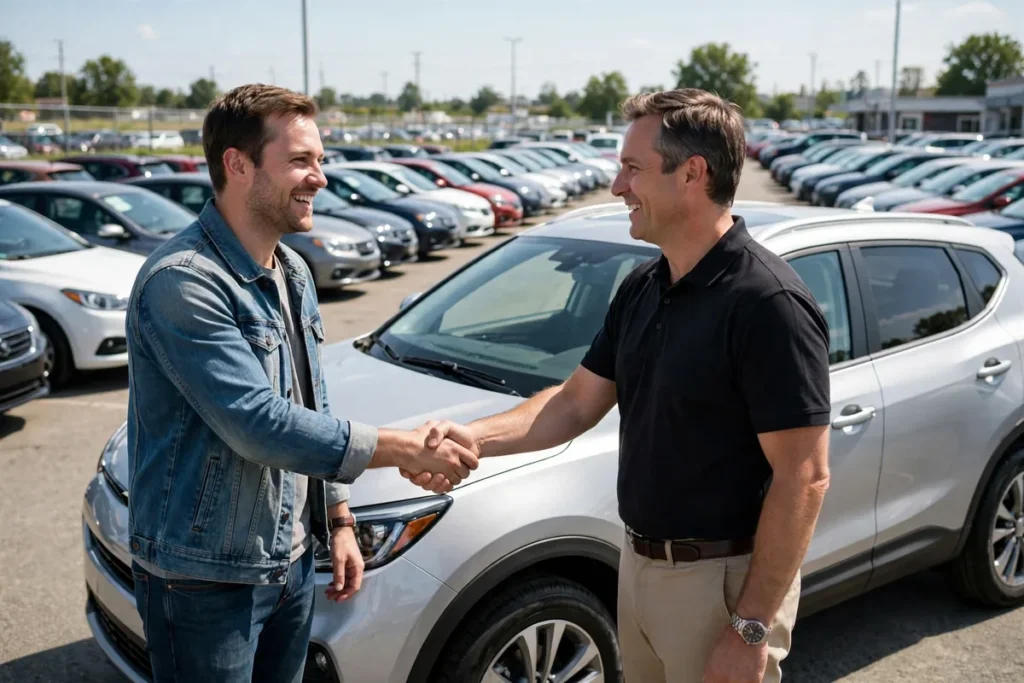
Searching for cars near me is one of the most common ways people start shopping, and it makes sense. Buying locally lets you see the car, drive it, have it inspected, and deal with a seller you can actually visit if something goes wrong. It also gives you leverage, because you are not locked into one distant seller or one take-it-or-leave-it price.
The trap is that local convenience can make you lazy. You find a car five minutes away, you like the color, the salesperson is friendly, and suddenly you are signing papers for a price you never checked. This guide walks you through the whole local buying process in order: setting a real budget, searching well, checking prices, handling fees, inspecting the car, negotiating, and signing paperwork you actually understand. Follow it in order and you will keep more money in your pocket.
Quick answer
Buying a car locally without overpaying comes down to four habits: set a total out-the-door budget before you shop, compare similar local cars before you fall for one, get an independent inspection, and negotiate the total price, not the monthly payment. Get preapproved first, and be ready to walk away from any deal that hides fees.
Start with a total budget, not a monthly payment
Dealers love to talk about monthly payments because a payment can be stretched, trimmed, and reshaped to hide a bad price. Your budget should start with the total amount you are willing to spend on the car itself, and then add the costs that come on top of it.
A useful way to think about it is in four layers:
- The price of the car
- Sales tax, title, and registration fees, which vary by state and locality
- Dealer fees and add-ons, if you buy from a dealer
- The first costs of ownership: insurance, an inspection, and any immediate maintenance
If your total budget is $20,000, that does not mean you should shop for cars listed at $20,000. Once tax and fees are added, a 20,000 dollar car can easily cost $21,500 to $22,500 out the door, depending on where you live. As a planning estimate only, leave 8 to 12% of your budget for tax and fees and adjust once you know your local rates. That cushion keeps a good deal from turning into a budget problem at the signing table.
Monthly payments deserve the same discipline. Before you shop, decide the maximum monthly payment you can afford, the longest loan term you will accept, and the largest down payment you can make without draining your emergency fund. A longer loan lowers the payment but usually raises the total interest you pay and increases the risk that you owe more than the car is worth. A 72-month or 84-month loan on a used car is a warning sign, not a favor. Shorter terms cost more per month and less over the life of the loan, and that trade-off is worth facing honestly before you fall in love with a car.
If you need financing, get preapproved before you visit a dealer. A preapproval from your bank or credit union gives you a real interest rate, a real payment ceiling, and a powerful negotiating tool: you can buy the car without needing the dealer’s financing. You can still let the dealer try to beat your rate, but you are comparing their offer against something real instead of accepting whatever payment they present first. The Consumer Financial Protection Bureau explains how auto loans work, including how to compare offers and spot costly add-ons.
Decide what you actually need before you search
Local listings are full of tempting cars that do not fit your life. A sporty two-door is fun until you try to fit a car seat, a work crew, or a weekly grocery run into it. Before you open a single listing, write down your non-negotiables:
- How many people and how much cargo you carry on a normal week
- Your daily commute distance and road conditions, including snow, hills, or rough roads
- Whether you tow, haul, or drive long distances regularly
- Your parking situation, including garage size, street parking, and tight driveways
- Fuel costs you can live with, and whether a hybrid or electric car fits your charging or driving pattern
- Features you truly need, such as all-wheel drive, a backup camera, or advanced safety features, versus features that are merely nice to have
This short list does two jobs. First, it narrows your search so you stop wasting weekends on cars you would never buy. Second, it protects you from upselling. When a salesperson suggests a bigger engine, a higher trim, or a luxury package, you can check it against your list instead of deciding on the spot.
Reliability matters more than brand loyalty when you are buying used. Look for models with a track record of reasonable maintenance costs and widely available parts. A car that is cheap to buy but expensive to repair is not cheap. Check common problems for the specific year and model you are considering, not just the brand in general, because one bad model year can be very different from the year before or after it.
Where to search for cars near you
The best local search uses more than one source. Each type of seller has strengths and blind spots, so combining them gives you a fuller picture of what your area actually offers.
Dealer lots and dealer websites
Franchise dealers sell the brand they represent and usually take trade-ins of many other brands, so their used inventory can be surprisingly varied. Independent used-car lots focus entirely on used cars and range from excellent local businesses to lots you should avoid. Dealer websites often show more inventory than the lot itself, including cars that are being prepared for sale or arriving soon.
Buying from a dealer usually means a more formal process, a chance to finance on site, and in some cases a limited warranty or a return window. It also usually means dealer fees and add-ons, so the listed price is rarely the final price. Read reviews, check how long the dealer has been in business, and pay attention to how they handle complaints. A clean lot and a friendly greeting tell you very little. A clear written price, a willingness to let you get an independent inspection, and straight answers about fees tell you a lot.
Online marketplaces and listing sites
Large listing sites gather inventory from dealers and private sellers across your area, which makes them the fastest way to compare prices. Use the filters well: set your maximum price to your out-the-door thinking, not your dream number, set a realistic distance radius, and filter by the features that are actually on your non-negotiable list.
Save searches and turn on alerts for the exact models you want. Good local cars at fair prices sell fast, and an alert can put you first in line. When you expand your radius by 25 or 50 miles, you often find better prices or better condition, and a short drive can save you hundreds or even thousands of dollars. Just remember to factor in the cost and time of traveling to see a car that might not match its photos.
Private sellers
Private sellers often price below dealers because they have no lot, no staff, and no reconditioning costs to recover. You may also get a fuller story about the car, including maintenance records and the reason for selling. The trade-off is that private sales are usually sold as-is, with no warranty and little recourse if a problem appears the next week. That makes an independent inspection even more important.
Meet private sellers in safe, public places during daylight, bring someone with you, and never carry large amounts of cash to a first viewing. If a seller pressures you to decide on the spot, refuses an inspection, or cannot produce a title in their name, walk away. There will be another car.
Auctions, credit unions, and local notices
Credit unions sometimes sell repossessed vehicles to members and non-members at prices below dealer retail, and the cars usually come with a known lien history and a straightforward title process. Local auctions, including public auto auctions and government surplus sales, can offer bargains, but most sell as-is with little time for inspection, so they suit experienced buyers better than first-time buyers. Community notice boards, workplace bulletins, and local classifieds still turn up honest private sales, especially from owners who would rather sell to a neighbor than list online. Whatever the source, the same rules apply: check the price against similar cars, inspect before you pay, and verify the title.
How to check whether a local price is fair
Never judge a price by the listing alone. A car can look like a bargain because it has high mileage, accident history, a salvage or rebuilt title, or worn tires and brakes that will cost you money immediately. Price checking means comparing similar cars and adjusting for condition.
Start with pricing guides that show a range for your area, not a single number. Enter the exact year, trim, mileage, and major options, because a base model and a fully loaded model of the same car can differ by thousands of dollars. Then search your local listings for the same model within a similar mileage range. If most similar cars cluster around one price and your target is far below it, ask why. If it is far above it, the seller needs to justify the premium with condition, maintenance history, or recent major work.
Pay attention to these price signals:
- Mileage relative to age: a car with far more miles than average for its year should cost less, while a genuinely low-mileage car can justify a premium
- Title status: a clean title is worth more than a salvage, rebuilt, or branded title, and branded titles can affect insurance and resale
- Accident and damage history: repaired damage is not always a deal breaker, but it should be reflected in the price and disclosed honestly
- Tires, brakes, and fluids: a car that needs all four tires and a brake job soon is not the same deal as one with new tires and fresh brakes
- Service history: regular maintenance records, especially for timing belts, transmissions, and major services, add real value
- Time on the market: a car that has sat unsold for months may be overpriced or hiding a problem, and the seller may be ready to negotiate
Ask the seller directly how long the car has been for sale and whether the price has dropped. A price drop is useful information, not an insult to mention. It tells you the market has already pushed back once.
Worked example: the out-the-door math on a 20,000 dollar car
Example: you find a car listed at $20,000 and your total budget is $20,000. At 8 to 12% for tax and fees, the out-the-door cost lands at roughly $21,600 to $22,400, or $21,500 to $22,500 once local variations are included. That is $1,500 to $2,500 over your budget before insurance, inspection, or immediate maintenance. Working backward instead: with a 20,000 dollar total budget and a 10% cushion of $2,000 for tax and fees, you should shop for cars listed around $18,000. That single calculation is the difference between a good deal and a budget problem at the signing table.
Understand fees before you negotiate
Fees are where many buyers lose money, because they negotiate hard on the car price and then nod through the rest of the paperwork. Ask for an itemized out-the-door price in writing before you agree to anything. That single request removes most surprises.
Common charges to expect and question include:
- Sales tax, set by your state and sometimes your county or city
- Title and registration fees, usually set by the state
- A documentation fee, often called a doc fee, charged by dealers for paperwork
- Dealer add-ons such as paint protection, fabric protection, nitrogen-filled tires, theft deterrent systems, or tracking devices
- Delivery or destination charges on new cars, which are normal but should already be reflected in the advertised price
- Loan-related charges if you finance through the dealer, including any origination or processing fees
Doc fees vary widely. Some states cap them, others do not, and some dealers charge several hundred dollars while others charge far less. You may not be able to remove a doc fee if the dealer charges every buyer the same amount, but you can negotiate the vehicle price to offset it. The goal is the total out-the-door number, not winning a fight over one line item.
Add-ons deserve special skepticism. Many are high-profit items added during paperwork, not features you asked for. If you did not request it, you do not have to accept it. Ask for each add-on to be removed, and if the dealer says it is already installed and cannot be removed, ask for its cost to be reduced or for an equal reduction in the vehicle price. Products like extended warranties and gap insurance can have value for some buyers, but they should be a separate, deliberate decision with their own price comparison, not a rushed yes at the signing table.
For private sales, the fee picture is simpler but not free. You will still pay tax, title, and registration costs when you transfer ownership, and your state motor vehicle agency can tell you the exact amounts and deadlines. Do not skip this step. Driving on the seller’s plates or delaying the transfer can create legal and liability problems you do not need.
Inspect every car like you are spending your own money
Because you are. A shiny exterior and a clean interior can hide worn suspension parts, leaking seals, a weak battery, or a transmission that shifts roughly when cold. Photos and descriptions are a starting point, never a substitute for seeing and driving the car yourself.
Use a simple inspection routine on every car you seriously consider:
- Walk around the car in daylight and look for mismatched paint, uneven panel gaps, rust, and tires that do not match or are worn unevenly
- Check under the hood for leaks, cracked hoses, low or dirty fluids, and a battery that looks swollen or corroded
- Sit in every seat, test the windows, locks, lights, air conditioning, heater, and infotainment controls
- Look at the trunk, spare tire area, and under the car if you can do so safely
- Start the car cold if possible, listen for unusual noises, and watch for warning lights or smoke
- Drive on local streets and at highway speed, and test braking, steering, acceleration, and turning in both directions
- Drive over bumps and listen for clunks, rattles, or looseness in the suspension
- Park and check again for fresh leaks underneath
Then, for any car you are ready to buy, get an independent pre-purchase inspection from a mechanic you choose, not one the seller recommends. As a rough planning estimate, budget for an inspection in the low hundreds of dollars, and treat that money as cheap insurance on a purchase worth thousands. A good inspection report gives you a repair list you can use in negotiation, or it saves you from buying a car with a failing transmission, frame damage, or hidden flood history.
Also verify the title before you pay. The seller’s name should match the title, there should be no lien listed unless the seller can show it has been released, and the odometer reading should be consistent with the title and the history report. If anything about the title feels unclear, pause the deal until it is clear. Title problems are expensive and stressful to fix after money has changed hands. Before you pay, run the VIN through the National Highway Traffic Safety Administration recall lookup to check for open safety recalls.
Test drive with a purpose
A test drive is not a joyride. It is your best chance to discover problems that no listing can show. Plan a route that includes stop-and-go streets, a highway stretch, a hill if one is nearby, and a parking lot where you can turn sharply and reverse.
During the drive, pay attention to:
- How the car starts, idles, and accelerates from a stop
- Whether the transmission shifts smoothly or hesitates, jerks, or slips
- Whether the steering pulls to one side or feels loose
- Whether braking is smooth and straight, without vibration, grinding, or pulling
- Whether you hear wind noise, rattles, or humming that changes with speed
- Whether the visibility, seat comfort, and driving position work for your body on a longer drive, not just around the block
Turn the radio off for part of the drive so you can hear the car itself. Bring your normal passengers or cargo if that is practical, because a car that feels fine empty can feel cramped or underpowered when loaded. If the seller limits the drive to a short loop or refuses highway driving, treat that as information and ask why.
Negotiate on the out-the-door price
Negotiation works best when it is calm, specific, and based on evidence. You are not trying to win an argument. You are trying to reach a fair total price that reflects the market, the condition, and the fees.
Start by knowing your walk-away number: the highest out-the-door price you will pay for this specific car. Write it down before you negotiate. Then use evidence, not emotion:
- Show comparable local listings for similar cars at lower prices
- Point to inspection findings and the cost of needed repairs, using written estimates when you have them
- Mention time on the market and any price drops
- Offer a specific out-the-door number rather than asking the seller to guess what you will accept
- Keep your tone respectful and your timeline honest, including when you can pay and complete the paperwork
A few phrases that help in real conversations:
- “I like the car. Based on similar cars nearby and the inspection findings, I can offer this out-the-door price.”
- “Can you send me the itemized out-the-door price in writing so I can compare it fairly?”
- “I am preapproved and ready to move forward today at this total price.”
- “I understand if that does not work for you. I will keep looking and check back if it is still available.”
Be ready to walk away, and mean it. The strongest negotiating position is a genuine willingness to leave. There are many cars for sale near you, and the right car at the wrong price is still the wrong deal. If a seller uses high-pressure tactics, adds surprise fees after agreeing on a price, or refuses to put the deal in writing, leaving is not losing. It is protecting your money.
If you have a trade-in, separate the two deals
A trade-in can quietly erase a good negotiation. When the car price, the trade-in value, and the financing are all discussed as one blurry package, it is easy to win on one number and lose on the others.
Get trade-in offers from at least two sources before you negotiate, including a dealer that is not selling you the car and an online instant-offer service if one operates in your area. Clean the car, gather its service records, and fix small, cheap problems that hurt first impressions, such as a dead light bulb or a missing floor mat. Know your trade-in value range before you walk in, and negotiate the purchase price first, then the trade-in value, then the financing. If a dealer insists on combining them, ask for each number separately in writing. You cannot judge a deal you cannot see.
Read the paperwork before you sign anything
This is the step most buyers rush, and it is the step that matters most. Ask for every document, read it, and ask questions about anything you do not understand. Never sign a blank form, a form with blank amounts, or a contract you have not read because someone is waiting.
Before signing, confirm in writing:
- The vehicle identification number matches the car you inspected and drove
- The year, make, model, trim, mileage, and title status are correct
- The vehicle price, trade-in credit, taxes, fees, and total amount financed are itemized and match what you agreed
- The interest rate, loan term, monthly payment, and total of payments are stated clearly
- Any warranty, return policy, or promise made verbally is written into the contract or a separate signed document
- Any add-on you declined is not listed, and any add-on you accepted shows its real price and terms
- The delivery date, and what happens if the car is not ready or the financing changes
For private sales, use a bill of sale that lists the buyer and seller, the vehicle identification number, the mileage, the sale price, the date, and both signatures, along with the signed title transfer required by your state. Keep copies of everything. Good paperwork protects both sides and makes registration far easier.
Local buying scams and red flags
Most local sellers are honest, but car scams follow predictable patterns. Watch for these warning signs and walk away when you see them:
- A price far below market value paired with urgency, a sad story, or a reason you cannot see the car in person
- A seller who cannot meet in person, cannot show the title, or asks for payment by gift card, wire transfer, or cryptocurrency
- A title in someone else’s name, a recently transferred title with no explanation, or a seller who wants to skip the title transfer
- Odometer readings that do not match service records, the title, or the wear on the pedals, seats, and steering wheel
- Fresh undercoating or heavy cleaning that hides rust, leaks, or flood damage
- A car that can only be viewed at night, in bad weather, or in a location where a proper inspection is impossible
- Pressure to sign today, claims that another buyer is about to pay more, or refusal to allow an independent inspection
Trust your instincts. If a deal feels rushed, secretive, or too good to be true, it usually is. A legitimate seller understands caution, because careful buyers are also serious buyers.
Common mistakes to avoid
- Shopping by monthly payment instead of total out-the-door price, which hides a bad price behind a long loan.
- Skipping the independent inspection to save a small fee, then paying thousands for a hidden problem.
- Negotiating the car price but nodding through fees and add-ons at the signing table.
- Combining the purchase price, trade-in value, and financing into one blurry negotiation.
- Signing paperwork you have not read, or signing a form with blank amounts.
- Buying the first car you like without checking comparable local listings.
Pros and cons of buying locally
Pros: you can see, drive, and inspect the car before paying; a local seller is reachable if a problem appears right after the sale; and competing local listings give you real negotiating evidence. Cons: local choice can be narrow, especially for rare models; dealer fees and add-ons raise the final price; and the convenience of a car five minutes away can tempt you to skip the price check and the inspection. The fix is to treat a local car exactly like a distant one: same budget, same comparison, same inspection.
Further reading
For the money side of the purchase, see our guides to buying a used Toyota truck, car loans in the USA, lowering your car insurance, and how long brakes last.
Frequently asked questions
Should I buy from a dealer or a private seller?
Neither is always better. Dealers offer a formal process, possible financing, and sometimes a limited warranty, but charge fees and add-ons. Private sellers often price lower and share more of the car’s history, but sell as-is with little recourse. In both cases, compare prices, inspect independently, and verify the title before you pay.
How much should I budget for an inspection?
As a rough planning estimate, budget in the low hundreds of dollars for an independent pre-purchase inspection from a mechanic you choose. On a purchase worth thousands, that is cheap insurance: it either gives you a repair list to negotiate with or saves you from a car with a failing transmission, frame damage, or hidden flood history.
Is a 72-month loan on a used car a bad idea?
Usually, yes. A longer loan lowers the monthly payment but raises total interest and increases the risk that you owe more than the car is worth. Shorter terms cost more per month and less over the life of the loan. Decide your longest acceptable term before you shop, and get preapproved so you compare the dealer’s offer against something real.
What if the seller refuses an independent inspection?
Walk away. A legitimate seller understands caution, because careful buyers are also serious buyers. Refusing an inspection, limiting the test drive to a short loop, or pressuring you to sign today are all reasons to leave, not reasons to hurry.
Your next step
Start with the budget, not the listing. Write down your total out-the-door number, your non-negotiables, and your walk-away price for the car you want. Then search broadly, compare honestly, inspect independently, and negotiate the total. The right local car at a fair total price is worth the extra day of homework, and the wrong deal at any price is not worth signing.