If you have ever stood on a dock and listened to sailors talk, you know the feeling. Everyone sounds confident, the words fly fast, and you nod along while quietly wondering what a jib is and why nobody will just say left or right. This guide fixes that. It explains the sailing terms every beginner actually needs, in plain English, in the order you are most likely to hear them.
The Parts of the Boat
Hull
The hull is the body of the boat, the part that sits in the water and keeps you afloat. On a sailboat it is usually long and narrow, shaped to cut through waves rather than bounce over them. When someone says a boat has a “clean hull,” they mean the underside is free of barnacles and slime, which matters because a dirty hull slows the boat down and burns more fuel when the engine is running. If you ever buy a boat, a hull inspection is one of the first checks a surveyor will do, and it is money well spent before you commit.
Deck
The deck is the flat top surface you walk on. On smaller boats it can be narrow, wet, and sloped, so move slowly, stay low when the boat heels, and keep one hand free for a handhold. On larger charter boats the deck is wider, with seating areas and sun pads, which is part of what you are paying for when you step up in boat size.
Cockpit
The cockpit is the sunken seating area near the back of the boat where the crew sits and where the helm is located. Think of it as the driving seat and living room combined. On a day sail, this is where you will spend most of your time. On an overnight charter, the cockpit often doubles as an outdoor dining area in the evening, so check how comfortable it looks before you book, especially if you are sailing with family or friends who are new to boats.
Bow and Stern
The bow is the front of the boat. The stern is the back. You will hear these words constantly, so learn them first. “Move to the bow” means go forward. “Stow that in the stern” means put it toward the back. Boats also have a left side and a right side, but sailors almost never say left and right, for a reason explained in the next section.
Mast
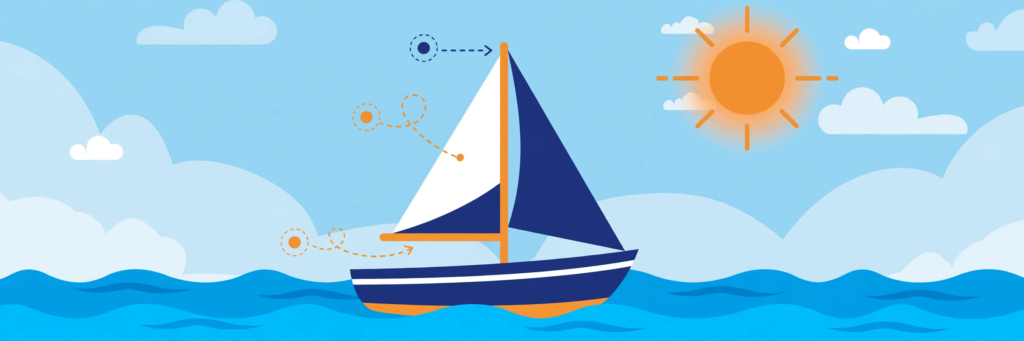
The mast is the tall vertical pole that holds the sails up. On most modern sailboats there is one mast, near the middle of the boat. It is held upright by wires called rigging, and it carries the mainsail on its back edge and often a front sail from its top. Masts look simple, but they are expensive to replace, which is one reason boat insurance and careful rigging checks matter. A typical mast inspection is part of a routine annual service on a well-kept boat.
Boom
The boom is the horizontal pole that sticks out from the bottom of the mast toward the stern. The bottom edge of the mainsail is attached to it. The boom swings from side to side when the boat changes direction, and it swings at head height in the cockpit, which is why every sailing instructor repeats the same warning: watch the boom. When you hear “boom coming across,” duck, stay low, and do not stand up until the move is finished.
Mainsail
The mainsail is the large sail attached to the mast and the boom. It is the main engine of the boat, and it is usually the first sail raised and the last one lowered. Mainsails come in different materials, and a new one for a mid-sized cruising boat can cost several thousand dollars as an estimate, which explains why charter companies and owners are careful about how sails are handled, flaked, and stored.
Jib and Genoa
The jib is the smaller sail at the front of the boat, attached to a wire called the forestay that runs from the bow up to the top of the mast. A genoa is simply a larger version of a jib that overlaps the mainsail. Beginners often start with just the mainsail and jib because that combination is easier to manage and teaches you how the two sails work together. If a sailing school offers a “mainsail only” first lesson, that is normal, not a cut-down experience.
Keel
The keel is the fin or weighted blade underneath the hull. It stops the boat from sliding sideways in the wind and keeps it upright. Without a keel, a sailboat would simply blow sideways across the water. Keels come in different shapes, and a deep keel generally means a steadier boat but also means the boat needs deeper water. That matters when you are choosing anchorages or marinas, because a deep-keel boat cannot sneak into shallow bays that a smaller boat can reach.
Helm, Tiller, and Wheel
The helm is the steering position. On smaller boats you steer with a tiller, a long handle connected directly to the rudder. Push the tiller one way and the boat turns the other way, which feels backwards for about ten minutes and then becomes natural. On larger boats you steer with a wheel, like a car, but the response is slower and gentler. “Take the helm” means take over steering. On your first sail, ask for a turn at the helm in open water. It is the fastest way to feel how wind, sails, and steering fit together.
Port, Starboard, and the Rest of Direction
Port and Starboard
Port is the left side of the boat when you are facing the bow, toward the front. Starboard is the right side. Sailors use these words instead of left and right because left and right change depending on which way you are facing, while port and starboard never change. A simple memory trick is that port and left both have four letters. Another is that port wine is red, and the port navigation light is red too. Once this clicks, half of all sailing instructions become clear.
Forward, Aft, and Abeam
Forward means toward the bow. Aft means toward the stern. Abeam means directly to the side of the boat, at a right angle. So if someone says “traffic abeam to starboard,” they mean there is another boat directly off your right side. If they say “move aft,” they want you to shift toward the back, usually to balance the weight or clear space at the front.
Windward and Leeward
Windward is the side the wind is coming from, also called “upwind.” Leeward, pronounced “loo-ard,” is the side the wind is blowing toward, also called “downwind.” This pair matters for comfort and safety. The windward side is usually higher out of the water when the boat heels, and the leeward side is lower and wetter. If you are prone to seasickness, the windward side and fresh air are your friends, and staying below deck in a stuffy cabin is not.
Wind and Points of Sail
True Wind and Apparent Wind
True wind is the wind you would feel if you were standing still. Apparent wind is the wind you actually feel on a moving boat, which is a mix of the true wind and the wind created by your own forward motion. This is why the wind can feel stronger once the boat picks up speed, and why sailors trim their sails to the apparent wind, not the wind shown on a weather forecast. Beginners do not need to calculate apparent wind. Just remember that the wind on your face on a moving boat is not quite the same as the wind on the dock.
Point of Sail
A point of sail is the angle of the boat relative to the wind. There are five main ones, and they describe everything from sailing almost straight into the wind to sailing directly away from it. Learning them is like learning gears in a car: each one has a different feel, a different sail setting, and a different speed.
Close Hauled
Close hauled means sailing as close to the wind as possible, roughly 45 degrees off the wind direction. The sails are pulled in tight, the boat heels over, and it feels exciting and a little dramatic. You cannot sail directly into the wind, so close hauled is the closest you can get. If you have ever wondered how sailboats travel upwind, this is the answer: they zigzag, which brings us to tacking.
Beam Reach
A beam reach means the wind is coming from directly abeam, from the side. This is often the fastest and most comfortable point of sail. The boat is fairly flat, the sails are eased out partway, and the ride feels steady. If your first lesson includes a beam reach, enjoy it. It is the point of sail that turns most beginners into people who want to go again.
Broad Reach and Running
A broad reach means the wind is coming from behind and to the side. Running means the wind is coming from directly behind. Both feel gentler than sailing close hauled because the wind is pushing you along rather than pulling you sideways. Running needs extra care, though, because an accidental jibe, explained below, is more likely when the wind is dead behind you. Skippers often avoid a dead run in gusty conditions and sail a broad reach instead.
In Irons and Luffing
In irons means the boat has turned too far into the wind and stalled, with the sails flapping and no forward drive. It happens to everyone, including experienced sailors, and the fix is usually to turn away from the wind until the sails fill again. Luffing means a sail is flapping because it is not trimmed correctly for the wind angle, either because the boat is too close to the wind or because the sail is eased out too far. A luffing sail is noisy, slow, and hard on the sailcloth, so trimming it in or adjusting course will quiet it down.
The Moves You Will Actually Do
Tacking
Tacking, also called coming about, is how you change direction by turning the bow through the wind. The boat turns from one side of the wind to the other, the sails switch sides, and the boom swings across. The skipper will usually call “ready about” and then “tacking” or “helm’s a-lee” so the crew knows to duck and be ready. As a beginner, your job during a tack is simple: stay low, watch the boom, and move to the other side when told. After a few tacks, the sequence feels natural.
Jibing
Jibing, also spelled gybing, is how you change direction by turning the stern through the wind, so the wind passes behind the boat and the sails switch sides from the back. Jibes need more care than tacks because the boom can swing across quickly and with force. In light wind a jibe is gentle. In strong wind it can be violent if the mainsail is not controlled. That is why skippers often call a jibe clearly, ease the mainsail in first, and keep everyone seated and low.
Trimming and Easing
Trimming means pulling a sail in tighter. Easing means letting it out. The goal is to keep the sail full and curved, not flapping and not pulled so tight that it stalls. A well-trimmed sail looks smooth, with a gentle curve like an airplane wing. On your first sail, you will probably trim the jib sheet, the rope that controls the jib, and you will quickly learn that small adjustments make a big difference to speed.
Halyards and Sheets
Halyards are the ropes or wires used to raise and lower sails. Sheets are the ropes used to control the angle of a sail once it is up. This naming trips up almost every beginner, because on land a sheet is something on a bed. On a boat, a sheet is always a rope that controls a sail. If someone says “ease the main sheet,” they mean let out the rope holding the mainsail, not drop something overboard.
Winches and Cleats
A winch is a drum that helps you pull a rope with much more force than your hands alone could manage. You wrap the rope around it a few times and crank the handle. A cleat is a fitting you wrap a rope around to hold it in place. Learning to use a winch safely, keeping fingers clear and never wrapping a rope around your hand, is one of the most useful practical skills from a first sailing course.
Reefing
Reefing means reducing the size of a sail when the wind gets strong, usually by folding or rolling part of the mainsail down and tying it off. Think of it as changing to a lower gear. A reefed sail is smaller, the boat heels less, and the ride becomes calmer and safer. Good sailors reef early, before the boat feels out of control. If you are on a charter and the skipper suggests reefing, that is good seamanship, not a sign of trouble.
Safety and Rules of the Road
Right of Way, Give Way, and Stand On
On the water, the rules about who moves first are called the rules of the road, or collision regulations. The boat that should keep its course and speed is the stand-on vessel. The boat that should change course to avoid a collision is the give-way vessel. As a rough beginner rule, a sailboat under sail generally has right of way over a powerboat, but there are many exceptions, including large ships, fishing boats, and boats that cannot easily manoeuvre. Never assume another boat has seen you, and never insist on right of way if doing so would cause a collision. Safety beats being right.
Heeling
Heeling is when the boat leans to one side under the pressure of the wind. A little heel is normal and part of the fun. A lot of heel can feel alarming the first time, but modern sailboats are designed to heel and recover, thanks to the weight of the keel underneath. If heeling makes you nervous, sit on the windward side, hold on, and watch the skipper. They will ease the sails or reef if the heel becomes too much.
Knot
A knot is a unit of speed equal to one nautical mile per hour. One nautical mile is a little longer than a land mile, so 10 knots is roughly 11.5 miles per hour on land. Most cruising sailboats travel at 5 to 8 knots in a decent breeze, which feels faster on the water than the number suggests, especially when you are close to the waves. When a charter listing says a boat cruises at 7 knots, it is giving you a realistic sense of how far you can travel in a day, not a racing claim.
PFD and Man Overboard
A PFD is a personal flotation device, what most people call a life jacket. Wear one, especially if you are new, if the weather is rough, or if you are sailing at night. Modern inflatable PFDs are light and comfortable, and many sailing schools provide them. “Man overboard” is the call if someone falls in. The crew should point at the person continuously, throw a flotation aid, and start the recovery drill the skipper has briefed. It is a drill worth practising in calm conditions, because it is far easier to learn before you ever need it for real.
What Sailing Costs in 2026: A Beginner Money Guide
Sailing has a reputation for being only for the wealthy, and it can be expensive at the top end, but the entry point is far more affordable than most people expect. The prices below are estimates based on typical 2026 listings and school pricing, not verified quotes, and they vary a lot by location, season, and boat size. Treat them as planning figures, not promises.
A short introductory sailing experience, often two to three hours with an instructor on board, typically costs in the range of 75 to 200 dollars per person as an estimate. A full beginner course, such as a two-day basic keelboat course, often runs from about 400 to 800 dollars as an estimate, and many schools include the boat, fuel, and safety gear in that price. If you want a recognised qualification, an American Sailing Association basic course or an equivalent national course is the usual route, and the certificate can later reduce charter costs because charter companies trust certified sailors more than self-taught ones.
Chartering is where the numbers spread out. A bareboat charter, where you rent the boat without a crew and sail it yourself, usually requires experience or a qualification, and a week on a mid-sized monohull in a popular area often costs from roughly 2,000 to 5,000 dollars as an estimate, before food, fuel, and marina fees. A crewed charter, where a skipper and sometimes a cook come with the boat, costs more, often from about 5,000 dollars per week upward as an estimate, but it is the best option for a first longer trip because you learn while someone else handles navigation and docking.
Day charters with a skipper sit in between. A half-day or full-day private sail for a small group often costs from a few hundred dollars to over a thousand dollars as an estimate, depending on the boat and location. Splitting that between four to six friends makes it comparable to a day out at a theme park, with a much better story at the end.
Gear for a beginner is modest. You do not need to buy everything before your first lesson. Start with non-slip deck shoes, sun protection, and a comfortable PFD if your school does not provide one. Budget sailing gloves cost roughly 20 to 40 dollars as an estimate, a basic waterproof jacket roughly 50 to 150 dollars as an estimate, and deck shoes roughly 40 to 100 dollars as an estimate. Wait until you have sailed a few times before buying sailing-specific clothing, because you will quickly learn what you actually need for your local weather.
Buying a boat is a different decision entirely, and it is worth separating the purchase price from the running costs. Small used day sailers can be found for a few thousand dollars, while a cruising-ready used boat can run from tens of thousands into six figures. Annual running costs, including marina fees, insurance, maintenance, and storage, are often estimated at around 10 percent of the boat’s value per year as a rough rule of thumb, though older boats and expensive marinas can push that higher. That is why many beginners start with lessons and charters, learn what size and style of boat they like, and only buy once they know how often they will really sail.
Frequently Asked Questions
Do I need to know all these terms before my first lesson?
No. A good instructor will explain each term as it comes up, and you will learn fastest by doing. Reading this guide beforehand simply means fewer surprises and more confidence on the day.
What is the hardest sailing term for beginners?
For most people it is port and starboard, simply because it replaces left and right. The four-letter trick, port and left, solves it for most learners within a day. Apparent wind is the next hardest concept, but you do not need to master it to enjoy your first sail.
Is sailing hard to learn?
The basics are not hard. Most people can steer, trim a sail, and tack a boat after a weekend course. Sailing well in strong wind, at night, or over long distances takes longer, which is why qualifications are built in stages. Think of it like driving: the first lesson teaches you to move, and experience teaches you judgment.
Final Word
Sailing has its own language because it needs one. Left and right are not reliable on a boat that turns, and “pull that rope” is not precise enough when there are a dozen ropes doing different jobs. Once you know the words in this guide, you will understand instructions faster, feel safer on board, and enjoy the sail more, because you will spend less time confused and more time watching the water.