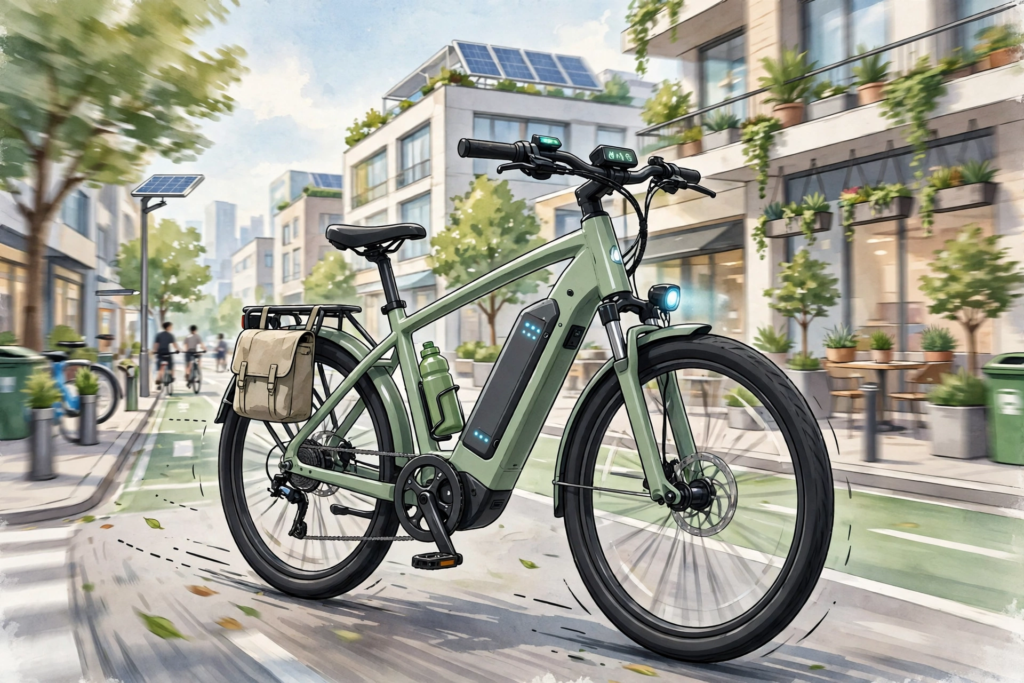
An electric bike can be the cheapest way to turn a short car trip into something far less expensive. It can also be an expensive mistake if you buy the wrong type, pay for range you will never use, or discover too late that your local rules, hills, or storage situation do not suit the bike you chose.
This guide keeps the focus on the money questions that matter most: what kind of electric bike fits your riding, what you should expect to pay, what it costs to run, and when it genuinely saves money compared with a car. Prices and ranges below are typical, illustrative ranges drawn from current market listings and buying guides, not guarantees. Actual prices vary by seller, season, specification, and location, so always check the current price of the exact model before you buy.
What an electric bike actually is
An electric bike, often shortened to e-bike, is a bicycle with a small electric motor and a rechargeable battery that helps you ride. It is not a motorcycle in disguise, and in most everyday models it is not meant to replace pedalling altogether. The motor assists you; it does not usually do all the work unless the bike has a throttle.
The three parts that matter most are the motor, the battery, and the controller that links them. The motor provides the push. The battery, measured in watt-hours (Wh), stores the energy. The controller and display let you choose how much help you want, from a gentle nudge on flat ground to strong assistance on a hill.
Battery size is a useful shorthand for range, but it is not the whole story. A larger battery generally goes further, yet rider weight, hills, wind, tyre pressure, temperature, and the assistance level you choose all change the result. A bike advertised at 70 miles on its lowest setting, on flat ground, with a light rider, may deliver far less on a hilly commute at full assistance. A sensible rule used by many buyers is to treat the advertised maximum as a best case and plan around roughly 60 to 70 percent of it for everyday riding.
Pedal assist, throttle, and motor types
Pedal assist
With pedal assist, the motor only helps while you pedal. You choose a level, often labelled eco, tour, and turbo, or numbered from one to five. Low levels stretch the battery and still take the edge off hills and headwinds. High levels make riding feel much easier, but drain the battery faster.
There are two common ways a bike senses your pedalling. A cadence sensor detects that the pedals are turning and delivers a set amount of power for the level you chose. It is simple and common on lower-priced bikes. A torque sensor measures how hard you are pressing the pedals and matches your effort more smoothly. It usually feels more natural, especially when starting from a stop or climbing, and it often appears on mid-range and premium models.
Throttle
A throttle lets you ride without pedalling, using a twist grip or a thumb lever, much like a small scooter. It is handy for pulling away at traffic lights, giving tired legs a break, or riding a short distance without effort. The trade-off is range: throttle-only riding uses more energy, so the battery runs down faster than it does with pedal assist.
Hub motors and mid-drive motors
Most affordable electric bikes use a hub motor built into the front or rear wheel. Hub motors are simple, quiet, and usually cheaper to build and replace. They work well on flat and gently rolling routes.
Mid-drive motors sit at the pedals and drive through the gears. They tend to climb better, feel more balanced, and make efficient use of the gears on steep terrain. They also usually cost more, and because they put more force through the chain and gears, those parts may wear faster. For a flat commute, a hub motor is often enough. For regular steep hills or loaded cargo riding, a mid-drive motor is worth considering.
Electric bike classes: what the numbers mean
In the United States, most electric bikes fall into three classes. Local rules still vary, so check the rules where you plan to ride, especially for shared paths and trails.
| Class | How it works | Maximum assisted speed | Throttle |
|---|---|---|---|
| Class 1 | Pedal assist only | 20 mph | No |
| Class 2 | Pedal assist plus throttle | 20 mph | Yes |
| Class 3 | Pedal assist only | 28 mph | No |
Class 1 bikes are the most widely accepted on bike paths and trails. Class 2 bikes add the convenience of a throttle at the same 20 mph limit. Class 3 bikes are built for faster road commuting, but they are often restricted on some paths, and they usually come with stronger brakes and lights to match the higher speed.
Outside the United States, the rules differ. In the United Kingdom and the European Union, for example, standard electric bikes are generally limited to pedal assistance up to about 15.5 mph, with a 250-watt motor limit. If you buy a bike abroad or import one, do not assume it meets your local rules.
Types of electric bikes
Commuter and city electric bikes
Commuter bikes are the practical centre of the market. They usually have an upright riding position, mudguards, a rear rack, integrated lights, and tyres suited to paved roads. Many are step-through designs, which make getting on and off easier in work clothes or with a bag.
A commuter bike is the right choice if most of your riding is on roads and paved paths, you want to arrive without being exhausted, and you need to carry a laptop bag, groceries, or a change of clothes. Look for hydraulic disc brakes, a comfortable saddle, and a rack rated for the load you actually carry.
Folding electric bikes
Folding bikes collapse for storage in a small flat, an office corner, or a car boot, and they pair well with trains and buses. The compromise is usually smaller wheels, a slightly less stable ride at speed, and a bike that is still heavy to carry up stairs, even when folded.
A folding bike is worth it if storage space or mixed transport is your main problem. It is less appealing if you have a garage and a direct road route, where a full-size commuter bike will ride better for similar money.
Cargo electric bikes
Cargo bikes are built to carry children, shopping, parcels, or work equipment. Long-tail designs stretch the rear rack, while front-loader designs put a large box ahead of the rider. Strong frames, powerful motors, and heavy-duty brakes are essential, because a loaded cargo bike can weigh far more than a standard bike.
A cargo bike can replace a second car for school runs and local errands in some households, which is where its higher price starts to make financial sense. It is a poor choice if you need to carry it upstairs or fit it into a small lift.
Mountain and fat-tyre electric bikes
Electric mountain bikes add suspension, wide tyres, and strong motors for trails and rough ground. Fat-tyre bikes use very wide tyres for grip on sand, snow, gravel, and unmaintained roads. Both are fun and capable, but they are heavier, less efficient on paved roads, and often more expensive to maintain than a commuter bike.
Buy one of these if rough terrain is a regular part of your riding, not just an occasional weekend idea. For a paved commute, the extra weight and rolling resistance are costs you pay on every trip.
Step-through, cruiser, and road electric bikes
Step-through frames suit riders who want easy mounting, including anyone with limited flexibility. Cruisers prioritise comfort and a relaxed pace for short local trips. Electric road bikes are lighter and faster, built for longer paved rides, and usually cost more for the weight savings and components. None of these is better in general; each is better for a specific kind of riding.
| Type | Best for | Typical price range | Watch out for |
|---|---|---|---|
| Commuter and city | Daily road riding and errands | About 1,000 to 3,000 dollars | Cheap brakes and no rack or lights included |
| Folding | Small spaces and mixed transport | About 800 to 2,500 dollars | Folded weight and small-wheel ride feel |
| Cargo | Children, shopping, and heavy loads | About 2,000 to 5,000 dollars and more | Size, weight, and storage space |
| Mountain and fat-tyre | Trails and rough ground | About 2,000 to 5,500 dollars and more | Weight, tyre wear, and maintenance |
| Premium commuter and road | Long commutes and frequent riding | About 3,500 to 6,500 dollars and more | Paying for features you may not use |
These ranges are broad because specification matters so much. A basic city bike near 1,000 dollars and a premium commuter above 5,000 dollars are both real products, but they are not the same purchase. Compare brakes, battery size, motor type, warranty, and included accessories, not just the headline price.
What to pay: a practical budget guide
Under about 1,000 dollars
At this level, expect a basic hub motor, a smaller battery, mechanical disc brakes or basic hydraulic brakes, and fewer included accessories. These bikes can be good value for short, flat trips, but check the weight limit, the warranty, and whether a replacement battery is available. A very cheap bike with no parts support can become expensive if one key part fails.
About 1,000 to 2,500 dollars
This is the sweet spot for most commuters. Bikes in this range commonly offer hydraulic disc brakes, a 400 to 700 Wh battery, a rack, lights, and mudguards, and a motor strong enough for hills and loaded riding. If you plan to ride daily, this is usually the range where reliability and comfort improve enough to justify the extra cost.
About 2,500 to 5,000 dollars
Here you are paying for better motors, often mid-drive, larger batteries, higher-quality gears and brakes, lighter frames, and dealer support. Cargo bikes and capable mountain bikes sit in this range. The extra money makes most sense if you ride long distances, carry heavy loads, or want a bike that will last many years of hard use.
Above 5,000 dollars
Premium bikes offer refined motors, integrated batteries, belt drives that need less maintenance, high-end suspension, and lightweight materials. They can be excellent, but the extra cost is hard to justify on money grounds alone unless the bike replaces a large number of car trips or you ride very long distances regularly.
The hidden costs of buying
Budget for more than the bike itself. A good helmet, a strong lock, lights if they are not included, a pump, and a basic repair kit are essentials, not extras. Many buyers allow roughly 10 to 15 percent of the bike budget for these items in the first year. If you will leave the bike outside, a better lock matters more than a slightly better motor. Also ask about assembly: some bikes arrive nearly ready to ride, while others need professional assembly, which may add to the cost.
Battery life, charging, and replacement
Most electric bike batteries take roughly 3 to 6 hours for a full charge, depending on battery size and charger. For most commuters, overnight charging or charging at work covers daily use easily. A removable battery is a real advantage if you cannot park near a power outlet, since you can take the battery indoors to charge.
Battery lifespan is usually described in charge cycles, with many quality batteries rated for roughly 500 to 1,000 full cycles, or about 3 to 5 years of regular use, before capacity drops noticeably. Heat, leaving a battery fully flat for long periods, and constant fast charging can shorten its life. Storing a battery partly charged, in a cool dry place, and avoiding extreme heat helps it last longer.
Replacement is the biggest single running cost to plan for. Typical replacement batteries cost roughly 300 to 800 dollars, depending on capacity and brand, with some larger or premium batteries costing more. Spread over several years, that is still small compared with car fuel and servicing, but it is not a cost to ignore. Before you buy, check that a replacement battery is actually sold for your model and what it costs. A bargain bike with an unavailable battery is a short-lived bargain.
Running costs: electric bike versus car
This is where an electric bike earns its keep. Charging a typical 400 to 700 Wh battery costs only pennies per full charge at typical household electricity rates, and one charge may cover 25 to 40 miles of mixed riding, depending on assistance level and conditions. Tyres, brake pads, chains, and occasional servicing are the main ongoing costs, and they are far cheaper than car servicing, although electric bikes can wear chains and brake pads faster than ordinary bikes because they are heavier and faster.
A car, by contrast, combines fuel, insurance, servicing, tyres, registration, depreciation, and often parking and finance charges. Published comparisons based on average United States driving costs put a typical new sedan at well over 10,000 dollars per year to own and run, while a commuter electric bike, including charging, maintenance, gear, and an eventual battery replacement, typically totals a small fraction of that over the same period. The exact gap depends heavily on how many car trips the bike replaces, local fuel and insurance prices, and how long you keep each vehicle, so treat any headline saving as illustrative rather than a promise.
| Cost | Electric bike, typical | Car, typical |
|---|---|---|
| Purchase | About 1,000 to 3,000 dollars for a good commuter | Tens of thousands of dollars for a new car |
| Energy per trip | Pennies per charge | Fuel on every trip |
| Insurance | Often optional or low cost, rules vary | Usually required and far more expensive |
| Maintenance per year | Roughly 100 to 300 dollars for consumables and servicing | Often 1,000 dollars or more, plus tyres and repairs |
| Battery replacement | Roughly 300 to 800 dollars every 3 to 5 years | No equivalent, but major repairs can cost far more |
| Parking | Usually free or very low cost | Often charged, especially in cities |
The honest limit is that an electric bike does not replace every car trip. It is a poor substitute for long motorway journeys, carrying several passengers, towing, or travelling in severe weather without suitable clothing and infrastructure. The saving is real when the bike replaces short, frequent trips: commuting, school runs, shopping, and local errands. If it only replaces one short trip a week, the payback period stretches out, and a cheaper bike or a regular bicycle may make more sense.
A simple payback check
Try this before you buy. Add up what you spend on the car trips the bike could replace: fuel, parking, and any per-trip charges. Then divide the total cost of the bike, gear, and first-year maintenance by that monthly figure. That gives a rough sense of how many months of replaced trips it would take to cover the purchase. If the answer is under a year for a daily commuter, the case is strong. If it is several years, be honest about whether you will actually ride that often, in all seasons, before spending more.
Also count time. In congested cities, a bike can be faster than a car once parking and traffic are included, while on long rural routes a car usually wins. Test your actual route, not just the distance on a map.
How to choose the right electric bike
Start with your route, not the specification sheet. How far is it, how hilly is it, what surfaces will you ride on, and where will you store and charge the bike? A 10-mile flat commute needs a very different bike from a 25-mile hilly ride or a school run with two children.
Next, check the fit. Frame size, step-through versus high frame, saddle comfort, and handlebar position matter more over months of riding than a small difference in motor power. If you can, test ride before buying, especially for folding and cargo bikes, where size and handling vary widely.
Then look at the parts that affect safety and long-term cost: hydraulic disc brakes, a battery from a known maker with a replaceable pack, a warranty that covers the motor and battery for a reasonable period, and a local dealer or service option if you do not repair bikes yourself. A bike bought online can be excellent value, but check who will service it and how warranty claims work.
Finally, check the rules. Confirm the class allowed on your planned routes, whether a throttle is permitted where you ride, and whether your workplace or home has secure storage and charging. A bike you cannot store safely is a bike you will stop using.
Common mistakes to avoid
Buying on advertised range alone is the most common mistake. Real range depends on assistance level, terrain, weight, wind, and temperature. Buying the most powerful motor is another: power helps on hills, but it also drains the battery and may push a bike into a class with more restrictions. Buying the cheapest bike without checking battery availability, brake quality, and warranty is a third. And buying a cargo or fat-tyre bike for a simple paved commute adds weight, cost, and maintenance for capability you may never use.
A quieter mistake is ignoring security and weather. A good lock, mudguards, lights, and clothing for rain and cold decide whether a bike gets used in November as often as in May. The cheapest bike in the shop is not cheap if it sits unused for half the year.
Frequently asked questions
How far can an electric bike go on one charge?
It depends on battery size, assistance level, terrain, rider weight, and wind, but many commuter bikes cover roughly 25 to 50 miles of mixed real-world riding per charge. Treat advertised maximums as best cases measured in favourable conditions, and choose a battery that covers your round trip with charge to spare.
Do I need to pedal an electric bike?
On pedal-assist bikes, which include Class 1 and Class 3 models, yes: the motor only helps while you pedal. On Class 2 bikes with a throttle, you can ride without pedalling up to 20 mph, although doing so uses the battery faster. Every electric bike can also be pedalled with the motor off, although it will feel heavier than a regular bicycle.
How long does an electric bike battery last?
A quality battery typically lasts roughly 500 to 1,000 full charge cycles, or about 3 to 5 years of regular use, before its capacity drops noticeably. Replacement typically costs roughly 300 to 800 dollars, depending on capacity and brand. Storing the battery partly charged and away from extreme heat helps it last longer.
Is an electric bike cheaper than a car?
For short, frequent trips, usually yes, by a wide margin. Charging costs pennies per charge, maintenance is far cheaper, and there is generally no fuel, mandatory insurance, or parking bill on the same scale as a car. The saving depends on how many car trips the bike actually replaces, so it is strongest for daily commuters and weakest for occasional riders.
What should I check before buying an electric bike?
Check your route and storage first, then the bike class allowed where you ride, the real-world range for your commute, brake quality, battery replacement cost and availability, warranty length for the motor and battery, and the total cost including helmet, lock, lights, and assembly. A test ride, where possible, is worth more than any specification sheet.
The bottom line
An electric bike is not a magic money-saving device, but for the right rider it is one of the most practical ways to cut transport costs. Choose the type that fits your route and storage, spend enough to get reliable brakes and a replaceable battery, and be realistic about range and weather. If the bike replaces car trips most days, the running costs are tiny compared with a car, and the purchase can pay for itself far sooner than most people expect. If it will only be used occasionally, buy simpler and cheaper, or stick with a regular bicycle until your riding habit proves itself.
Related: electric transport keeps moving fast, from e-bikes to the Tesla flying Roadster.