Tesla Flying Roadster Cost: Price, Thrusters, Maintenance, and Refills Explained
On October 15, 2026, Tesla showed a redesigned Roadster at the SpaceX test site in McGregor, Texas, that drove up a curved ramp while upside down, flipped in midair, jumped over a row of Teslas, and landed on its wheels. Elon Musk called it the world’s first flying car. The demo was real, and it was livestreamed. But the car you can actually buy, the price you will pay, and the rules for driving it are still mostly unconfirmed.
This guide covers every cost angle: the price, the reservation amounts, the three trims, how the SpaceX thrusters work, how refills work, what maintenance will cost, insurance, and what is confirmed versus what is still just a claim.
Tesla Flying Roadster at a Glance
| Fact | What we know |
|---|---|
| Unveiled | October 15, 2026, SpaceX McGregor, Texas |
| Production target | 2028, according to Musk |
| Final price | Not announced |
| Performance reservation | 50,000 dollars (5,000 dollars, then 45,000 dollars within 10 days) |
| Thrust reservation | 250,000 dollars total (an extra 245,000 dollars within 10 days) |
| Rocket trim | Invite only, single seat, not approved for public roads |
| Claimed range | More than 300 miles, all trims |
| Claimed top speed | More than 230 mph (Rocket trim) |
| Seats | 2 (Performance and Thrust), 1 (Rocket) |
Every performance figure in this article is a Tesla claim. No independent testing exists yet.
Is the Tesla Roadster Really a Flying Car?
No, not in the way most people picture a flying car. It has no wings and no rotors, and it cannot sustain flight. What it does is hop, flip, and hover briefly using cold-gas thrusters and a suction fan system.
The physics sets a hard limit. The car carries about 600 litres of compressed air, roughly 250 kilograms, feeding 10 nozzles. Hovering a car that weighs around 2 tonnes takes roughly 20 to 30 kilograms of air per second, which means a full tank buys seconds of hover, not minutes. Published estimates range from about 7 seconds to about 20 seconds at full hover. That matches what Tesla showed: a launch, a flip, and a controlled landing.
The legal picture is just as limited. Business Insider reported that the FAA told it the vehicle does not meet its definition of an aircraft. Tesla itself says the Rocket trim, the only one with the full flight system, is not approved for public roads. So the car that flies is not the car you can drive to work, and the car you can drive does not fly.
The Three Trims and What Each Costs to Reserve
Tesla named three trims. Treat the Thrust and Rocket trims as add-ons to the Performance car, not as separate models.
| Trim | Seats | What it adds | Claimed 0 to 60 mph | Reservation |
|---|---|---|---|---|
| Performance | 2 | Active aero and a fan suction system for grip | Under 1.6 seconds | 50,000 dollars |
| Thrust | 2 | Rear cold-gas thrusters for acceleration | Under 0.9 seconds | 250,000 dollars |
| Rocket | 1 | Thrusters around the whole body for lift and rotation | Under 0.59 seconds | Invite only |
Two warnings about reservations. First, a reservation is not a purchase price. Business Insider found Tesla terms stating the final price is undetermined and delivery is not guaranteed. Second, the Performance trim, the road car, has no thrusters at all. If you want the flying tricks, you are paying for Thrust or Rocket, and Rocket is invite only.
How Much Will the Tesla Flying Roadster Cost to Buy?
Tesla has not announced a final price. That is the single most important cost fact about this car.
History explains why buyers should be cautious. When Tesla first showed the second-generation Roadster in November 2017, it promised a 200,000 dollar base price, a 250,000 dollar Founders Series, a 50,000 dollar deposit, 620 miles of range, 0 to 60 mph in 1.9 seconds, and deliveries in 2020. None of that happened on schedule. The 2026 car now claims more than 300 miles of range instead of 620, seats two instead of four, and targets production in 2028.
What can you reasonably expect? The reservation structure points to six figures well above 200,000 dollars for a Thrust car, and Rocket pricing is unpublished and invite only. That is an estimate based on the reservation amounts, not a Tesla price. Until Tesla publishes a real price, any article quoting an exact purchase price for the 2026 Roadster is guessing.
How the SpaceX Thrusters Work
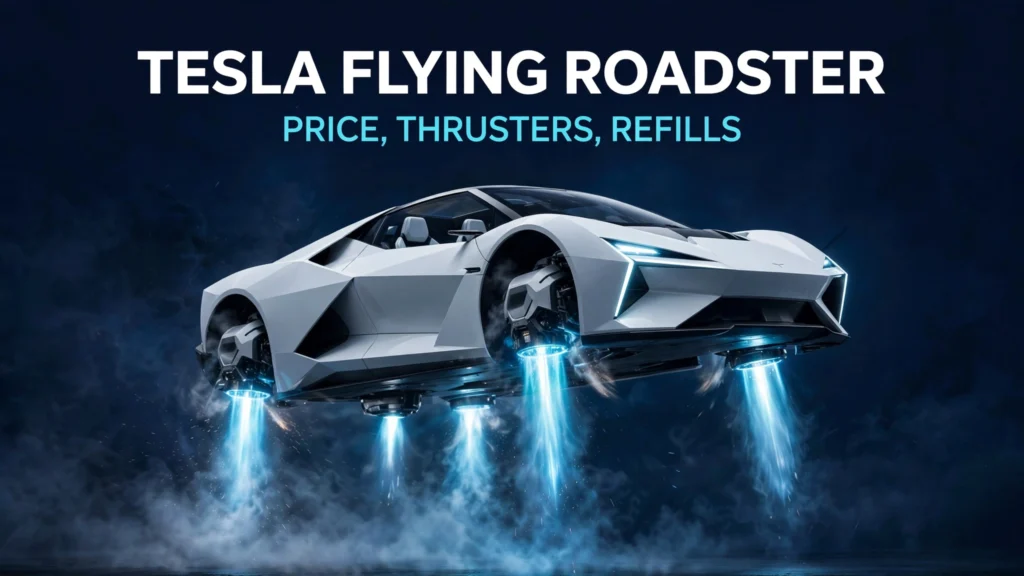
The thrusters are cold-gas thrusters, supplied with SpaceX technology. They burn nothing and produce no flame. They simply vent very high pressure air through nozzles, and the push comes from the air leaving. That is why the system is street plausible in a way a rocket is not: the exhaust is air.
The hardware, as described by Tesla engineering vice president Lars Moravy and reported by TechCrunch and The Verge, looks like this:
- 10 nozzles. Rear nozzles push the car forward and up. Smaller nozzles around the body rotate it, which is what made the midair roll possible.
- Two carbon-fibre overwrapped pressure vessels (COPVs). These are the same type of tank SpaceX uses on rockets. Together they hold about 600 litres of compressed air, roughly 250 kilograms.
- All-electric actuators. These trim thrust in fractions of a second to keep the car stable in flight. The demo car was driven autonomously, and nobody was inside the demo cars.
- A separate suction system. A multi-mode fan and ground sealing system pulls air from beneath the car, creating downforce Tesla quotes at up to 2g. That suction is what held the car upside down on the ramp, even while stationary.
The COPV tanks replace the rear seats, which is one reason the 2026 car seats two instead of the four seats promised in 2017.
Refills: What Does the Roadster Run On, and How Do You Refill It?
The Roadster runs on electricity and air. There is no rocket fuel to buy and no special propellant to order. That is the good news.
Tesla says the car recharges its own air supply. Outlets report an onboard compressor, powered by the main battery, that refills the tanks while driving. Tesla has not detailed how long a refill takes, how many stunts one tank allows, or whether heavy stunt use needs a service visit. Those are open questions, and they matter: if a full tank gives seconds of hover, then a day of stunt driving means many refill cycles, and the refill time decides whether that is practical or annoying.
For the battery side, the math is the same as any electric car, but one number is missing. A full charge costs your battery size multiplied by your local electricity rate, and Tesla has not published the battery size for this version. The 2017 car promised a 200 kWh pack, but the 2026 car is a different machine with a shorter claimed range, so do not carry that figure over. Expect home charging costs in line with other large-battery electric cars, and public fast charging to cost more per mile.
Maintenance: What Will It Cost to Keep?
Tesla has published no maintenance schedule for the Roadster. Everything in this section is an estimate drawn from hypercar and electric car ownership, and it is labeled as such. Treat it as planning guidance, not a Tesla price list.
- Tires will be the biggest running cost. Sub-one-second launches and 2g downforce shred tires. Hypercar tires typically run 400 to 800 dollars each, and hard use can mean several sets a year. A Roadster driven the way the demo suggests could eat a set of tires in a few thousand miles.
- Brakes last longer than on a gas hypercar, but not forever. Regenerative braking handles daily slowing, yet track and stunt use still eats pads and rotors. Carbon-ceramic brake replacements on cars in this class run into the thousands of dollars.
- The battery is a long-term cost, not a yearly one. Electric car batteries degrade slowly, and a replacement outside warranty on a premium electric car is a five-figure job. The Roadster figure is unpublished.
- COPV tank inspection is the unique Roadster cost. Pressure vessels need periodic inspection and certification in aerospace practice, and nobody has published the interval or the price for a road car version. This is the maintenance unknown to watch, because it has no equivalent on any other production car.
- Compressor, fans, and actuators are new moving parts. The onboard compressor, the suction fans, and the thruster actuators have no reliability history in a road car. Budget for dealer-only service visits, because this is not a system an independent shop will touch in the early years.
- Steer-by-wire and software. The 2026 car uses a steer-by-wire yoke and a heavy sensor and actuator package. Expect software updates to be routine and hardware faults to be dealer-only.
A rough yearly maintenance estimate for normal road use, excluding tires, sits in the low thousands of dollars. With regular stunt or track use, tires alone can push that several times higher. These are planning estimates, not quotes.
Insurance and Legal Status: Can You Drive It, and Can You Insure It?
The Performance trim is the road car. The Thrust trim is a limited release, and its public-road status for thruster use is untested. The Rocket trim is not approved for public roads at all.
No insurer has published a rate for a thruster-equipped Roadster. Expect the highest insurance bracket: a six-figure hypercar with a stunt system will cost several thousand dollars a year to insure, and coverage may only be available through specialty carriers, especially for Thrust and Rocket cars. Get a real quote before reserving, because an uninsurable car is an undrivable car.
On the flying question, do not expect to fly to work. The FAA position reported by Business Insider, the car’s roughly 2 tonne weight, and the absence of any pilot certification path for this vehicle all point the same way: airborne use belongs on a closed course, if it is allowed anywhere at all. State road rules for using thrusters on public roads are equally untested.
Total Cost of Ownership: The First Five Years
Because the purchase price is unannounced, any total cost figure is built on assumptions. This table shows the shape of the cost, not a promise.
| Cost item | Planning figure | Status |
|---|---|---|
| Performance reservation | 50,000 dollars, applied to purchase | Confirmed reservation amount |
| Purchase price | Unknown, expected well above 200,000 dollars for Thrust | Estimate, not a Tesla price |
| Home charging | Roughly 600 to 1,000 dollars a year at typical rates | Estimate, battery size unpublished |
| Tires | 1,600 to 3,200 dollars per set, several sets a year with hard use | Estimate |
| Insurance | Several thousand dollars a year, specialty carriers likely | Estimate, no published rate |
| Maintenance and inspections | Low thousands a year for road use, higher with stunt use | Estimate, no Tesla schedule |
| Thruster air refills | Air itself is free, compressor runs on battery power | Tesla says onboard refill, time unpublished |
The purchase price dominates everything else. Until that number exists, the total cost of ownership is a sketch, not a budget.
What Is Confirmed Versus What Is Still a Claim
| Confirmed | Still a claim |
|---|---|
| The October 15, 2026 demo happened and was livestreamed | 0 to 60 times (under 1.6, 0.9, and 0.59 seconds) |
| Thruster hardware is real: 10 nozzles, COPV tanks, about 600 litres of air | Top speed above 230 mph |
| Three trims: Performance, Thrust, Rocket | Range above 300 miles |
| Reservation amounts: 50,000 and 250,000 dollars | Final purchase price |
| Production target of 2028 | Hover duration and refill time |
| Rocket trim is not approved for public roads | Maintenance schedule and insurance rates |
| FAA told Business Insider the vehicle does not meet its aircraft definition | Street legality of thruster use on public roads |
Should You Reserve One?
Reserve only if you are comfortable putting money down on a car with no price and a 2028 target from a company that has missed every earlier Roadster production date. The 5,000 dollar first step is the part Tesla calls fully refundable, according to reports from the event, so the early risk is limited to your time and patience.
Everyone else should wait for three things: a published price, independent performance testing, and regulatory clarity on which trims can actually be driven on public roads. The demo proved the engineering is real. It did not prove the car is buyable, insurable, or affordable yet.
Frequently Asked Questions
Can the Tesla Roadster really fly?
It can hop, flip, and hover briefly using compressed-air thrusters, but it cannot sustain flight. Expect jumps measured in meters and hover measured in seconds, not trips through the sky.
How much does the Tesla flying Roadster cost?
No final price has been announced. Reservations cost 50,000 dollars for Performance and 250,000 dollars for Thrust, and the Rocket trim is invite only with unpublished pricing.
When will the Tesla Roadster be available?
Tesla targets production in 2028. Given that the 2017 car promised 2020 delivery and arrived as a 2026 demo, treat 2028 as a target, not a delivery date.
How do the thrusters refill?
Tesla says the car recharges its own air supply with an onboard compressor powered by the main battery. Refill time and stunts per tank are unpublished.
Is the flying Roadster street legal?
The Performance trim is the road car. The Rocket trim is not approved for public roads, and thruster use on public roads is legally untested.
How long can it hover on one tank?
Published physics estimates range from about 7 seconds to about 20 seconds at full hover on roughly 600 litres of air. Tesla has not published an official figure.
Bottom Line
The Tesla flying Roadster is a real engineering demonstration with a 2028 target, a 50,000 dollar entry reservation, and no final price. Its thrusters run on air, refill onboard, and deliver seconds of hover, not flight. The costs that matter most, the purchase price, the maintenance schedule, and the insurance rate, are all still unpublished. The smart move is to enjoy the demo, keep your money until Tesla publishes a price, and let the first owners discover what the COPV inspections and tire bills actually look like.