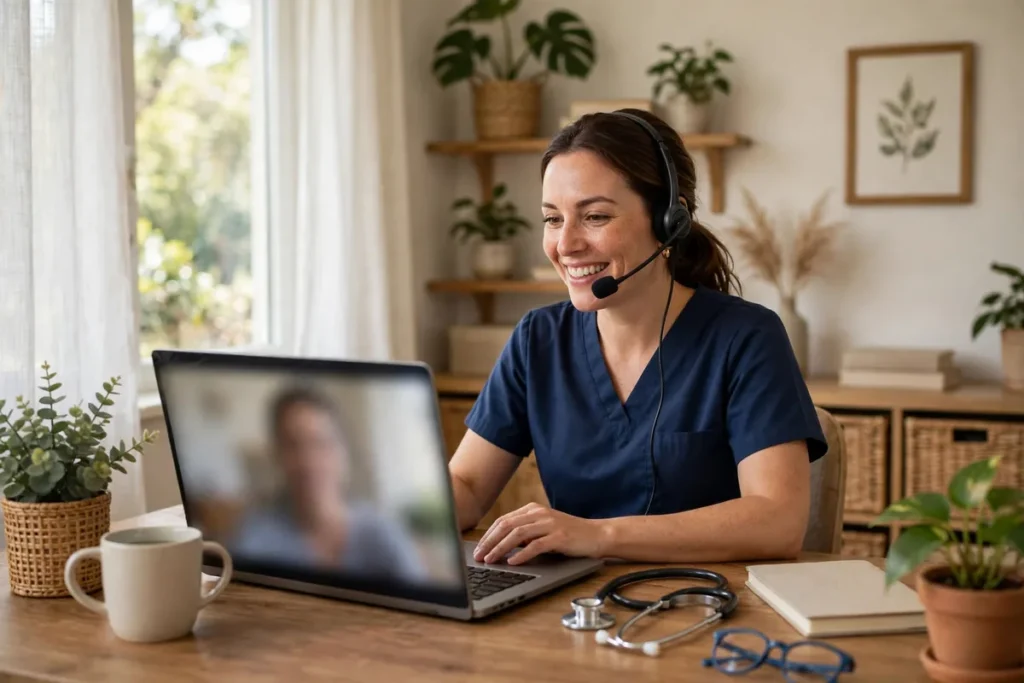
If you love nursing but you are tired of twelve hour shifts on your feet, night rotations, and long commutes, remote nursing jobs can feel like a different career entirely. You still use your clinical judgment. You still help patients. You just do it from a home office, on the phone, on video, or inside a charting system, instead of at a bedside.
That does not mean remote nursing is easy, or that every listing you see online is real. Some remote roles are excellent, stable, and well paid. Others are thinly disguised sales jobs, or outright scams. This guide walks through the real roles, realistic pay ranges, the licenses you actually need, where to apply, and the warning signs to avoid.
Quick answer
Remote nursing jobs are real clinical roles done from home, mostly in telehealth triage, case management, utilization review, and remote monitoring. Most registered nurse roles pay roughly $65,000 to $120,000 a year depending on the lane and experience. You still need the right state licenses, and you should never pay anyone to get hired.
What remote nursing jobs actually are
A remote nursing job is a nursing role where your main work happens away from a hospital ward or clinic. Most of the work falls into four buckets: talking with patients, reviewing records, coordinating care, or teaching and supporting other clinicians.
You might answer calls from patients who are worried about a new symptom, review a hospital stay to decide whether it meets criteria for continued coverage, call a patient after discharge to check that they picked up their medication, or train new nurses on a telehealth platform. In each case, your license and your judgment are the product. You are not just answering a phone. You are assessing, documenting, and making decisions within a defined scope.
Most remote nursing roles are full time, with set schedules. A smaller number are part time, per diem, or contract. Some employers let you work from any state where you hold a license. Others hire only in specific states, because of licensing rules, tax rules, or team coverage needs. Always check the state list in the posting before you apply, even if the headline says remote.
The main types of remote nursing jobs
1. Telehealth and nurse triage
Telehealth nurses assess patients by phone or video. A parent calls about a child with a fever. An adult with diabetes reports dizziness after a medication change. A patient recovering from surgery is unsure whether wound redness is normal. You ask structured questions, use triage protocols, and decide the next step: self care at home with clear return precautions, an urgent care visit, an emergency department visit, or a follow up call in a set number of hours.
This role suits nurses who are calm under pressure, good listeners, and comfortable making decisions without seeing the patient in person. You need strong documentation skills, because your note is often the only record of the call. Many telehealth roles require at least two to three years of clinical experience, often in emergency, primary care, pediatrics, or medical surgical nursing.
Pay is often in the middle of the remote nursing range. As a broad estimate, many telehealth registered nurse roles in the United States in 2026 pay roughly $70,000 to $95,000 per year for full time work, with variation by employer, state, shift, and experience. Night, weekend, and holiday shifts sometimes pay a differential on top of base pay. Treat any posting that promises far above this range for an entry level triage role with caution, and read the fine print on whether the figure is hourly, salaried, or based on a maximum number of calls.
2. Case management
Case managers coordinate care for patients with complex needs. You might work for a hospital system, a health plan, or a care management company. Your caseload could include patients with heart failure, cancer, chronic kidney disease, or multiple conditions at once.
Day to day work includes reviewing treatment plans, calling patients and families, arranging home health visits, checking that referrals went through, helping with medication access, and planning safe discharges. You work closely with physicians, social workers, pharmacists, and therapists. The goal is simple to state and hard to do well: the right care, at the right time, without gaps that send a patient back to hospital.
Case management often pays more than triage, especially for nurses with a case management certification or several years of experience. As a broad estimate, remote case management roles in 2026 commonly pay roughly $80,000 to $110,000 per year, with senior or specialized roles paying more. Certification in case management, often written as CCM, can help you stand out, though many employers will hire experienced nurses and support certification after you start.
3. Utilization review
Utilization review nurses, sometimes called utilization management nurses, review whether a service, admission, or procedure meets medical necessity criteria. A hospital requests three more inpatient days. A surgeon requests prior authorization for a procedure. A home health agency requests additional visits. You review the chart, apply the relevant criteria, and approve, request more information, or send the case for physician review when it does not clearly meet criteria.
This work is detail heavy and rules driven. You need to be comfortable reading charts quickly, spotting missing documentation, and writing clear, defensible notes. It suits nurses who like structure and who can stay neutral when a request is denied. You are not deciding whether a patient deserves care in a moral sense. You are checking whether the documented clinical picture meets the standard that the health plan or program uses.
As a broad estimate, remote utilization review roles in 2026 commonly pay roughly $75,000 to $105,000 per year. Roles at large health plans and managed care organizations often come with strong benefits, including health insurance, paid time off, and retirement contributions, which matter when you compare total compensation rather than salary alone.
4. Remote patient monitoring and chronic care management
In these roles you monitor data from patients at home: blood pressure readings, blood sugar readings, weight changes, oxygen levels, or symptom surveys sent through an app or device. When a reading crosses a threshold, you call the patient, assess symptoms, reinforce the care plan, and escalate when needed.
This is a growing area, because more care is moving into the home. The work is often steadier and less urgent than triage, with more emphasis on coaching, education, and follow up. If you enjoy building relationships with patients over weeks and months, rather than handling one off urgent calls, this lane may fit you well.
Pay varies widely by employer and by whether the role is clinical or more coaching focused. As a broad estimate, many of these roles in 2026 pay roughly $65,000 to $95,000 per year for registered nurses. Be careful with postings that call a role nursing but describe mainly sales, appointment booking, or general customer service. The job description, not the title, tells you what the work really is.
5. Nurse education, training, and quality
Experienced nurses also work remotely as educators, clinical trainers, quality reviewers, and auditors. You might onboard new telehealth nurses, review calls for quality and protocol compliance, write clinical guidelines, or audit charts for documentation accuracy.
These roles usually require more experience, often five years or more, plus a track record in the specialty. They also tend to be less numerous than triage or case management roles, so competition can be higher. Pay is often at the upper end of the remote range. As a broad estimate, senior remote education and quality roles in 2026 commonly pay roughly $90,000 to $120,000 per year, with leadership roles paying more.
How much do remote nursing jobs really pay
Remote nursing pay depends on five things more than anything else: your license and education, your years and type of experience, the employer, the state or states you cover, and the shift you work.
As a general picture for 2026, using broad estimates rather than guaranteed figures:
- Telehealth and triage registered nurse: roughly $70,000 to $95,000 per year
- Case management registered nurse: roughly $80,000 to $110,000 per year
- Utilization review registered nurse: roughly $75,000 to $105,000 per year
- Remote patient monitoring and chronic care registered nurse: roughly $65,000 to $95,000 per year
- Nurse educator, quality reviewer, and senior specialist: roughly $90,000 to $120,000 per year
Licensed practical nurses and licensed vocational nurses can also find remote roles, often in triage support, care coordination, and prior authorization support, but pay is lower than for registered nurse roles. As a broad estimate, remote LPN and LVN roles in 2026 commonly pay roughly $50,000 to $70,000 per year, depending on the role and employer.
Also compare total compensation. A role paying $5,000 less in salary but offering better health insurance, a retirement match, paid licensing fees, home office equipment, and genuine paid time off can be the better deal. Ask about shift differentials, overtime rules, productivity bonuses, and whether training time is paid. Get the answers in writing before you accept. For the national picture, the Bureau of Labor Statistics reports registered nurse median pay and job outlook, which is a useful reality check against any posting that promises far more for far less work.
Worked example: comparing two offers on total value
Example: Offer A pays $95,000 a year and includes health insurance, a retirement match, paid licensing fees, and a home office equipment stipend. Offer B pays $100,000 a year with minimal benefits, no licensing support, and unpaid training time. On salary alone, Offer B looks $5,000 better. Once you price health coverage, the retirement match, and licensing fees you would otherwise pay yourself, Offer A can easily come out ahead, and its paid training and sustainable caseload may matter even more over a year. That is why this guide keeps saying to compare offers on total value, not on the headline number. The figures here are illustrative, not a quote from any employer.
Licenses you need for remote nursing
Licensing is where many new remote nurses get tripped up, because remote does not mean license free. In the United States, nursing practice is generally tied to where the patient is located, not just where you sit. If you live in Texas and you assess a patient in Florida, you usually need to be licensed to practice in Florida, or covered by a compact license that includes Florida.
The Nurse Licensure Compact, often shortened to NLC, helps here. If your primary state of residence is a compact state and you hold a multistate license, that license generally lets you practice in other compact states, including for telehealth, subject to each state’s rules. If you live in a non compact state, or if you want to work with patients in non compact states, you will usually need separate single state licenses for those states. The official Nurse Licensure Compact site lists participating states and explains multistate licensure.
Practical steps:
- Confirm your current license status and whether your home state is a compact state.
- Read each job posting for its required states. Some employers list ten or more states. Others hire only in a handful.
- Ask during the interview whether the employer pays for additional licenses and renewals. Many large employers do, and some will help you apply.
- Keep a simple tracker of every license you hold, its expiration date, and its continuing education requirements. Missing a renewal can pause your ability to work.
Some roles also require or prefer extra credentials. Case management certification, often written as CCM, is common for case managers. Utilization review roles may prefer experience with specific criteria sets used by health plans. Telehealth roles may require basic life support certification and recent acute care experience. A Bachelor of Science in Nursing, often shortened to BSN, is preferred or required by many large employers, even when an associate degree nurse could legally do the work. If you plan a long remote career, a BSN is usually worth pursuing.
For nurses outside the United States, rules differ by country and by employer. Some international telehealth companies hire nurses licensed in their home country to support patients in that country. Others hire for administrative, education, or documentation roles that do not involve direct patient assessment across borders. Do not assume a United States posting will accept a non United States license. Check the posting and ask the recruiter directly.
Where to apply for remote nursing jobs
Start with employers, not just job boards. Large hospital systems often post remote roles on their own careers pages before they appear elsewhere. Health plans and managed care organizations hire large numbers of case managers and utilization review nurses. Telehealth companies hire triage nurses, nurse practitioners, and chronic care nurses on an ongoing basis.
Good places to search include:
- Hospital system careers pages, filtered for remote or work from home nursing roles
- Health plan and insurance company careers pages, searching for case management and utilization review
- Telehealth company careers pages, searching for triage, virtual care, and remote patient monitoring
- General job boards, searching for exact phrases like remote registered nurse, telehealth nurse, remote case manager, and remote utilization review nurse
- Nursing specific job boards and professional association job boards
Set up alerts for your exact target titles, and apply quickly. Popular remote postings can close early once an employer has enough qualified applicants. Tailor your resume for each role type. A triage resume should highlight assessment, protocol use, and high volume call experience. A case management resume should highlight care coordination, discharge planning, and work with complex patients. A utilization review resume should highlight chart review, criteria use, and authorization experience.
When you interview, ask questions that reveal what the job is really like:
- How many patients or cases will I handle per shift, and how is that measured?
- What does training look like, and is it paid?
- What are the scheduled hours, and how often do weekends or holidays rotate?
- Which states will I cover, and does the company pay for those licenses?
- What equipment does the company provide, and what must I supply myself?
- How are quality and productivity reviewed, and what support is available if I am struggling?
If an employer cannot answer basic questions about caseload, schedule, or licensing, that is useful information. A good remote employer has clear answers, because they have run the program before.
Remote nursing scams to avoid
Remote nursing is a real field, which is exactly why scammers target it. They know nurses want flexible work, and they copy real job postings, company logos, and recruiter names to look legitimate. Protect yourself with a few firm rules.
Never pay to get a job. A legitimate employer will not ask you to pay for training, equipment, background checks, software, or a starter kit before you start. If a recruiter asks for payment by wire transfer, gift card, cryptocurrency, or a peer to peer payment app, stop. That is a scam, even if the rest of the conversation sounded professional.
Be suspicious of instant offers with no real interview. Real nursing employers verify your license, check references, and interview you, usually by video or phone, with clinical questions. An offer that arrives after a short text chat, with no license check and no clinical discussion, is a red flag.
Check the company independently. Do not trust contact details in the message alone. Search for the company, find its official careers page or main phone number yourself, and confirm the role exists. Check that the email domain matches the company domain. A recruiter using a free personal email account to offer a hospital job is a warning sign.
Watch for overpayment and equipment tricks. A classic scam sends a check for equipment, asks you to deposit it and send part of the money onward, and then the original check bounces. A real employer either ships equipment directly or reimburses you through payroll after you start. Never deposit a check from a supposed employer and forward money to a third party.
Guard your personal information. Do not send your Social Security number, bank login details, photos of your ID, or license numbers through chat or text before you have verified the employer and reached a formal, secure onboarding step. Legitimate onboarding uses secure portals, not messaging apps.
Be careful with listings that promise unusually high pay for vague work. A posting that offers six figure pay for part time, no experience, flexible hours, and duties described only as helping patients from home is almost certainly not a real nursing role. Compare the pay to the ranges in this guide. If it is far above them with far lower requirements, ask why, and verify the employer before you share anything.
If you suspect a scam, stop communicating, save the messages, and report the listing to the job board. You can also report it to your state board of nursing or consumer protection office if you received a fake offer using a real employer’s name. Reporting helps protect other nurses, and it costs you nothing.
How to get started, step by step
If you are starting from a bedside role, here is a realistic path that many nurses follow:
- Step 1: Pick one lane. Triage, case management, and utilization review are different jobs. Pick the one that fits your experience and temperament, and focus your applications there first.
- Step 2: Close the gaps. If your target lane prefers case management certification or recent experience in a specialty, make a plan to get it. That might mean a certification course, a year in a related unit, or a lateral move into discharge planning or charge review at your current employer.
- Step 3: Fix your home setup. You need a quiet room with a door, reliable high speed internet, and a desk setup you can sit at for a full shift. Test your connection, your headset, and your backup plan for outages before interviews.
- Step 4: Rewrite your resume for remote work. Lead with license, states covered, relevant clinical experience, and remote friendly skills: triage, care coordination, chart review, documentation, and electronic health record systems you know. Remove duties that do not transfer, and keep the resume to two pages at most.
- Step 5: Apply in batches and track everything. Apply to ten to twenty well matched roles, not two hundred random ones. Track the company, role, date applied, states required, and follow up date in a simple spreadsheet. Follow up once if you hear nothing after two weeks, then move on.
- Step 6: Prepare for scenario interviews. Practice talking through a triage call, a difficult discharge, or a chart that does not meet criteria. Interviewers want to hear your reasoning step by step, not just your final answer.
- Step 7: Compare offers on total value. Look at salary, benefits, schedule, licensing support, equipment, training, and workload. A slightly lower salary with a sustainable caseload and real support is often the better long term choice.
Is remote nursing right for you
Remote nursing is a strong fit if you want a predictable schedule, less physical strain, and more time at home, and if you are comfortable working independently with clear protocols. It is a weaker fit if you need constant in person teamwork to stay energized, if you dislike long stretches on the phone or computer, or if your home does not currently allow a private, quiet workspace.
It is also worth being honest about career growth. Remote roles can lead to senior clinical roles, quality leadership, training, and management, but the path is less visible than on a hospital unit, where leaders see you every day. You will need to advocate for yourself more: ask for feedback, volunteer for projects, and keep your certifications current.
Common mistakes to avoid
- Applying to every remote posting instead of one lane that fits your experience, which produces generic applications that get ignored.
- Assuming remote means license free. Practice follows the patient’s state, and missing licenses can pause your ability to work.
- Comparing offers on salary alone and ignoring benefits, licensing support, equipment, and caseload.
- Trusting a posting because it uses a real employer’s name and logo. Verify the role on the employer’s own careers page.
- Sharing license numbers, ID photos, or bank details through chat before reaching a formal, secure onboarding step.
- Buying expensive home office equipment before you have a verified, formal offer.
Pros and cons of remote nursing
Pros: a predictable schedule, far less physical strain than bedside shifts, no commute, and the chance to use real clinical judgment from a home office. Cons: long stretches on the phone or computer, less visible career growth that forces you to advocate for yourself, strict licensing paperwork across states, and a scam risk that bedside hiring rarely carries. The fit comes down to temperament and workspace: if you work well independently with clear protocols and you have a quiet room with a door, the pros usually win.
Further reading
For the wider remote-work picture, see our guides to best part-time remote jobs, how to search for jobs effectively, and highest-paying freelance skills.
Frequently asked questions
Do I need a BSN for remote nursing jobs?
Not always, but it helps a lot. Many large employers prefer or require a BSN, especially for case management and utilization review. Telehealth roles are sometimes more flexible, particularly for nurses with strong relevant experience. If you hold an associate degree, apply anyway to roles that list it as acceptable, and consider a bridge program for the long term.
Do remote nurses work nights and weekends?
Some do, some do not. Telehealth triage often runs around the clock, so nights and weekends are common, sometimes with shift differentials. Case management and utilization review are more often weekday business hours, though some teams cover extended hours. Always confirm the schedule in the posting and the interview, and get it in writing in your offer.
Will my employer provide equipment?
Many large employers provide a laptop, monitor, headset, and secure access tools. Some provide a stipend instead. Smaller companies and contract roles may expect you to use your own computer. Ask before you accept, and do not buy expensive equipment for a job that has not yet sent you a formal offer through a verified channel.
Final checklist before you apply
- Your license is active, and you know which states it covers
- You have picked one primary lane: triage, case management, utilization review, or monitoring
- Your resume highlights assessment, documentation, and coordination experience
- Your home workspace is quiet, private, and has reliable internet
- You have a short list of target employers, not just job boards
- You know the scam warning signs, and you will never pay to get hired
- You will compare offers on total compensation and workload, not salary alone
Remote nursing jobs reward the same strengths that make a good bedside nurse: sound judgment, clear communication, and steady follow through. The setting changes. The core work does not. Apply with a focused plan, verify every employer, and choose a role you can sustain, not just a role you can get.