If a major war ever disrupted daily life in your country, the first problems you would face would probably not be dramatic. They would be ordinary: shops closed, phones unreliable, roads crowded, and official advice changing through the day. Learning how to survive world war 3 is really about handling those ordinary problems under pressure, with a plan you made while things were calm.
Most households do not need a bunker, a stockpile, or specialist equipment to be better prepared. They need a clear plan, a few days of supplies at home, a way to stay informed, and a way to look after the people around them. This guide covers those basics in plain language, one step at a time. It stays at the level of civil preparedness, the same kind of planning that helps in storms, floods, and other emergencies. It does not cover military matters, and it does not suggest that ordinary readers need to take on roles that belong to trained professionals.
Quick answer
Prepare for disruption, not for a single dramatic event. Write a one-page family plan with contacts and meeting points, store water and food for at least three days, keep a battery radio and a go-bag ready, and follow official instructions promptly when they are issued.
Stay calm and use reliable sources
The first skill in any emergency is staying calm enough to think clearly. Fear spreads quickly, especially online, and rumours can be more damaging than the event itself. A household that checks information carefully will make better decisions than one that reacts to every alarming post.
Decide in advance which sources you will trust. National and local government announcements, civil defence agencies, and established public broadcasters are the usual starting points. Look for official emergency alerts, statements from local authorities, and guidance from recognised humanitarian organisations. Social media can be useful for local updates, but it should never be the only source, because posts can be outdated, mistaken, or deliberately misleading.
A practical habit is to check trusted sources at set times, rather than refreshing feeds all day. Constant scrolling raises anxiety without adding useful information. During a fast-moving situation, officials often ask people to stay indoors, avoid certain roads, or prepare to leave. Following those instructions promptly matters more than debating them online.
Ready.gov, the United States government preparedness site, publishes a basic emergency kit list and planning guidance that any household can use as a starting point. The American Red Cross also publishes emergency preparedness guidance for households. Both are linked at the end of this guide.
Make a family communication plan
Every household should agree on a simple communication plan before it is needed. The plan answers four questions: how will family members contact each other, where will they meet if they are separated, who is the out-of-area contact, and what happens if phone networks fail. Writing the plan down matters, because memory is unreliable under stress.
An out-of-area contact is valuable because local networks may be overloaded while calls to another region still work. Each family member should carry that number on paper, not only in a phone. A meeting point should be easy to find and safe to reach, such as a relative’s home, a school, or a community centre, with a backup location in case the first one is closed. Children should know both locations and understand that they should stay with a trusted adult until the family reunites.
It is also worth agreeing on a short message format. A text that says where a person is, whether they are safe, and where they are heading next is far more useful than a long, worried message. If networks are congested, short texts often get through when voice calls do not.
Water and food storage basics
Water and food are the foundation of home preparedness. People can manage without many comforts, but they cannot manage without drinking water, and a household that runs out of food quickly becomes stressed and tired. The good news is that a basic supply is affordable and easy to build up gradually.
How much water to store
Ready.gov recommends storing one gallon of water per person per day for several days, for drinking and sanitation. A household of four aiming for three days would therefore need around twelve gallons, or about forty-five litres. For a two-week supply, the same household would need around fifty-six gallons, or roughly two hundred litres. These are planning figures, not exact requirements, because needs vary with climate, activity, and health.
Water should be stored in clean, food-grade containers with tight lids, kept in a cool, dark place. Commercially bottled water is the simplest option, because it is already sealed and dated. Tap water stored at home should be replaced every six months unless it has been treated for longer storage, and containers should be labelled with the date they were filled. Households should also know how to turn off their main water supply, and they should keep a basic water filter or purification tablets as a backup, following the product instructions carefully.
Building a food supply that works
A useful food store is built from foods the household already eats. There is no need for exotic survival rations. Tinned beans, vegetables, and fruit, rice, pasta, oats, dried lentils, peanut butter, crackers, powdered milk, and tinned meat or fish all keep well and can be cooked simply. A three-day supply is a sensible first goal, followed by a two-week supply for those with space and budget.
Families should also think about cooking without mains power: a camping stove used outdoors, with proper ventilation and care, or foods that need no cooking at all, such as crackers, tinned fruit, and dried fruit. Costs vary, but a basic three-day food and water supply for a family of four can typically be built for an estimated $75 to $150 or pounds, spread over several shopping trips. A two-week supply often costs an estimated $250 to $500 or pounds, depending on diet and local prices. These are rough estimates, not fixed prices, and buying a little extra each week keeps the cost manageable.
Shelter options: staying put or evacuating
One of the hardest decisions in an emergency is whether to stay at home or leave. Both options can be right, depending on the situation, and the best choice is usually the one officials recommend for that area at that time. Planning for both outcomes in advance removes much of the pressure.
When staying at home makes sense
Staying at home, often called sheltering in place, is usually the best option when the danger is outside and the home itself is safe. It keeps the family together, protects stored supplies, and avoids crowded roads. A home that is structurally sound, away from immediate danger, and stocked with water, food, and medicine is a good place to wait out a short disruption.
Households that shelter in place should choose an interior room away from windows if there is a risk of debris or blast effects, and they should keep doors and windows closed if officials advise it. They should listen to official broadcasts, conserve phone battery, and check on neighbours when it is safe to do so. A home shelter plan should also include a way to stay warm or cool without mains power, such as blankets, warm clothing, and a safe alternative heat source used with proper ventilation.
Staying put does not mean doing nothing. It means conserving supplies, keeping routines as normal as possible, and being ready to leave quickly if instructions change. Families should keep their go-bags packed and near the door, even while sheltering, so a sudden evacuation order does not catch them unprepared.
When evacuation is the safer choice
Evacuation is the right choice when officials order it, when the home is damaged or unsafe, or when essential services such as water and heating are likely to be unavailable for a long time. It is also sensible when a household member needs medical care that cannot be provided at home. Leaving early, before roads become congested, is almost always safer than leaving late.
An evacuation plan should name at least two routes out of the area, because the main road may be closed or blocked. It should list a destination, such as a relative’s home, a friend’s house, or an official shelter, and it should include a backup destination further away. Drivers should keep their fuel tank at least half full during uncertain times, and they should carry a paper map, because navigation apps may fail if networks go down.
Households without a car need a plan too. They should know the location of public transport stops, community evacuation points, and neighbours or friends who could offer a lift. Local authorities often publish evacuation routes and shelter locations in advance, and checking them before a crisis is a simple, high-value step.
Communication when networks fail
Modern life depends on mobile phones and the internet, and both can fail during a large-scale emergency. Networks may be overloaded, damaged, or restricted. A household with a backup plan will not be cut off.
Low-tech communication tools
A battery-powered or hand-crank radio is one of the most useful preparedness items. It can receive official broadcasts without a mobile network, and it works when the power is out. A household should keep spare batteries, know which local stations carry emergency information, and practise tuning the radio before it is needed.
Other low-tech tools include a whistle for attracting attention, a paper notebook for messages, and a printed list of important numbers. Walkie-talkies can help family members stay in touch over short distances, such as within a neighbourhood, although their range is limited and they depend on batteries. Written notes left at an agreed location, such as a neighbour’s door or a community board, are an old-fashioned but reliable fallback.
Protecting phone battery and access
If mobile networks are working, conserving battery becomes a priority. Turning down screen brightness, closing unused apps, switching to low-power mode, and sending short texts instead of making calls all extend battery life. A portable power bank, kept charged, can recharge a phone two or three times, and a car charger provides another option. Solar chargers work in daylight but charge slowly, so they are best treated as a backup rather than a primary source.
Families should also download offline maps for their area and for evacuation routes, and they should save copies of important documents on the phone as well as on paper. If the internet fails, offline maps and stored documents still work. It is also wise to agree on a time to check in, such as once every few hours, so family members do not drain batteries by constantly trying to reach each other.
Evacuation planning in detail
A good evacuation plan is written down, practised, and kept where everyone can find it. It does not need to be long. One page covering routes, destinations, contacts, and supplies is enough, provided every adult in the household knows where it is.
Build a go-bag for each person
A go-bag is a small bag packed in advance so a family can leave within minutes. Each person should have one, and children can help pack their own, which also reduces their anxiety. A typical go-bag contains water, a few snacks, medicines, a change of clothes, warm layers, toiletries, a torch, spare batteries, a phone charger, copies of documents, some cash, and a comfort item for a child, such as a small toy or book.
Go-bags should be checked every six months. Water and snacks expire, children outgrow clothes, and medicines change. A quick seasonal check, tied to an easy date such as the start of spring and autumn, keeps bags ready without much effort. Bags should be stored near an exit, not buried in a loft or garage, and everyone should know to grab them without being told.
Routes, destinations, and timing
Planning two routes matters because emergencies close roads without warning. One route might follow main roads, while the other uses quieter back roads. Both should be driven or walked in advance if possible, so the family is not navigating unfamiliar streets under stress. Destinations should be confirmed with the host in advance, and the family should know what to do if the host is unavailable.
Timing is equally important. Leaving at the first credible warning is safer than waiting to see how events develop. Roads fill quickly once an evacuation is ordered, and fuel stations can run out. A family that leaves early may feel foolish if the danger passes, but that is a far better outcome than being stuck in traffic during a crisis. Officials sometimes stagger evacuations by area, so following local instructions about timing is essential.
Documents, cash, and essential records
In an emergency, documents and cash become surprisingly important. Banks may be closed, card payments may fail, and officials may ask for identification at shelters, checkpoints, or medical facilities. A little preparation here prevents large problems later.
Documents to keep ready
Households should keep copies of identification documents, passports, birth certificates, medical records, insurance policies, property deeds or rental agreements, and a list of medicines and allergies. Originals should be kept in a waterproof folder that can be grabbed quickly, and copies should be stored separately, either with a trusted relative, in a safe deposit location, or as secure digital copies on a phone.
A written list of important numbers is just as valuable: family contacts, the out-of-area contact, doctors, pharmacies, insurers, banks, employers, and schools. If a phone is lost or dead, that paper list becomes the only way to reach help. Children should carry a card with a parent’s name and number, in case they become separated.
Cash and payment backups
Cash is a practical backup when card systems fail. Keeping a modest amount of small-denomination notes and coins at home allows a family to buy fuel, food, and essentials during a short disruption. An estimated $100 to $300 or pounds per household is a reasonable starting reserve for many families, adjusted for household size and local costs. Larger sums are not necessary and can create their own risks, so the reserve should be kept secure and discreet.
It is also wise to keep bank cards from more than one account if possible, and to know the location of nearby cash machines. During a crisis, cash machines may run out or lose power, so withdrawing a small reserve before an emergency is better than relying on a machine during one. Families should also keep receipts and records of any emergency spending, because insurers and aid organisations may ask for them later. For the money side of readiness, see how much emergency fund you need.
Helping children and elderly family members
Children and older adults experience emergencies differently, and both groups benefit from preparation that is tailored to their needs. Calm adults, clear routines, and honest, age-appropriate information help children enormously, while practical support with mobility, medicine, and warmth helps older adults stay safe.
Talking to children without frightening them
Children pick up on adult anxiety quickly, even when adults try to hide it. Honest, simple explanations work best. A parent might say that grown-ups are making a plan to keep everyone safe, that the family has food and water ready, and that the child will stay with a trusted adult. Avoiding graphic detail, limiting news exposure, and keeping normal routines such as meals, bedtime stories, and play all reduce fear.
Letting children take part in preparation also helps. Packing their own go-bag, choosing a comfort item, learning the family meeting point, and practising a calm walk to a safe room all give children a sense of control. If a child asks a difficult question, it is better to give a short, honest answer than to dismiss the worry. A child who feels heard is less likely to imagine something worse.
Supporting elderly relatives
Older adults may need help with mobility, hearing, vision, medication, and staying warm. A preparedness plan should list their medicines, dosages, and prescribing clinicians, and it should include at least a week’s supply of essential medicines where possible, stored safely and rotated before expiry. Mobility aids, spare glasses, hearing-aid batteries, and warm clothing should be packed in their go-bag.
Isolation is a particular risk for older adults living alone. Neighbours, relatives, and community groups should agree who will check on them, how often, and what to do if they cannot be reached. A simple daily check-in call or visit can catch problems early. Older adults should also be included in planning conversations, because they often have valuable experience of past disruptions and clear preferences about where they would go and what help they want.
Worked example: a family of four builds a three-day supply
Example: take a household of two adults and two children who want a three-day supply as a first goal. Using the Ready.gov figure of one gallon per person per day, the water maths is simple: 4 people times 1 gallon times 3 days equals 12 gallons. That covers drinking and basic sanitation. The family buys twelve one-gallon jugs, labels them with the purchase date, and stores them in a cool, dark cupboard, plus a small filter and purification tablets as a backup.
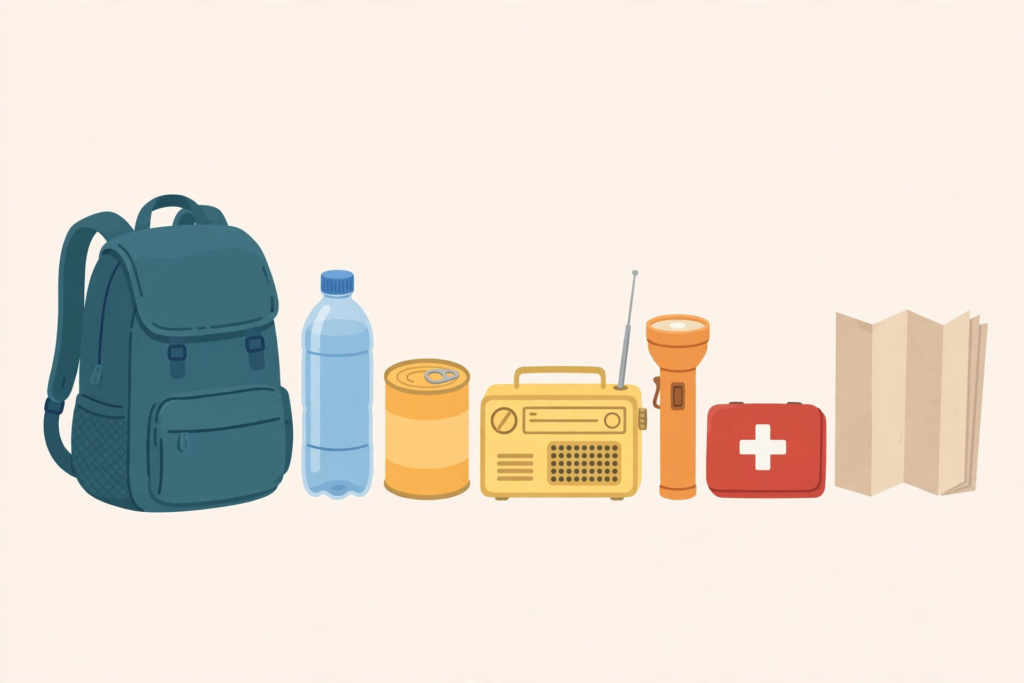
For food, the same family picks items they already eat: tinned beans, tinned tomatoes, rice, pasta, oats, peanut butter, crackers, tinned fruit, and powdered milk. They add a manual can opener, a torch with spare batteries, a battery radio, and a basic first aid kit. Using the planning estimates in this guide, the three-day food and water supply costs roughly $75 to $150 or pounds, and the light, radio, and first aid items add roughly $65 to $180 or pounds. The total first step lands around $140 to $330 or pounds, spread over several weekly shops, and the family then repeats the process to stretch the supply toward two weeks. Nothing in the example requires a bunker, a specialist supplier, or a single large purchase.
A basic preparedness kit checklist with typical costs
A preparedness kit does not need to be bought all at once. Building it over a few months, one category at a time, keeps the cost manageable and avoids panic buying. Prices vary by location and quality, so the figures below are broad planning estimates, not exact quotes.
Water, food, and cooking: drinking water for three days per person, plus extra for hygiene, estimated $10 to $30 or pounds per person. Tinned and dried foods for three days, building to two weeks, estimated $75 to $150 or pounds for a family of four for three days, and $250 to $500 or pounds for two weeks. A manual can opener, estimated $5 to $15 or pounds. A portable camping stove for outdoor use, with fuel, estimated $30 to $80 or pounds. Basic cooking pots, plates, and utensils if not already owned, estimated $20 to $50 or pounds.
Light, power, and communication: a battery-powered or hand-crank radio, estimated $20 to $60 or pounds. Torches and spare batteries, estimated $15 to $40 or pounds. A portable power bank, kept charged, estimated $20 to $50 or pounds. A car phone charger and spare charging cables, estimated $10 to $25 or pounds. A whistle, paper notebook, pens, and a printed contact list, estimated $5 to $15 or pounds. If you are weighing backup power for the home, see how much a whole-house generator costs.
Health, hygiene, and comfort: a first aid kit with bandages, antiseptic, pain relief, and any personal medicines, estimated $30 to $80 or pounds, plus medicine costs. Soap, toothpaste, toilet paper, sanitary supplies, and nappies where needed, estimated $20 to $50 or pounds. Warm blankets, sleeping bags, and a change of clothes per person, estimated $40 to $120 or pounds per person if bought new, far less if using items already owned. Sturdy shoes, rain gear, and warm layers, estimated $30 to $100 or pounds per person if bought new.
Tools, documents, and transport: a basic tool kit, duct tape, and plastic sheeting for temporary repairs, estimated $20 to $60 or pounds. A waterproof folder for documents and cash reserve, estimated $10 to $25 or pounds. A paper map of the local area and evacuation routes, estimated $5 to $15 or pounds. Fuel for the vehicle, kept at least half full during uncertain times, cost varies with vehicle and fuel prices. Pet food, water, carrier, and lead where needed, estimated $20 to $60 or pounds.
Taken together, a starter kit for a family of four often costs an estimated $300 to $700 or pounds, spread over several months, if most clothing and bedding are already owned. A more complete two-week kit may cost an estimated $700 to $1,500 or pounds. The most important items are water, food, medicine, light, and a way to hear official advice, and those can be gathered first for well under $200 or pounds. Home insurance can also matter after storm or conflict damage, so it is worth checking whether homeowners insurance covers winter storm damage and how flood insurance works while you review your documents.
Common mistakes
The first mistake is preparing for a dramatic scenario instead of a disruption. A household that buys specialist gear but has no water, no contact plan, and no paper copies of key numbers is less prepared than a household with a week of ordinary food and a written plan.
The second mistake is relying on a single system. One phone, one route, one vehicle, or one source of news is a single point of failure. Backups matter, even simple ones: a second torch, a paper map beside the phone, and a meeting point beside the call plan.
The third mistake is buying supplies and never testing them. A radio with dead batteries, a stove without fuel, and a torch that no one can find in the dark are not really supplies at all. Test each item once, and teach every adult in the home how to use it.
The fourth mistake is letting the plan live only in one person’s head. If that person is away or unreachable, the plan is useless. Write it down, share it with every adult in the household, and keep a copy in each go-bag.
Pros and cons of preparing early
Preparing early has clear advantages. Supplies bought gradually cost less per trip and avoid panic buying. A written plan removes arguments and guesswork during a stressful day. Practised routines, such as tuning a radio or walking an evacuation route, feel familiar when they are actually needed. Neighbours who know each other’s plans can check on each other faster.
There are downsides to weigh honestly. Supplies take storage space and need rotation, or food and medicines expire. Money spent on a kit is money not spent elsewhere, so a household on a tight budget should start with water, food, and a radio before adding anything else. Preparation can also feed anxiety if it turns into constant news-checking or worst-case planning. The fix is to set a limit: build the plan, buy the basics, check the kit twice a year, and then get on with normal life.
Frequently asked questions
Can I prepare without spending a lot of money?
Yes. The highest-value steps cost little or nothing: a written family plan, a printed contact list, a paper map, a half-full fuel tank, and a little extra water and food added to each weekly shop. A battery radio and a torch are the two purchases worth prioritising, and both are modestly priced.
How long should my supplies last?
Three days is a sensible first goal, because it covers most short disruptions. Two weeks is a stronger goal for households with space and budget. Beyond that, the returns shrink: storage, rotation, and cost all grow, while most disruptions that a household plan can handle are measured in days, not months.
Should I leave or stay if officials give conflicting advice?
Follow the instruction that applies to your area from your local authority. National news and social media may describe a different area or an older instruction. If you are told to evacuate, leave. If you are told to shelter in place, stay. When in doubt, the local official instruction wins.
What should children carry if the family is separated?
A card with a parent’s name and phone number, the out-of-area contact number, and the family meeting point. Children should also know that they should stay with a trusted adult and wait at the meeting point rather than trying to travel alone.
Do I need a generator or a bunker?
No. Neither is required for a basic household plan. A generator can help during a power cut, but it needs fuel, ventilation, and maintenance, and it must never run indoors or in a garage because of carbon monoxide. A bunker is a major construction project that most households do not need. Water, food, a plan, and a radio come first.
Final thoughts
Learning how to survive world war 3 is, at its heart, learning how to look after a household through a difficult and uncertain period. The families that cope best are not the ones with the most equipment. They are the ones with a plan, a few days of supplies, a way to stay informed, and neighbours they can rely on. Calm decisions, verified information, and practical kindness go further than any single purchase.
Readers who want to start today can take three simple steps. First, write a one-page family plan covering contacts, meeting points, routes, and destinations. Second, add a little extra water and food to the next few shopping trips until a three-day supply is stored. Third, pack a go-bag for each person and place it near the door. Those three steps cost little, take an afternoon, and leave a household noticeably better prepared.
For official checklists, see Ready.gov: build a kit, Ready.gov: make a plan, and the American Red Cross emergency preparedness guide.