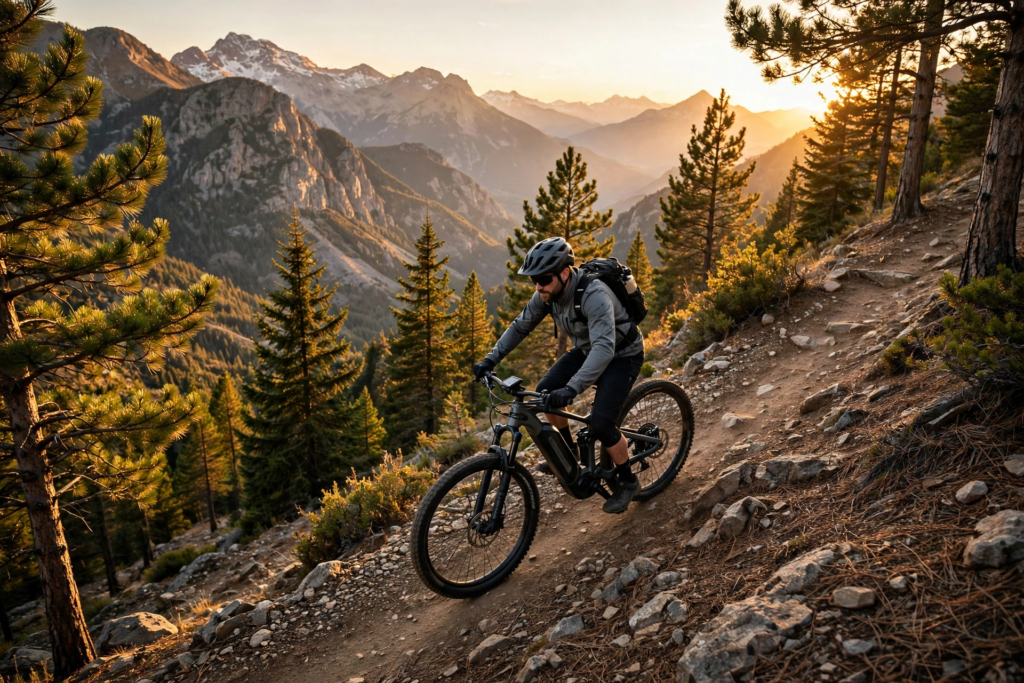
If you love mountain biking but dread the climbs, an eMTB might be for you. An eMTB is a mountain bike with a motor and battery that help you pedal up hills and over rough trails. It is not a motorcycle with pedals, and it is not just a regular electric bike with knobbly tyres.
This guide explains how an eMTB differs from a regular e-bike, what suspension and motor choices mean, what one costs to buy and run, and where you can ride one. Prices here are typical ranges and estimates for 2026, not guarantees. Always check the price and specification of the exact bike before you buy.
Quick answer
An eMTB is a mountain bike with a pedal-assist motor and battery that helps on climbs and trails, up to 20 miles per hour in the United States. It is not a motorcycle: you pedal, and the motor adds power while you do. Expect to spend $3,500 to $7,000 for a full-suspension trail bike, plus running costs.
What an eMTB actually is
An eMTB starts as a mountain bike: a strong frame, wide handlebars, disc brakes, and deep-tread tyres for dirt, roots, rocks, and mud. It then adds a motor, a battery, and a controller with a handlebar display or remote.
On most eMTBs, the motor only helps while you pedal. This is pedal assist. You pick a level, often labelled eco, trail, and boost or turbo, and the motor adds power in proportion to your effort. A torque sensor measures how hard you press the pedals, so the help feels smooth. Push gently on a flat fire road and you get a gentle push. Push hard on a steep climb and the motor pushes hard too. That smooth feel matters on a trail, where a sudden surge can break traction on loose dirt.
The battery is usually built into the down tube, the thick tube from the handlebars toward the pedals. Size is measured in watt-hours, shortened to Wh. A bigger number generally means more range, but trail range depends heavily on gradient, assistance level, rider weight, and mud. Treat any advertised maximum as a best case and plan around a conservative estimate.
Most eMTBs use a mid-drive motor, sitting at the pedals and driving through the gears. That matters for climbing, because the motor can use the gears just as your legs do, staying efficient on a steep pitch instead of straining at low speed. It also keeps weight low and central, which helps handling over rocks and drops. Hub motors, sitting in a wheel, are common on cheap city e-bikes but rare on serious trail eMTBs: they cannot use the gears, and they add weight where you least want it off road.
eMTB versus a regular e-bike
A regular e-bike is built for roads, paths, and commuting. An eMTB is built to be ridden hard off road, bounced over roots, and washed down after a muddy ride. Almost every part differs as a result.
- Feature: Main job — Regular e-bike: Roads, paths, commuting — eMTB: Trails, climbs, descents, rough ground
- Feature: Suspension — Regular e-bike: None, or a short front fork — eMTB: Long-travel fork, often rear suspension too
- Feature: Tyres — Regular e-bike: Narrower, smoother tread — eMTB: Wide, 2.4 to 2.8 inch tyres, deep tread
- Feature: Motor — Regular e-bike: Often a hub motor — eMTB: Almost always mid-drive
- Feature: Motor torque — Regular e-bike: Often 40 to 65 Nm — eMTB: Often 75 to 120 Nm
- Feature: Brakes — Regular e-bike: Disc brakes for road speeds — eMTB: Larger rotors, four-piston calipers on many models
- Feature: Geometry — Regular e-bike: Upright, stable for traffic — eMTB: Slacker head angle, longer reach, stable downhill
- Feature: Weight — Regular e-bike: Often 20 to 27 kg — eMTB: Often 22 to 27 kg
- Feature: Price range — Regular e-bike: Often about $1,000 to $3,500 — eMTB: Often about $2,500 to $7,000 and more
Those price ranges are estimates for typical models in 2026. Trail capability costs money because the frame, fork, shock, wheels, and brakes must all be stronger.
The practical test is simple. If most of your riding is on roads and paved paths, a regular e-bike will be lighter, cheaper, easier to maintain, and more efficient. The wide tyres and suspension of an eMTB just add weight and drag on every paved trip. If most of your riding is on trails, a regular e-bike will disappoint you: its fork, wheels, and brakes are not made for repeated impacts, and its motor may struggle on steep, loose climbs where an eMTB keeps pulling steadily.
There is a middle ground. Some riders use an eMTB for trails at the weekend and roads during the week. That can work, but you pay more, carry more weight, and wear trail tyres faster on tarmac. If you ride a trail only twice a year, a regular e-bike plus a rented mountain bike for those trips may be cheaper overall.
Hardtail versus full suspension
The biggest choice after budget is suspension layout.
A hardtail eMTB has suspension only at the front. The rear wheel is fixed to the frame. A full-suspension eMTB, often shortened to full-sus, has a fork at the front and a shock at the rear, linked by a pivoting frame.
Hardtail eMTBs
A hardtail is simpler, lighter, and cheaper, with no rear shock to service. On smooth trails, fire roads, and gentle singletrack it feels direct and efficient, because every pedal stroke reaches the rear wheel. The trade-off is comfort and grip on rough ground: roots and rocks kick the rear wheel up, which can bounce you out of the saddle and break traction. On long, rough descents a hardtail is more tiring. If you are new to mountain biking, or you ride smoother trails and want the best value, a hardtail is sensible. Typical prices in 2026 run from about $2,000 to $4,500 as an estimate.
Full-suspension eMTBs
A full-suspension eMTB usually gives 130 to 170 mm of travel at both ends. Travel is how far the suspension can compress, and more travel generally handles bigger hits. Trail bikes sit around 130 to 150 mm, while enduro-style bikes push toward 160 to 180 mm for steep, technical terrain.
The benefit is grip and control. The rear wheel stays in contact with the ground over roots and rocks instead of bouncing, giving more traction on rough climbs and more confidence on descents, and sparing your body on a long ride. The costs are real: often 2 to 4 kg heavier, and $1,000 or more extra for a comparable specification, plus shock and pivot servicing. If you ride technical singletrack, steep descents, or rocky trails regularly, it is usually worth it. Typical prices in 2026 run from about $3,500 to $7,000 for mainstream models, with premium carbon models above that as an estimate.
A simple rule helps. Smooth fire roads and gentle trails: hardtail. Technical singletrack, roots, rocks, and steep descents at least once a week: full suspension. Unsure: demo both on the same trail before you buy, because the difference is much clearer on dirt than in a shop.
Motors, torque, and battery range on a trail
Watts measure rated motor power. In the United States many eMTBs are rated at 750 watts. In the United Kingdom and the European Union, road-legal pedal-assist bikes are generally limited to 250 watts continuous. Those limits describe the legal rating, not the peak power briefly produced on a steep climb, which is often higher. Do not compare a wattage number from one country with one from another without checking the local rule.
Torque, in newton-metres and shortened to Nm, matters most for trail climbing. Torque is twisting force. More torque means the motor pushes harder at low speed, exactly what you need grinding up a steep, loose, or rocky climb at walking pace. A city e-bike with 50 Nm feels fine on a paved hill. On a steep trail climb, with a heavy bike and soft ground, 85 Nm or more feels very different: the bike keeps moving instead of stalling and spinning the rear wheel.
Most modern trail eMTBs offer 75 to 120 Nm as an estimate. More torque is not automatically better: very high torque in boost mode can spin the rear wheel on loose dirt if you pedal heavily, so smooth tuning matters as much as the headline number. A well-tuned 85 Nm motor often climbs better than a peaky 120 Nm motor that surges.
A common trail battery is 625 to 750 Wh, with some models offering 800 Wh or more, or a range extender in a bottle-shaped pack. As an estimate, a 750 Wh battery might give 2 to 4 hours of trail riding, or roughly 25 to 50 miles of mixed trail, depending on assistance, gradient, rider weight, and conditions. Eco mode on gentle trails goes furthest. Boost mode on steep climbs goes least far. If your regular loop is longer, look for a larger battery, a range extender, or a removable battery you can swap mid-ride.
A full charge typically takes 3 to 5 hours from empty as an estimate. Most riders charge overnight. Store the battery partly charged in a cool, dry place, avoid leaving it fully flat for months, and expect gradual capacity loss over years. A replacement battery often costs several hundred dollars as an estimate, so factor that into long-term ownership.
Wheels, tyres, brakes, and the dropper post
Most eMTBs use 29-inch wheels, which roll over roots and rocks more easily, or mixed wheels, called a mullet setup, with a 29-inch front wheel and a 27.5-inch rear wheel. The smaller rear wheel can feel more nimble and gives more clearance on steep descents. Tyres are wide, typically 2.4 to 2.8 inches, with aggressive tread for mud and loose surfaces. Wider tyres can run at lower pressure for grip and comfort, but wear faster on roads. Tubeless tyres, with no inner tube and sealant to plug small punctures, are standard on most trail eMTBs and worth keeping.
Geometry is the shape of the frame. A slacker head angle, where the fork leans back more, makes the bike more stable downhill. A longer reach gives room to move your body on steep ground. A steeper seat angle puts you in a better climbing position. You do not need to memorise the numbers: an eMTB is shaped for descending confidence, while a regular e-bike is shaped for an upright road position, which is why an eMTB can feel long and low at first, and why a test ride on a real trail beats one around a car park.
Brakes deserve attention. Trail descents are long, and a heavy eMTB builds speed quickly. Most eMTBs use hydraulic disc brakes with larger rotors, often 200 mm or more, and four-piston calipers on mid-range and premium models. Larger rotors shed heat better, so brakes keep working on a long descent instead of fading. Do not accept small rotors to save money on steep terrain. Brakes are safety equipment, not a place to cut corners.
Finally, the dropper post: a seat post that lowers at the press of a handlebar lever, then rises again on a second press. Drop it on a descent so you can move back and low, raise it on a climb for efficient pedalling. Most trail eMTBs include one as standard in 2026, and if yours does not, budget for one.
What an eMTB costs to buy and run
As an estimate for 2026, hardtails run from about $2,000 to $4,500, mainstream full-suspension models from about $3,500 to $7,000, and premium carbon models from $7,000 upward. Direct-to-consumer brands are often cheaper for the same specification, but you assemble the bike yourself or pay a shop, and warranty support may be slower. A local shop costs more upfront, but gives assembly, setup, a test ride, and warranty help. For a first eMTB, that support is often worth the premium.
Do not forget kit. A good helmet is essential, and a full-face helmet is worth considering for steep or technical descents. Add gloves, eye protection, a repair kit with pump, tyre levers, spare tube or tubeless plugs, and a multi-tool, plus a way to carry water. Budget a few hundred dollars as an estimate, more if you want knee and elbow pads or a hydration pack.
Running costs are higher than for a road e-bike. The motor puts more force through the chain, cassette, and chainring, so they wear faster, especially in boost mode on steep climbs. As an estimate, a chain might last a few hundred miles of hard trail riding, and a cassette might need replacing once or twice a year for a frequent rider. Tyres and brake pads wear faster too, and suspension needs a basic service every year or so, costing a few hundred dollars at a shop as an estimate.
Electricity is the cheapest part: charging a 750 Wh battery uses less than one kilowatt-hour, so a full charge typically costs well under a dollar at typical household prices as an estimate. Insurance is worth checking, given the price: many home policies cap bike cover below eMTB prices, and theft from a car or trailhead may not be covered. Check whether motor and battery are covered and whether an approved lock is required.
Where you can ride an eMTB: trail access rules
This is the part many buyers skip, and it can ruin a purchase. An eMTB is not automatically allowed everywhere a regular mountain bike is allowed. Rules vary by country, region, land manager, and trail network, and they change over time. Always check the specific trails you plan to ride before you buy, and again before a new area.
In the United States, many trail systems follow the three-class system. Class 1 is pedal-assist only, up to 20 mph. Class 2 adds a throttle, also up to 20 mph. Class 3 is pedal-assist up to 28 mph. Most trail-legal eMTBs are Class 1, the most widely accepted on natural-surface trails, but acceptance is not universal. Federal land managers, state parks, and local trail organisations set their own rules. Some allow Class 1 on mountain bike trails. Others restrict eMTBs to motorised trails or ban them from certain singletrack. A trail that allows mountain bikes does not automatically allow eMTBs, and a trailhead sign is the rule that counts on the day.
In the United Kingdom and the European Union, standard pedal-assist e-bikes, generally limited to 250 watts and assistance up to about 15.5 mph, are treated as bicycles in many contexts, which simplifies access in some places. But access still depends on rights of way, land ownership, and local rules, and a bike exceeding the standard limit may be treated as a motor vehicle. If you import a high-powered eMTB, do not assume it meets your local rules.
Etiquette matters too, and eMTB riders are watched closely because the motor is visible. Yield to walkers and horses where required, slow down on shared paths and blind corners, and do not ride wet, closed, or fragile trails: a heavy eMTB can damage soft ground more than a lighter bike, and damaged trails are often why access gets restricted. Stay on the marked trail and be friendly at trailheads.
Before you buy, list the five trails or trail centres you will ride most and check each for eMTB access, via the land manager, a trail association page, or a trailhead sign. If your favourite trail bans eMTBs, that should shape your purchase more than any specification sheet.
Who should buy an eMTB, and who should not
An eMTB is a great buy if you love trail riding but struggle with climbs, whether through fitness, age, injury, or simply wanting to ride further in the time you have. The motor flattens climbs without flattening descents, so you can ride more trail in a morning. It also suits riding with a faster group, or doing multiple laps of a trail centre in one visit.
It is a poor buy if you mainly ride roads and paved paths, have nowhere secure to store a heavy, expensive bike, or cannot lift it onto a car rack or up steps. eMTBs typically weigh 22 to 27 kg, and many standard car racks are not rated for that weight. It is also a poor buy if your local trails ban eMTBs, or if your budget only stretches to the cheapest model with weak brakes and a small battery. A cheap eMTB with poor brakes on a steep trail is a safety compromise, not a bargain.
If unsure, rent or demo first. Many trail centres and shops rent eMTBs by the day, and a day on your local trails tells you more about motor feel, battery range, and suspension than any review. Try eco, trail, and boost on a climb, and try a hardtail and a full-suspension model on the same trail if you can.
Worked example: what the first year really costs
Example: all figures here are planning estimates drawn from the ranges in this guide. You buy a mainstream full-suspension eMTB for $4,500. Add about $300 of kit: a helmet, gloves, eye protection, a repair kit, and a way to carry water. Over the first year of regular trail riding, allow about $250 for a suspension service, plus chains, brake pads, and tyres as they wear. That puts the first-year total at roughly $5,050 before electricity, which is the cheapest part: a full charge of a 750 Wh battery uses less than one kilowatt-hour. The point of the example is that the bike price is only the start, and the running costs deserve a line in your budget.
Common mistakes first-time eMTB buyers make
- Buying on motor wattage alone, instead of checking torque, battery size, and suspension for the trails you actually ride.
- Assuming every mountain bike trail allows eMTBs: trail access rules vary by land manager, so check before you ride.
- Skipping the test ride and the shop setup, then discovering the fit, brakes, or suspension are wrong on a steep descent.
- Forgetting the running costs: chains, cassettes, tyres, brake pads, and a yearly suspension service add up.
- Riding in the highest assist mode all the time, which drains the battery fast and wears the drivetrain faster.
Buying checklist
First, confirm trail access for your five most-ridden trails. Second, choose layout: hardtail for smoother trails and value, full suspension for technical trails and regular rough descents. Third, check motor and battery: a mid-drive motor with at least 75 Nm of torque as a starting point for steep climbs, and a battery of 625 Wh or more for longer loops. Ask about range in trail mode, not eco mode on a flat road.
Fourth, check brakes and fork: hydraulic disc brakes with rotors of 200 mm or more, and a fork from a recognised suspension brand with travel matched to your trails. Fifth, check fit: a bike too big is hard to control on steep descents, and one too small feels cramped on climbs. Use the size chart, test ride if you can, and ask the shop to set sag, how much suspension compresses under your weight, before you judge the ride. Sixth, check service and warranty: how long motor and battery cover lasts, where to take the bike, and how long a replacement battery takes to order. Seventh, budget for the whole purchase: helmet, kit, lock, and first service on top of the bike price. Spend on motor, battery, suspension, brakes, and fit first, and treat the rest as a bonus.
Pros and cons
Pros:
- Climbs and long rides become accessible, so you ride more often and further.
- A mid-drive motor with a torque sensor feels natural, adding power as you pedal.
- Full suspension and strong brakes handle rough trails better than a road e-bike.
- Fitness still improves: you pedal throughout, with assistance you can dial down.
Cons:
- Purchase prices run from about $2,000 for a hardtail to $7,000 and up for premium models.
- Chains, cassettes, tyres, and brake pads wear faster under motor power.
- Weight makes lifting, transport, and repair harder than with a regular mountain bike.
- Trail access is restricted in places, and the rules vary by land manager.
Frequently asked questions
Is an eMTB cheating?
Only if you think mountain biking is about suffering on climbs. Most eMTB riders still pedal hard, still get a workout, and still need skill on descents. The motor shortens climbs, so you ride more descents in the same time. If fitness alone is the goal, a regular mountain bike gives more effort per mile. If trail time and exploring are the goal, an eMTB gives more of it.
How far can an eMTB go on one charge?
As an estimate, a 750 Wh battery might deliver 25 to 50 miles of mixed trail, or 2 to 4 hours, depending on assistance, gradient, rider weight, and conditions. Eco mode on gentle trails goes furthest, boost mode on steep climbs least far. Plan within your comfortable range, or consider a range extender or second battery for long days.
Can I ride an eMTB in rain and mud?
Yes, but clean it afterwards. Rinse mud, dry the chain, and lubricate it after a wet ride. Avoid pressure-washing directly at motor seals, bearings, and electrical connections, as high-pressure water can force past seals. A gentle wash, brush, and cloth will do the job.
Do I need a licence to ride an eMTB?
A standard pedal-assist eMTB meeting your country’s e-bike limits is generally treated as a bicycle, with no licence required. A more powerful bike, or one with a throttle that works without pedalling, may be treated as a motor vehicle in some places, with licence, registration, and insurance requirements. Check local rules before you buy, especially if importing a bike.
Can I ride an eMTB on any mountain bike trail?
Only if that trail allows eMTBs. Check the land manager’s rules, trail association guidance, and trailhead signs. Do not assume mountain bike access means eMTB access. When in doubt, ask before you ride.
The money verdict
An eMTB is worth the money if you will ride trails regularly, if your local trails allow eMTBs, and if you buy the right layout for those trails. For a rider who avoids mountain biking because of climbs, or rides once a month and wishes it were once a week, an eMTB can transform how much you ride, and the cost per ride falls quickly with weekly use.
It is not worth it if you will mainly ride roads, if your trails ban eMTBs, or if you buy the cheapest model and face weak brakes, a small battery, and high maintenance bills. Then a good regular e-bike for roads, plus rented mountain bikes for occasional trail days, gives more value.
If you buy, spend on the fundamentals: a mid-drive motor with strong torque, a battery large enough for your regular loop, capable suspension, strong brakes, and a frame that fits. Service it, keep it clean, and ride within the trail rules.
Further reading: for the wider e-bike picture, see the electric bike guide and beginner dirt bikes, and for another beginner outdoors guide see sailing terms for beginners. Outside Factaxy, IMBA covers mountain bike trail access and stewardship, PeopleForBikes tracks e-bike policy, and the US Forest Service e-bike page explains where e-bikes are allowed on federal trails.