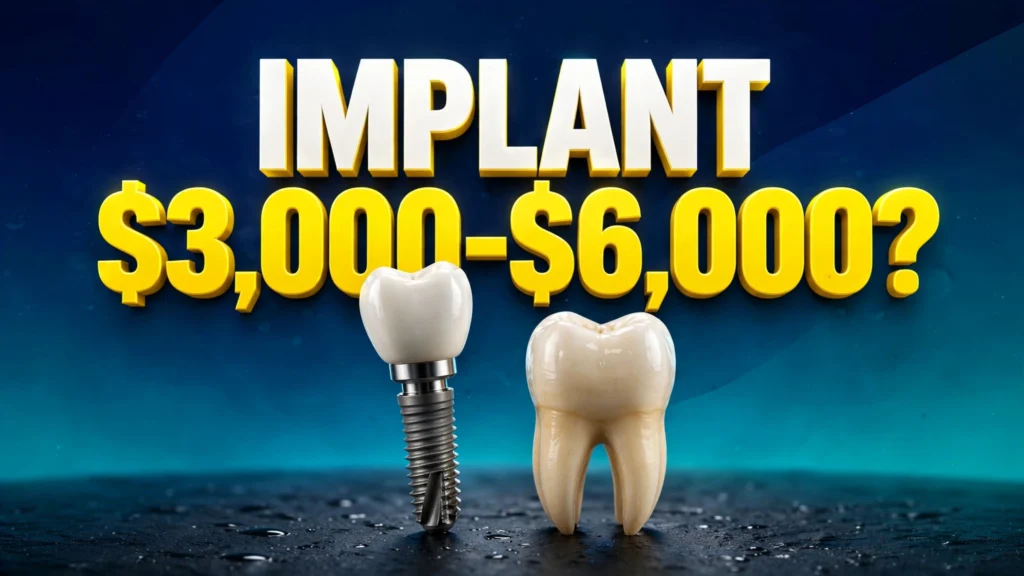
The Short Answer: $3,000 to $6,000 Per Tooth, All-In
A single dental implant without insurance typically costs $3,000 to $6,000 per tooth once every line item is counted. The titanium post itself is only about half the bill — the abutment (the connector) and the crown on top are billed separately, and extras like extraction or bone grafting can push the total higher. Quotes that advertise one low number are usually quoting just the post. Always ask for the all-in, per-tooth total in writing before you commit.
Dental Implant Cost Breakdown (Self-Pay, Per Tooth)
| Line item | Typical cost without insurance | Notes |
|---|---|---|
| Implant post (titanium screw) | $1,500–$2,500 | The part anchored in the jawbone; surgery fee often bundled here |
| Abutment (connector piece) | $500–$1,000 | Joins the post to the crown |
| Crown (the visible tooth) | $1,000–$2,500 | Same pricing as a standalone crown, by material |
| Tooth extraction (if needed) | $150–$500 | Simple vs. surgical extraction |
| Bone graft (if needed) | $500–$1,200+ | Common when the tooth has been missing a while |
| Sinus lift (upper molars, if needed) | $1,500–$3,000 | Only for upper back teeth with low sinus floor |
| X-rays / 3D CT scan | $50–$500 | A cone-beam CT is standard for implant planning |
The realistic self-pay total for one straightforward implant — post, abutment, and crown, no grafting — lands around $3,000–$5,000. Add a bone graft and you are looking at $3,500–$6,000+. The consultation quote should itemize every one of these lines; if it does not, ask.
Full-Mouth and Multi-Tooth Options
One implant per missing tooth gets expensive fast, so dentists use shared-implant designs for bigger jobs:
- Implant-supported bridge (3 teeth on 2 implants): typically $6,000–$12,000 total — cheaper per tooth than three separate implants.
- All-on-4 / full arch (one jaw): typically $15,000–$30,000 per arch. Four implants support a full fixed bridge.
- Full mouth (both arches): typically $30,000–$60,000+. This is the number that shocks people, and it is why financing and phased treatment plans exist.
- Implant-retained denture (2 implants + snap-on denture): typically $5,000–$10,000 — the budget route to a stable lower denture.
If you need several teeth, price the multi-tooth designs before pricing individual implants. The per-tooth math almost always favors the shared designs.
The Insurance Math: Why Implants Break Dental Plans
Dental insurance treats implants as a luxury more often than a necessity. Most plans either exclude implants entirely or cover them at roughly 50% under major restorative benefits — and that 50% applies to the insurer’s allowed amount, capped by an annual maximum of $1,000–$2,000. A single implant can blow through two years of maximums. Add 6–12 month waiting periods for major work, and many insured patients discover their “coverage” pays $1,000–$1,500 of a $5,000 bill.
Medical insurance almost never covers implants unless tooth loss came from an accident or a covered medical condition — and even then, expect a fight. Before scheduling, get three numbers from your insurer: your remaining annual maximum, whether implants are covered at all under your plan, and whether any waiting period applies.
Cheaper Paths to the Same Implant
- Dental schools. Accredited dental schools place implants at significantly lower prices — often 30–50% less than private practice — with supervised residents or specialists. The trade-off is time: longer appointments and slower scheduling.
- Mini implants. Smaller-diameter implants ($500–$1,500 per implant) work for denture stabilization and some single-tooth cases. They are not a substitute for a standard implant in every situation, but ask whether your case qualifies.
- In-office membership plans. Many practices sell annual memberships ($250–$400/year) with 10–25% off major procedures. On a $5,000 implant, a 15% discount covers the membership several times over.
- Phase the treatment. The post can often be placed now and the crown added months later, splitting one $5,000 bill into two payments across calendar years — which can also let you use two years of insurance maximums.
- Payment plans and financing. In-house plans and 0% APR medical financing (6–24 months) are common. Read deferred-interest terms carefully before signing.
- Dental tourism. Implants abroad can cost a fraction of U.S. prices, but factor in travel, follow-up care back home, and what happens if something fails. Get the implant brand and model in writing so any U.S. dentist can service it later.
- Shop the full treatment plan. Implant fees vary enormously between practices. Get the itemized plan — post, abutment, crown, grafting — and get a second quote for the same components.
Implant vs. Bridge vs. Denture: The Money Comparison
- Implant ($3,000–$6,000): 25+ year lifespan is realistic with good care. Highest upfront cost, lowest long-term cost per year. Does not damage neighboring teeth.
- Bridge ($2,000–$5,000 for three teeth): cheaper upfront, but the two neighboring teeth must be crowned — you are cutting down healthy teeth. Typical lifespan 10–15 years, then it needs replacing.
- Partial denture ($800–$2,000): cheapest now, but the least comfortable, needs periodic adjustment, and does nothing to stop jawbone loss under the missing tooth.
Over 20+ years, one implant that lasts is often cheaper than a bridge replaced twice. The exception is when neighboring teeth already need crowns anyway — then the bridge math improves a lot.
What Happens If You Wait?
Delay has a specific, expensive mechanism with implants: bone loss. Once a tooth is gone, the jawbone beneath it starts resorbing. Wait a year or two and you may need a bone graft ($500–$1,200+) that would not have been necessary right after extraction. Neighboring teeth also drift into the gap, which can complicate the eventual implant placement. If money is the reason for waiting, the phased approach — extraction and post now, crown later — preserves the bone while spreading the cost.
Frequently Asked Questions
How long do dental implants last?
The titanium post can last 25+ years, often a lifetime, with good oral hygiene. The crown on top typically needs replacement after 10–15 years ($1,000–$2,500) — budget for that as a future line item, not a failure.
Does getting an implant hurt?
The surgery is done under local anesthesia (sedation is available), so you should not feel pain during placement. Most people manage post-op soreness for a few days with over-the-counter painkillers. Significant pain after the first week warrants a call to the dentist.
Can I get an implant if I’ve already lost bone?
Often yes — that is exactly what bone grafting is for. A 3D CT scan shows how much bone you have and what grafting is needed. Severe bone loss in the upper jaw may require a sinus lift. Your dentist or oral surgeon will map this out before quoting.
Will insurance ever cover an implant?
Sometimes partially. Some dental plans cover 50% of the crown portion as major restorative work while excluding the post. A few premium plans now include implant benefits. Medical insurance may contribute if tooth loss resulted from an accident or tumor. Always get a pre-treatment estimate submitted to the insurer before surgery.
How many appointments does it take?
Typically 3–5 visits spread over 3–6 months: consultation and imaging, post placement, a healing check, abutment placement, and crown fitting. Bone grafting adds months of healing time. Same-day “teeth in a day” protocols exist but cost more and are not right for every case.
The Bottom Line
A dental implant without insurance is a $3,000–$6,000 commitment made of three separately billed parts — post, abutment, crown — plus whatever your mouth needs before the post goes in. The insurance math is usually disappointing, so the real savings come from the itemized quote, a second opinion, dental schools, and phasing the work. Get every line in writing, price the alternatives honestly, and do not let a missing tooth sit long enough to need a bone graft too.