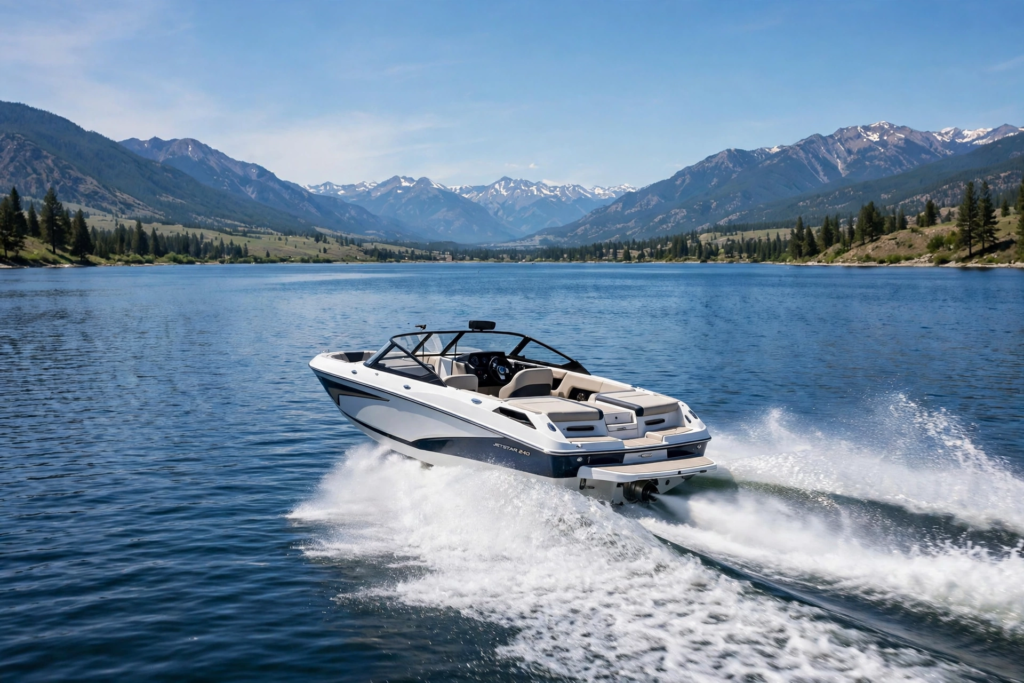
If you have ever watched a personal watercraft dart across a lake, turn on a dime, and stop in water barely deep enough to wade in, you have seen jet propulsion at work. Jet boats use the same idea, scaled up to carry families, friends, fishing gear, and wakeboards. Instead of a propeller spinning in open water behind the hull, a jet boat pulls water in through an intake on the bottom of the boat, speeds it up inside a pump, and pushes it out through a nozzle at the stern. That stream of water is what moves the boat forward.
Jet boats have been around for decades, but they have become much more popular in recent years as builders like Yamaha, Scarab, Chaparral, and Sea-Doo have refined the design. They are now a serious option for anyone shopping for a runabout, a bowrider, a fishing boat, or a wake boat. They are not right for everyone, though. This guide explains how jet drives work, how they compare with traditional propellers, what they cost to buy and maintain, and which buyers get the most value from them.
Quick answer
A jet boat moves by pumping water through an impeller and out a steerable nozzle, with no exposed propeller. That gives you shallow-water access, quick acceleration, and safer swimming around the stern. Expect roughly 10 to 20% higher fuel use than a comparable propeller boat, plus impeller and intake care. Sea trial one at docking speed before you buy.
How a jet drive actually works
A jet drive is simpler to picture than it sounds. Think of it as a powerful water pump built into the back of the boat. Water enters through an intake grate on the underside of the hull. Inside the boat, an impeller, which is a bit like a fan blade inside a tube, spins at high speed and accelerates that water. The water then exits through a steerable nozzle at the back of the boat. Push water backward fast enough, and the boat moves forward. It is the same basic principle that pushes a jet ski, only larger.
Steering works differently from a propeller boat. There is no rudder in the water. Instead, the nozzle itself pivots left and right to aim the thrust. At speed, this gives jet boats famously sharp, responsive handling. At very slow speeds, however, there is a learning curve: with no propeller wash over a rudder, a jet boat can feel loose and drifty when you are idling into a dock or a slip. Most owners get used to it within a few outings, and many modern jet boats now offer slow-speed steering aids, thrust directors, or joystick-style controls that make docking much easier.
Reverse also works differently. A reverse bucket drops down over the nozzle and redirects the jet stream forward, slowing or backing the boat. It works well, but it is not as precise at very low speed as a propeller in forward and reverse gears, so plan your first few dockings with patience and a little extra space.
Another key point: a jet boat has no exposed propeller. That matters for safety around swimmers, for shallow water, and for peace of mind if you tow tubers or have kids swimming near the stern. It does not mean the boat is harmless, since the jet stream itself is powerful, but it removes the most common cause of serious propeller injuries.
Jet drive versus propeller: the honest comparison
No drive system wins on every measure. Here is how jet and propeller boats stack up where it matters most.
Shallow water
This is the jet boat’s biggest advantage. Because nothing hangs below the hull, many jet boats can run in water as shallow as 12 to 18 inches once they are up on plane, and they can idle through water only a couple of feet deep. A propeller boat, by contrast, typically needs at least 2 to 3 feet of clearance to avoid striking the bottom, and an outboard or sterndrive lower unit can be damaged badly by a single grounding.
That said, shallow does not mean careless. Jet intakes can suck up sand, gravel, weeds, and rope in very shallow or weedy water, which can clog the pump or damage the impeller. If you boat in skinny water, learn how to clear the intake grate and check it after every trip.
Acceleration and top speed
Jet boats are known for quick, punchy acceleration. They get on plane fast and feel lively from a standing start, which makes them fun for tubing, wakeboarding, and general play. At the top end, the picture is more mixed. A well-matched propeller is usually a little more efficient at sustained cruising speed, so a comparable propeller boat may edge out a jet boat on top speed and fuel economy at wide-open throttle. In real family boating, where you spend most time cruising at 25 to 35 miles per hour and pulling toys, the difference is small enough that most owners never notice it.
Fuel economy
Propellers tend to win on fuel efficiency, especially at cruising speed. Jet pumps lose some energy in the pump itself, and they often need higher engine revs to hold the same speed. As a rough planning estimate, expect a jet boat to use roughly 10 to 20% more fuel than a similar propeller boat in similar conditions. That figure is an estimate, not a laboratory measurement, and it varies with hull weight, engine size, load, and how you drive. If fuel cost is your top concern and you log long cruising hours, a propeller boat or an outboard may save you money over a season.
Handling
At speed, jet boats feel agile and sporty, with tight turns that propeller boats struggle to match. At idle and docking speed, propeller boats feel more predictable because the rudder and propeller give you steering even when you are barely moving. Jet boats require a bit more throttle input to steer at low speed, which feels odd at first. Practice in open water before your first crowded marina visit, and consider a model with a low-speed steering enhancement if docking makes you nervous.
Safety around swimmers
The lack of an exposed propeller is a genuine safety plus, especially for families with children, dogs, or frequent swimmers. Many parents choose a jet boat for exactly this reason. Keep in mind that the jet nozzle still produces a strong stream, so swimmers should stay clear of the stern while the engine is running, and you should always shut the engine off before anyone climbs aboard from the water.
Noise and vibration
Modern jet boats are much quieter than older models, but they tend to run at higher revs and can sound busier than a propeller boat at cruising speed. Vibration is generally low, since there is no long shaft or exposed gearcase, but pump cavitation, a rattling or slipping feeling when the impeller loses its grip on the water, can occur if the intake is clogged or the impeller is worn. If you feel that, back off the throttle and check the intake.
Types of jet boats you can buy
Jet propulsion shows up across several boat categories. Knowing which type fits your boating style will narrow your search fast.
Jet runabouts and bowriders. These are the most common jet boats, typically 19 to 25 feet long, built for day trips, swimming, tubing, and cruising with family and friends. They offer open seating, sun pads, and storage, and they are easy to trailer. If you want one boat that does a bit of everything on a lake or a calm bay, start here.
Jet fishing boats. Some builders offer center consoles and bay boats with jet drives for anglers who fish shallow flats, rivers, and back bays. The shallow draft lets you reach spots propeller boats cannot, which is a real advantage for inshore fishing. The trade-off is that jet boats can be noisier at trolling speed and less precise for slow trolling, so serious offshore anglers usually still prefer an outboard.
Jet wake and surf boats. A growing number of wake boats use jet drives paired with ballast systems and surf tabs. They produce a clean wake for wakeboarding and wakesurfing, and the lack of a propeller is reassuring when surfers are close behind the boat. Check the surf wave quality in person before you buy, since wake shape varies by model and ballast setup.
Jet tenders and small runabouts. Compact jet boats in the 14 to 18 foot range work well as tenders, lake toys, or first boats. They are light, easy to tow, and simple to maintain. They also have limited seating and storage, so they suit couples and small families better than big groups.
Personal watercraft. Jet skis and their larger three-seat cousins are technically jet boats too, and they share the same drive principle. They are a different purchase, with different rules and storage needs, but if you love the feel of a jet drive, a personal watercraft is the purest and cheapest way to experience it.
What jet boats cost in 2026
Prices vary widely by size, brand, engine, and features, so use these ranges as planning estimates for the 2026 market rather than exact quotes. Small jet runabouts in the 19 foot range often start around $35,000 to $50,000 new. Mid-size bowriders from 21 to 24 feet commonly run from about $55,000 to $90,000. Larger jet boats with twin engines, premium sound, surf systems, and upgraded interiors can pass $100,000, with some well-equipped models reaching $120,000 or more. Used jet boats are widely available, and a clean 5 to 10 year old model in the 19 to 23 foot range often sells for roughly $20,000 to $45,000 depending on hours, condition, and engine configuration. Those used figures are estimates based on typical listings, so always check current local prices before you budget.
Running costs deserve equal attention. Fuel is the biggest ongoing expense, and as noted above, jet boats tend to use a bit more of it. Insurance for a jet boat is generally comparable to a similar propeller boat, though rates depend on your location, value, and boating history. Storage, trailering, and winterization costs are similar to other boats of the same size. The cost that surprises some first-time jet owners is impeller and wear ring replacement, covered in the maintenance section below.
When you compare prices, compare total ownership, not just the sticker. A cheaper jet boat that needs a new impeller, a pump rebuild, and upholstery work can cost more in year one than a slightly pricier boat that was well maintained.
Maintenance: what jet owners actually do
One of the appeals of a jet boat is mechanical simplicity. There is no outdrive to service, no propeller shaft seals, no lower unit oil, and no exposed gearcase to damage. That simplicity is real, but jet boats still need regular care.
After every outing. Flush the engine with fresh water if you boat in salt water, rinse the hull and interior, and check the intake grate for weeds, rope, fishing line, or debris. A quick visual check takes two minutes and prevents most pump problems.
Impeller and wear ring. The impeller is the heart of the pump, and the wear ring is the sleeve it spins inside. Over time, sand and debris wear the gap between them wider, which causes cavitation and lost performance. Many owners replace a wear ring every few seasons, and an impeller when it is nicked, bent, or worn. As a planning estimate, a wear ring replacement often costs a few hundred dollars in parts and labor, while an impeller replacement can run roughly $500 to $1,500 depending on the model and whether you do the work yourself. Those are estimates, not fixed prices, so get a quote from your dealer or a local shop for your exact model.
Engine oil and filters. Jet boats use inboard-style engines that need regular oil and filter changes, typically once a season or every 50 to 100 hours, following your manual. Spark plugs, coolant, and battery care follow the same schedule as other inboard boats.
Pump oil and seals. Some jet pumps have their own oil or grease points, and pump seals should be inspected during annual service. A leaking pump seal can let water into bearings, so do not ignore a pump that sounds rough or feels gritty.
Winterization. If you boat in a cold climate, winterize before the first freeze: drain water from the engine and pump, stabilize fuel, fog the engine if your manual calls for it, and protect the battery. Jet boats are not harder to winterize than other inboards, and many owners handle it themselves after one dealer demonstration.
Trailer and hull. Because jet boats are often trailered to shallow ramps, check bunks, rollers, lights, and bearings regularly. Inspect the hull bottom for scrapes, especially near the intake, since a damaged intake grate can hurt performance and let debris into the pump.
Overall, most owners find jet boat maintenance straightforward and often a little simpler than sterndrive maintenance. The key habit is intake inspection. A clean intake is a happy pump.
Worked example: buying a used jet bowrider
Example: suppose you find a clean, single-engine 21-foot jet bowrider, about six years old, listed at $38,000 with a trailer included. Taxes and registration vary by state, but as a planning estimate, allow about 8 to 12% on top of the price for taxes and fees, which puts the out-the-door figure near $41,000 to $42,500. Before you pay, budget for a pump check: if the sea trial shows cavitation on takeoff, a wear ring and impeller job could add roughly $800 to $1,800, which becomes a negotiating point rather than a surprise. Over a season of weekend use, fuel will likely run about 10 to 20% higher than the same weekends in a comparable propeller bowrider, so if a propeller boat would burn $1,000 of fuel, plan on roughly $1,100 to $1,200 for the jet. The example shows why the sticker is only the first number: pump condition and fuel use decide whether the cheaper boat stays cheaper.
Best uses: where jet boats shine
Jet boats are at their best in a few specific situations. If one of these describes your boating, a jet boat deserves a close look.
Shallow lakes, rivers, and bays. If your home water is skinny, weedy, or rocky, the shallow draft and lack of a lower unit are major advantages. You can explore flats, sandbars, and river stretches that would keep a propeller boat at the dock.
Family swimming and watersports. The no-propeller design, quick acceleration, and open bowrider layouts make jet boats natural family boats. Tubing, wakeboarding, swimming, and sunset cruises are exactly what they are built for.
Beaching and sandbar days. Jet boats are easy to nose up to a beach or sandbar without worrying about a propeller striking sand. Just remember to shut the engine off in very shallow water so the pump does not suck up sand, and push off into deeper water before restarting.
First-time buyers. The simple drivetrain, easy trailering, and forgiving handling at speed make jet boats approachable for new owners. The docking learning curve is real, but it is short, and dealer delivery training usually covers it.
Where jet boats are less ideal: long offshore runs in rough water, where a deep-V outboard hull and propeller efficiency matter more; slow-speed trolling for hours, where precise low-speed control is prized; and high-mileage cruising, where fuel economy differences add up over a season.
Buying checklist: how to choose the right jet boat
Use this checklist when you shop, whether new or used.
- Match the boat to your water. Shallow river or lake, deep lake, or coastal bay. Shallow water favors a jet. Deep open water favors a deeper hull, jet or propeller.
- Pick your size honestly. Count your usual crew, not your maximum party. A 19 foot boat seats a small family well. A 23 to 25 foot boat handles eight adults far more comfortably.
- Single or twin engine. Single-engine jet boats are lighter, simpler, and cheaper to run. Twin-engine models offer more power, better acceleration with a full load, and redundancy if one engine has trouble. Twins also cost more to buy, fuel, and maintain.
- Test the docking feel. During a sea trial, spend real time at idle speed. Practice docking, reversing, and turning in a tight space. If it feels too loose for you, ask about steering aids or try a different model.
- Check the pump on a used boat. Look at the impeller for nicks and bent blades, check the wear ring gap if you can, and feel for cavitation during acceleration on the sea trial. A boat that slips or rattles on takeoff may need pump work, which is a negotiating point, not necessarily a deal breaker.
- Inspect the intake and hull bottom. Scrapes near the intake, a bent grate, or signs of hard groundings tell you how the boat was used. Minor scrapes are normal. Major damage deserves a professional look.
- Review engine hours and service records. Low hours with no service history can be worse than higher hours with complete records. Ask for oil change, winterization, and pump service receipts.
- Sit in every seat. Jet bowriders look roomy in photos but vary in legroom, storage, and shade. Bring your usual crew to the showroom if you can.
- Price the extras. Bimini tops, covers, trailers, depth finders, and surf systems add up. Get an out-the-door price that includes the trailer and the options you actually want.
- Confirm dealer and parts support. Jet pumps use model-specific parts. Make sure a dealer or qualified shop near you stocks impellers, wear rings, and seals for the brand you choose.
Common mistakes
- Skipping the docking test. A jet boat feels great at speed and loose at idle. If you only test full throttle, you miss the one handling trait that takes practice.
- Running in water too shallow for the pump. The hull may clear the bottom while the pump still pulls sand. Push off into deeper water before starting.
- Ignoring the intake. Weeds, rope, and fishing line cause most pump trouble. A two-minute grate check after every trip prevents most of it.
- Buying on sticker alone. Pump work, upholstery, and a trailer can erase a bargain price in year one. Compare total ownership.
- Treating shallow draft as a safety guarantee. A jet boat still grounds, still hits rocks, and still needs navigation care. The missing propeller removes one risk, not all of them.
Pros and cons
Pros: no exposed propeller for safer swimming; shallow-water access down to about a foot on plane; quick, punchy acceleration; simple drivetrain with no outdrive to service; agile handling at speed; easy trailering.
Cons: roughly 10 to 20% higher fuel use than a comparable propeller boat; loose, drifty feel at docking speed until you learn it; impeller and wear ring wear from sand and debris; noisier at cruising revs; less precise for slow trolling; top speed and cruising efficiency slightly behind a well-matched propeller.
Common problems and how to avoid them
Cavitation on takeoff. Usually caused by a clogged intake, a worn wear ring, or a damaged impeller. Clear the grate, inspect the pump, and replace worn parts before the problem gets worse.
Weeds and rope in the pump. Avoid thick weed beds at speed, and shut down immediately if you feel a sudden vibration or loss of thrust after passing over rope or a tow line. Many boats have a clean-out port that lets you remove debris without hauling the boat.
Sand ingestion. Do not run the engine in water so shallow that the pump pulls sand off the bottom. Push off to deeper water before starting, and avoid powering onto a beach.
Porpoising or chine walking at speed. Some light jet boats can bounce or rock at high speed if weight is poorly distributed or trim is off. Shift weight forward, adjust trim if your model offers it, and back off the throttle. Persistent handling issues deserve a dealer check.
Slow-speed drift. This is normal for jet boats, not a defect. Use short bursts of throttle to steer at idle, and practice in open water until the feel becomes natural.
Frequently asked questions
Are jet boats good for beginners?
Yes, with one caveat. They are easy to drive at speed and simple to maintain, but docking takes practice. Take the dealer orientation seriously, practice in open water, and you will be comfortable within a few trips.
Can a jet boat go in salt water?
Yes. Many jet boats are used in coastal bays and salt water. Flush the engine and pump with fresh water after every saltwater outing, rinse the trailer, and follow your manual for corrosion protection. Saltwater use increases maintenance, but it does not rule out a jet boat.
Do jet boats handle rough water well?
It depends on the hull, not just the drive. A deeper-V jet hull handles chop better than a flat-bottomed one. For regular offshore or big-lake rough water, compare hull designs carefully and sea trial in conditions like the ones you will actually boat in.
How long does a jet boat impeller last?
With clean water and normal use, an impeller can last many seasons. Sand, gravel, and debris shorten its life considerably. Inspect it annually and replace it when blades are nicked, bent, or worn, rather than waiting for a failure on the water.
Are jet boats more expensive to insure?
Generally, insurance is comparable to a similar propeller boat of the same value and use. Your location, storage, boating experience, and claims history matter more than the drive type. Get quotes for both drive types if you are comparing specific models.
Can you wake surf behind a jet boat?
Yes, many modern jet wake boats are designed for wakesurfing, with ballast and surf systems. The wave quality varies by model, so demo the surf wave before you buy if surfing is a priority.
Further reading
For more on the water, see these guides: sailing terms every beginner should know, fishing kayaks, and electric bikes. For safety gear rules, check the BoatUS Foundation guide to Coast Guard equipment requirements and the Discover Boating summary of Coast Guard requirements.
The bottom line
A jet boat is a smart choice if you boat in shallow water, prioritize swimmer safety, love quick acceleration and sporty handling, and want a simple drivetrain without a propeller or outdrive to worry about. You will likely pay a little more in fuel and need to stay on top of intake and impeller care, and you will need to learn the low-speed docking feel. For many lake and bay boaters, those trade-offs are easy to accept.
A propeller boat remains the better pick if you log long cruising hours, troll slowly for hours at a time, or regularly run offshore in rough water, where propeller efficiency and low-speed precision matter most.
If you are still deciding, do two things before you buy: sea trial a jet boat and a comparable propeller boat on the same day, and spend at least ten minutes of each trial at docking speed, not just at full throttle. The boat that feels right at the dock and on the water, on your home lake, in your budget, is the right boat for you. That test tells you more than any brochure, and it is the fastest way to know whether jet propulsion fits the way you actually boat.