You see a headline that interest rates went up, and suddenly your mortgage quote is higher and your credit card statement looks worse, while your savings account still pays almost nothing. It feels like the numbers move on their own. That confusion is the problem this guide fixes. Current interest rates are not one number. They are a set of prices, each moved by different forces, and once you know which rate matters for your decision, the headlines start to make sense.
Quick answer: what are current interest rates?
Current interest rates are the prices lenders charge for borrowing money right now, and they change daily. The Federal Reserve sets a short-term benchmark, the federal funds rate, while longer rates such as mortgage rates follow Treasury yields, inflation, and investor expectations. Your own rate also depends on your credit, the loan type, and how long you borrow for.
What an interest rate actually is
An interest rate is the price of borrowing money, stated as a percentage of the amount borrowed over a year. Borrowers pay back the loan plus interest. Savers earn interest from the bank for the use of their money. Same word, opposite directions.
Two terms cause most of the confusion. The interest rate is the cost of borrowing itself. The APR, or annual percentage rate, is the interest rate plus certain fees and costs, spread over the year, so it is the fuller price of the loan. When two loans show the same rate but different APRs, the higher APR costs more once fees are counted.
The four rates that matter most
Nobody tracks every rate in the economy. Four of them explain almost everything you will read about.
The federal funds rate: the benchmark everything starts from
The federal funds rate is the rate banks charge each other for overnight loans. The Federal Open Market Committee, or FOMC, sets a target range for this rate, the main tool the Federal Reserve uses to carry out monetary policy. Its two goals, set by Congress, are maximum employment and stable prices.
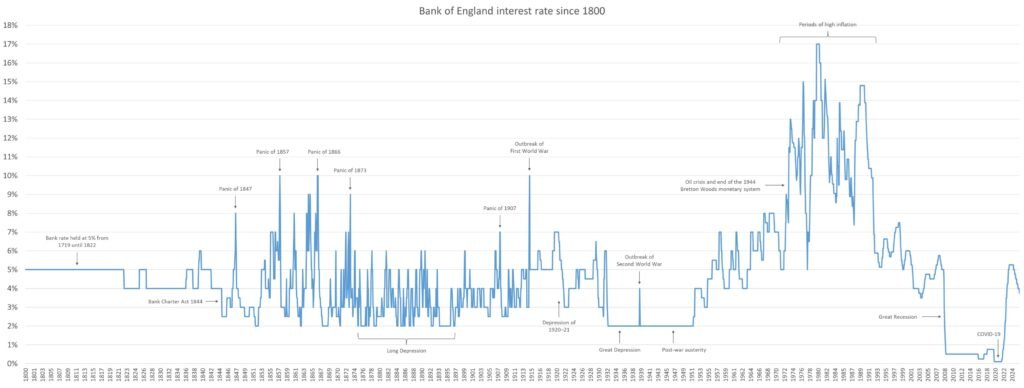
When the Fed lowers the target range, it is easing policy, which usually pulls other short-term rates down. When it raises the range, it is tightening policy, which usually pushes them up. A change in the federal funds rate normally affects other interest rates. The Federal Reserve explains this chain in its guide to monetary policy.
Treasury yields: what the government pays to borrow
When the United States government borrows, it sells Treasury bills, notes, and bonds, and the yield is what it pays investors. The Treasury publishes a daily par yield curve with yields from 1 month out to 30 years, updated every business day. The 10-year yield is quoted most often, because so many long-term rates take their cue from it.
Treasury yields matter because they are set by the market, not by the Fed. Investors buy and sell Treasuries all day, and yields move with what they expect for growth, inflation, and future Fed decisions.
Mortgage rates: long-term rates with a local twist
Mortgage rates follow the 10-year Treasury yield more closely than they follow the federal funds rate. The Fed can cut its benchmark rate while mortgage rates barely move, or even rise, if Treasury yields go the other way. Your own rate also depends on your credit score, your down payment, the loan type, and the lender.
Savings and card rates: the two sides of your wallet
Savings and certificate of deposit rates tend to rise when the Fed raises its benchmark, as banks compete harder for deposits, and credit card rates usually move the same way. The same announcement can therefore be good news for a saver and bad news for a borrower.
What moves interest rates
Rates do not move at random. Five forces do most of the work, and they often pull in different directions.
The Federal Reserve and the economy
The Fed watches jobs and prices. When the economy is weak, it may cut rates to make borrowing cheaper and encourage spending. When prices are rising too fast, it may raise rates to cool spending down. The FOMC meets regularly and releases a statement after each meeting.
Inflation
Inflation is the quiet force behind almost every rate. A lender who charges 4 percent while prices rise 5 percent a year is losing buying power, so lenders demand higher rates when they expect higher inflation. That is why a hot inflation report can push mortgage rates up the same morning, even with no Fed meeting in sight.
Investor expectations and government borrowing
Long-term rates reflect what investors expect short-term rates to average over the life of the loan. If investors think the Fed will cut rates later, long-term yields can fall even while short-term rates stay put. Supply matters too: when the government borrows more, it sells more Treasuries, and higher supply can push yields up.
Your credit and the type of loan
Risk is priced into every loan. A borrower with a strong credit history and a large down payment looks safer, so lenders offer a lower rate. A borrower with missed payments or a small down payment looks riskier, so the rate is higher. A secured loan, backed by a house or a car, usually carries a lower rate than an unsecured loan.
How long you borrow for
Longer loans usually carry higher rates than shorter ones. A 15-year mortgage normally has a lower rate than a 30-year mortgage, but a bigger monthly payment.
Where to check current interest rates
For the benchmark and Treasury yields, the Federal Reserve publishes its H.15 release of selected interest rates, and the Treasury publishes its daily par yield curve, both free, updated on business days. For mortgage rates, a lender quote is the only number that applies to you.
A market guide helps you judge whether a quote is in line with the market that week. Our mortgage rates today page shows the latest picture, while this guide explains what sits behind those numbers. For your own loans and savings, check the rate on your statement and note the date.
Worked example: what one point costs on a mortgage
This is an illustrative example, worked out with the standard loan payment formula. It is not a quote.
Take a home loan of 300,000 dollars for 30 years, or 360 monthly payments. At a fixed rate of 6 percent a year, the monthly rate is 0.5 percent, or 0.005. The monthly payment comes to 1,798.65 dollars. Over 360 payments that is 647,514.57 dollars in total, which means 347,514.57 dollars of interest.
Now raise the rate by one point, to 7 percent. The monthly rate is about 0.5833 percent. The monthly payment comes to 1,995.91 dollars, or 718,526.69 dollars over 360 payments, which means 418,526.69 dollars of interest. The difference is 197.26 dollars a month, from 1,995.91 minus 1,798.65, and 71,012.12 dollars over 30 years, from 718,526.69 minus 647,514.57.
One point costs about 197 dollars more every month and about 71,000 dollars more over the life of the loan. Savings work the same way in reverse: 10,000 dollars held for one year earns 400 dollars at 4 percent but only 100 dollars at 1 percent. Try the numbers yourself in our loan calculator or our compound interest calculator before you decide.
Common mistakes about current interest rates
The most common mistake is treating all rates as one number. A Fed rate cut does not automatically cut mortgage rates, because mortgages follow Treasury yields. Another is comparing rates from different days: a quote from last Tuesday and a quote from today can differ by a quarter of a point.
People also mix up the interest rate and the APR. A loan that advertises a low rate but a high APR is hiding fees in the fine print, so always compare APRs. And do not assume a rate you see online is the rate you will get: published averages describe a typical borrower with strong credit, while your rate depends on your credit score, your down payment, and the lender.
The upside and the limits of watching rates
Watching rates closely has real benefits. You can spot a good week to lock a mortgage rate or move savings to a better account. Knowing what moves rates also stops panic: when a headline says rates jumped, you can check whether it was the Fed, inflation, or Treasury yields.
There are limits too. Rates cannot be timed reliably, and even professionals who watch the bond market all day get the direction wrong often. Chasing the perfect rate can cost more than it saves, if it delays a home purchase or keeps money in a low-rate account while you wait. Understand the forces, check the numbers that apply to you, and act when the math works.
Frequently asked questions
What is the current interest rate right now?
There is no single current interest rate. The federal funds rate is the benchmark, Treasury yields cover government borrowing, and mortgage, card, and savings rates each follow their own path. Check the rate for the exact product you need.
Does the Federal Reserve set mortgage rates?
No, not directly. The Fed sets the target range for the federal funds rate, an overnight rate between banks. Mortgage rates follow long-term Treasury yields much more closely, so they can move in a different direction from the Fed’s rate on any given day.
Why do interest rates rise when inflation rises?
Lenders need to be paid for the buying power they lose while the money is out. When inflation is high, or expected to stay high, lenders charge higher rates to cover that loss. That is also why the Fed raises its benchmark when inflation runs hot.
What is the difference between an interest rate and an APR?
The interest rate is the cost of borrowing the money itself. The APR adds certain fees and costs into one annual figure, so it shows the fuller price of the loan. Compare APRs, not just advertised rates.
How often do interest rates change?
Market rates such as Treasury yields change every business day, sometimes sharply within a day. The federal funds rate changes only when the FOMC decides to move it. Your own loan or card rate changes when your lender changes it, or when you take out a new loan.
Interest rates look complicated from the outside, but they come down to one question: what does it cost to borrow money right now, and why? The Fed sets the short-term benchmark, the Treasury market sets the long-term anchor, inflation sets the mood, and your own credit sets the price you pay. Keep those four in mind, and the next rate headline will read more like useful information.
Sources and methodology
The figures, rules, and rates in this guide come from the authoritative sources linked throughout the article, including federalreserve.gov, home.treasury.gov. Where a figure is an estimate or a worked example, the article says so.