The Short Answer: 3–5% of Contracts, 10–20% of Endorsements
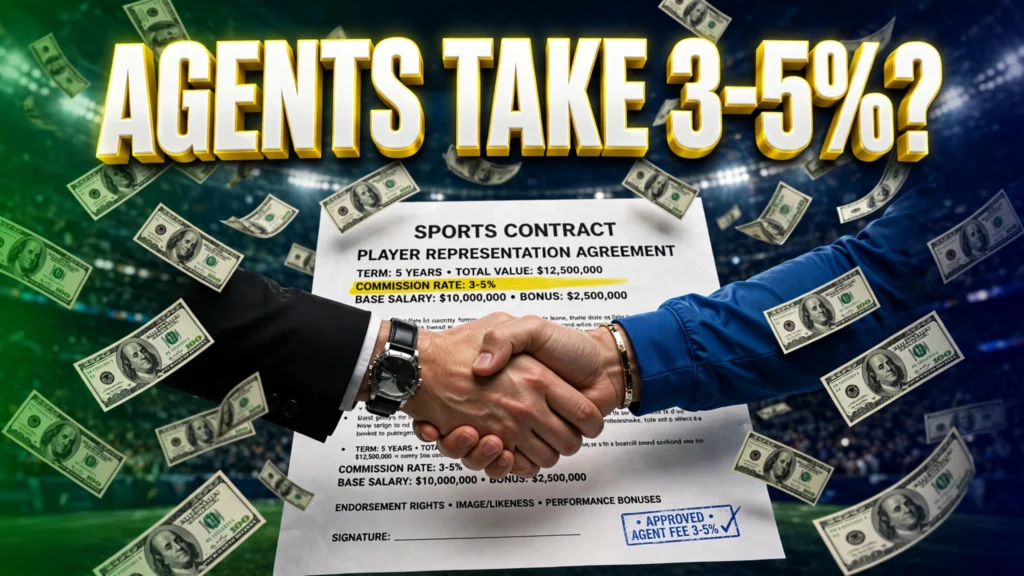
Sports agents do not take a salary — they take a cut. On playing contracts, the commission is capped by each league’s players’ union: 3% in the NFL, 4% in the NBA, and 5% in MLB. On endorsement and marketing deals, agents typically take 10–20%, because those deals are not union-capped and require far more legwork to land.
That sounds small until you run the math. A 3% cut of a $100 million NFL contract is $3 million. But most agents never touch a deal like that. The median sports agent earns a solid professional income, not a fortune — and the difference between the two comes down to whose phone they can get to ring. Here is how the pay structure actually works, league by league.
League Commission Caps: The Rules That Set Agent Pay
Every major U.S. players’ union caps what certified agents can charge on playing contracts. These caps exist to protect players from predatory representation, and they are non-negotiable ceilings — an agent can charge less, but never more.
| League | Union cap on contracts | Typical endorsement cut |
|---|---|---|
| NFL (NFLPA) | 3% | 10–20% |
| NBA (NBPA) | 4% | 10–20% |
| MLB (MLBPA) | 5% | 10–20% |
| NHL (NHLPA) | Typically 3–5% | 10–20% |
| MLS | Typically 3–5% | 10–20% |
The caps apply to the negotiated value of the playing contract — base salary, signing bonuses, and achievable incentives. Agents generally do not take a cut of benefits like pension contributions or per diems.
How $100 Million Gets Sliced Up: Real Pay Math
Take a hypothetical NFL quarterback signing a 4-year, $100 million deal with $60 million guaranteed. At the 3% cap, the agent’s commission is $3 million — usually paid out over the life of the contract as the player receives the money, not as a lump sum on signing day.
Now add endorsements. If that same player earns $5 million a year in endorsement deals and the agent takes 15%, that is another $750,000 per year. Over four years, the agent’s total haul from one star client can exceed $6 million.
But here is the part nobody talks about: the agent only gets paid when the player gets paid. If a player is cut, injured, or holds out, the agent’s income from that client drops to zero. And agents front enormous costs — recruiting travel, training-camp loans to unsigned rookies, marketing staff — before a client ever signs. Many young agents operate at a loss for years.
What the average agent actually earns
Forget the super-agents for a moment. An agent representing a handful of mid-tier players — say, three NFL veterans on $2–4 million deals — earns roughly 3% of $9 million, or $270,000 per year before expenses and before splitting with their agency. After the agency takes its share (often 30–50% for junior agents at big firms), the take-home can be closer to $130,000–$180,000.
Agents just starting out, representing practice-squad players or minor leaguers, may earn under $50,000 a year for the first few years. The business is brutally top-heavy: a small number of agents represent the majority of star players, and everyone else fights over the rest.
Endorsements: Where the Real Margin Lives
Contract commissions are capped and competitive. Endorsements are where agents build real wealth, because the percentage is higher and the deals compound.
- Standard endorsement cut: 10–20% of the deal value, with 15% the most common figure.
- Why it is higher: Landing a national shoe or beverage deal requires relationships, negotiation, and ongoing brand management — work the union caps were never designed to cover.
- Marketing-only agents: Some agents specialize purely in endorsements and charge 20–25%, since they do not touch the playing contract at all.
- The superstar multiplier: A player earning $30 million a year in endorsements at a 15% cut generates $4.5 million annually for the agent — often more than the contract commission.
This is why agencies fight hardest over marketable stars rather than just talented players. A charismatic role player with national commercials can be worth more to an agency than a better player nobody recognizes.
How Agents Get Certified (and What It Costs)
You cannot just declare yourself an agent. Each union runs its own certification process:
- NFLPA: Requires a bachelor’s degree (master’s or law degree preferred in practice), an application fee of around $2,500, and passing a written exam. Agents must also carry professional liability insurance.
- NBPA: Similar degree requirements, background check, and exam. The union has tightened standards in recent years after several agent misconduct cases.
- MLBPA: Certification requires an application, background check, and adherence to the union’s agent regulations. MLB has the highest cap (5%) partly because baseball contracts are the most complex to negotiate.
Total startup costs for a new agent — certification, insurance, travel, and floating unsigned clients — routinely run into the tens of thousands of dollars before the first commission check arrives.
The Super-Agent Tier: What the Top 1% Make
A tiny group of agents — names like Scott Boras in baseball or the heads of firms like CAA, WME, and Klutch — negotiate billions in contracts collectively. A single Boras client class in one offseason can generate tens of millions in commissions for his firm.
But these figures are firm revenue, not personal salary. Big agencies employ dozens of agents, lawyers, marketers, and analysts. The headline commission gets split across the whole operation. Even so, founding partners at top agencies are reliably among the highest-paid people in sports business, with annual earnings in the eight figures in peak years.
Is Being a Sports Agent Worth It Financially?
Run the honest math before romanticizing the job:
- Upside: No salary ceiling. One star client can change your life. Recession-resistant in the sense that sports spending rarely collapses.
- Downside: Years of negative cash flow. Clients can fire you at any time. You compete against agencies with 30-year relationships.
- Break-even: Most independent agents need 5–10 signed clients on real contracts before the practice sustains itself — a milestone that typically takes 3–5 years.
- The real product: You are not selling negotiation. You are selling trust and access. Players choose agents their friends vouch for.
Frequently Asked Questions
What percentage do sports agents take from contracts?
Union caps set the ceiling: 3% in the NFL, 4% in the NBA, 5% in MLB, and typically 3–5% in the NHL and MLS. Agents can charge less but never more on playing contracts.
Do sports agents get a cut of signing bonuses?
Yes — signing bonuses are part of the negotiated contract value, so the commission percentage applies to them like any other contract money.
How do agents make money from rookies who have not signed yet?
They generally do not. Agents often advance money to unsigned rookies for training and living expenses, then recoup it from the first contract’s commission — a loan against future earnings that only pays off if the player signs.
Can a player negotiate their agent’s commission down?
Yes. The union figures are maximums, not fixed rates. Star players with leverage sometimes negotiate 2% or even 1.5% on mega-deals, which is one reason agencies prefer volume.
Do agents pay taxes on commissions like regular income?
Generally yes — agent commissions are ordinary business income, taxed at regular rates. (If you are curious how athletes’ own side income gets taxed, see our guide on sports betting winnings taxes.)
The Bottom Line
Sports agents make 3–5% of playing contracts and 10–20% of endorsements — a formula that turns superstars into fortunes and leaves everyone else grinding. The caps keep the math honest, but the real story is the distribution: a handful of agents earn eight figures while most earn a good professional living or less. If you are drawn to the business, understand that you are buying into a tournament — and the entry fee is years of unpaid work.