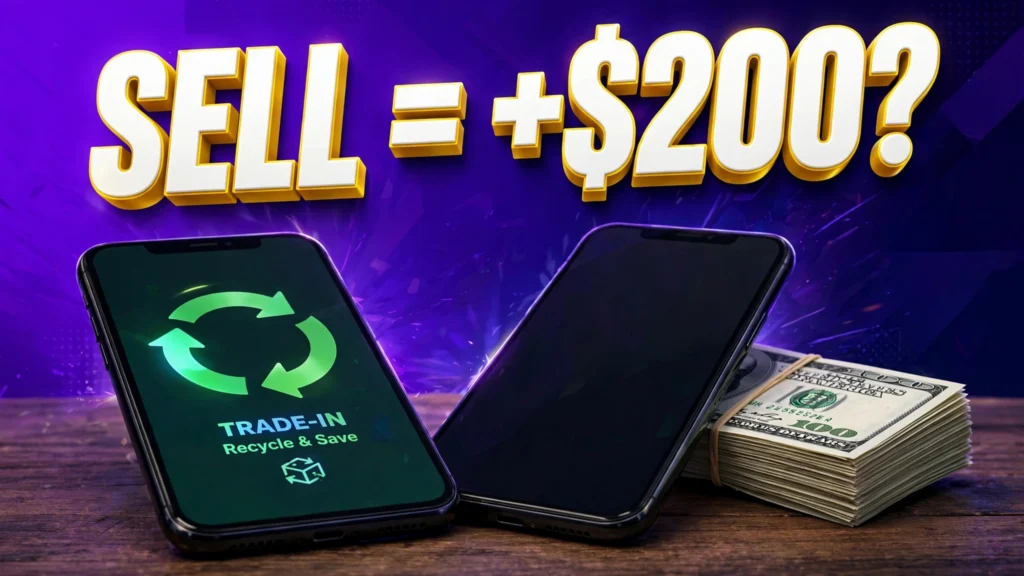
The Short Answer: Selling Privately Pays $100–$300+ More
On nearly every iPhone model, selling it yourself beats trading it in by $100 to $300+. Apple’s trade-in program and carrier offers are priced for convenience, not generosity. But “sell it privately” is not automatically the right answer — carrier bill-credit deals, your tolerance for hassle, and how fast you need the money all change the math. Here is the full 2026 breakdown of all three paths: Apple trade-in, carrier deal, and private sale.
Path 1: Apple Trade-In — Fastest, Lowest Payout
Apple’s trade-in gives you instant credit toward a new iPhone (or an Apple gift card), with values published on apple.com. Typical 2026 ballparks for phones in good condition:
| Model (good condition) | Apple trade-in credit | Private-sale value | Gap |
|---|---|---|---|
| iPhone 15 Pro / Pro Max | $400–$550 | $600–$800 | ~$200 |
| iPhone 15 / 15 Plus | $300–$400 | $450–$600 | ~$150–$200 |
| iPhone 14 series | $200–$330 | $350–$500 | ~$150 |
| iPhone 13 series | $150–$250 | $280–$400 | ~$130–$150 |
| iPhone 12 and older | $60–$150 | $120–$250 | ~$60–$100 |
Apple’s offer is take-it-or-leave-it and drops the moment a new model launches — trade-in values typically fall 10–20% in the weeks after a September launch event. If you are trading in, do it before the keynote, not after.
Path 2: Carrier “Up to $1,200” Deals — Read the Fine Print
Carriers advertise the biggest numbers — “get up to $800–$1,200 off with trade-in!” — but here is the catch most posts bury: the credit is paid as monthly bill credits spread over 24–36 months, and it vanishes if you leave the carrier or pay off the phone early. The real terms:
- It is a lock-in, not a discount. That “$1,000 off” is ~$28–$42/month shaved off your bill for 2–3 years. Switch carriers in month 14 and the remaining credits disappear — you owe the phone’s remaining balance.
- “Up to” does the heavy lifting. The headline number requires a recent Pro-model trade-in and a premium unlimited plan. Older phones and cheaper plans get far less.
- You usually must finance the new phone through the carrier at full retail price — no unlocked discount, no Apple Store promos.
- The math can still win if you were staying with that carrier anyway on a plan you already pay for. Then it is genuinely free money. If the deal requires upgrading to a $90/month plan from your $50 plan, the “$1,000 credit” costs you $960–$1,440 in plan inflation.
Path 3: Private Sale — Most Money, Most Hassle
Selling on Swappa, eBay, Facebook Marketplace, or a buyback service nets the most cash. Typical premiums over Apple trade-in: $100–$300+ depending on model and condition. The costs:
- Marketplace fees: eBay takes roughly 13%; Swappa charges a flat ~$15–$35 sale fee — much cheaper for expensive phones.
- Your time: photos, listings, buyer messages, and the occasional flake. Budget 1–3 hours total.
- Scam risk: use platforms with seller protection, never ship before payment clears, and meet local buyers in public places.
- Buyback services (ItsWorthMore, Decluttr-style buyers) split the difference — less than private sale, more than Apple, zero hassle, payment in days.
Rule of thumb: if the private-sale premium over trade-in exceeds $150, it is worth the hour of effort. Below that, the convenience of trade-in starts winning for most people.
The Decision Flowchart
- Staying with your carrier 24+ months on a qualifying plan? Take the carrier deal — it is usually the highest total value.
- Want an unlocked phone or switching carriers? Sell privately, buy the new iPhone outright (ideally with a rewards credit card for the purchase protection and points).
- Need it done in 10 minutes at the Apple Store? Take Apple’s trade-in and accept the $100–$300 convenience tax.
- Phone is damaged or very old? Compare Apple’s quote against buyback services — damaged phones often fetch more from specialist buyers than from Apple.
Timing: When to Sell for Maximum Value
iPhone resale values follow a predictable annual cycle. Values are highest in July–August, right before the September launch, and drop 10–20% in the month after new models ship. They then decay gradually until the next summer. If your upgrade timing is flexible, selling in August and buying in October (when launch-day demand cools and early deals appear) captures the spread on both ends. Never trade in during launch week — that is when your old phone is worth the least and the new one costs the most.
Before You Hand It Over: The Money-Safety Checklist
- Back up everything (iCloud or computer) and verify the backup before wiping.
- Sign out of iCloud / turn off Find My iPhone. An activation-locked phone is worth $0 to any buyer — Apple, carrier, or private.
- Unpair your Apple Watch and remove the device from your Apple ID.
- Factory reset (Settings → General → Transfer or Reset → Erase All Content).
- Remove the SIM / transfer your eSIM to the new phone first.
- Photograph the phone’s condition before shipping to any buyer — your evidence if a “not as described” dispute appears.
Skipping the iCloud sign-out is the single most expensive mistake in phone resale: buyers and trade-in programs reject locked phones outright, and you will be troubleshooting from your new phone while the old one sits in a drawer losing value.
What About Android Phones?
The same three-path logic applies to Samsung, Pixel, and other Android flagships — with one difference: Android resale values fall faster. A Galaxy S-series phone typically retains 40–50% of its value after a year versus ~60% for an iPhone, so the sell-vs-trade-in gap is smaller in dollars but larger in percentage terms. Samsung’s own trade-in promos (often inflated during Galaxy Unpacked events) can occasionally beat private sale — worth checking before you list. And carrier bill-credit lock-ins work identically regardless of brand: the 24–36 month trap does not care which logo is on the phone.
Frequently Asked Questions
Does Apple give cash for trade-ins?
Not directly — Apple applies trade-in value as instant credit toward a new purchase or an Apple gift card. If you want actual cash, sell privately or use a buyback service.
Is it better to trade in or sell to a carrier?
Carriers usually beat Apple’s trade-in values through bill-credit promotions, but the credits lock you in for 24–36 months. Compare the total cost of the plan over the lock-in period, not just the headline credit.
When is the best time to sell an iPhone?
July–August, just before Apple’s September launch event. Values drop 10–20% after new models are announced, so selling early in the cycle maximizes your return.
Should I fix a cracked screen before selling?
Usually yes if the repair is cheap relative to the value lift — a $100 third-party screen repair on a phone worth $400 more intact pays for itself. But get quotes first: on older models the repair can exceed the resale gain, in which case sell it as-is to a specialist buyer.
The Bottom Line
Selling your iPhone privately beats Apple’s trade-in by $100–$300+ on most models — the convenience tax is real. Carrier deals can beat both, but only if you were staying put for two-plus years anyway; otherwise the bill-credit lock-in eats the headline savings. Time your sale for July–August, sign out of iCloud before you hand anything over, and run the three-path math for your specific model. Do that and the difference between the best and worst option is often a free month of the new phone’s payments.