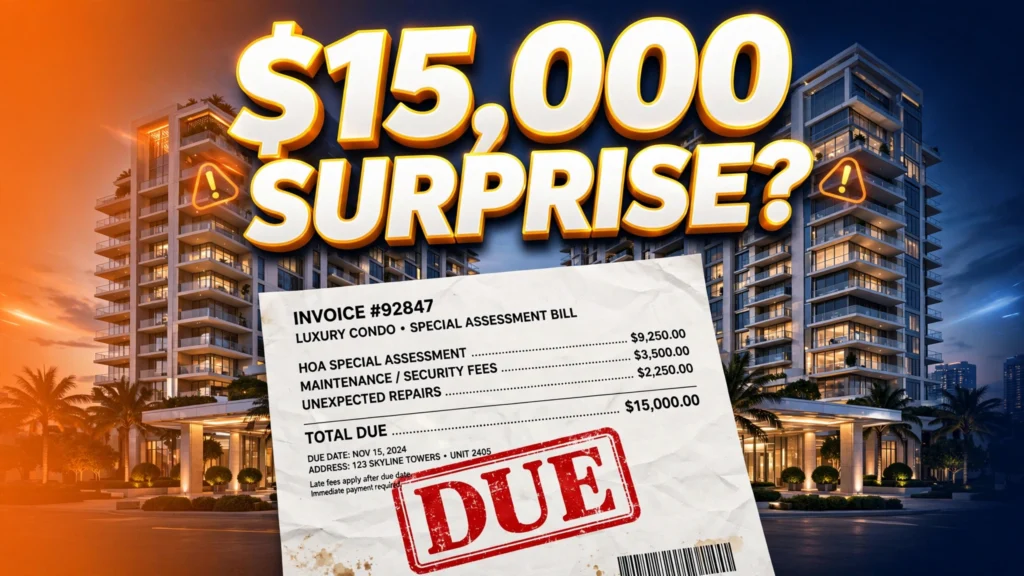
The Short Answer: A One-Time Levy on Top of Your Dues
Your HOA dues cover the predictable stuff — landscaping, insurance, management, routine maintenance. A special assessment is what happens when something big breaks that the reserves can’t cover: a new roof, elevator modernization, concrete restoration, repaving. The HOA board votes a one-time levy, divides it among the owners, and you get a bill — often $5,000 to $20,000, sometimes due within 30 to 60 days. It’s the largest surprise bill in homeownership, and most buyers never see it coming because they never looked for it.
Here’s what special assessments are, why underfunded reserves cause them, the Florida law that changed the game, and the due-diligence checklist that lets buyers spot the next one before closing.
What Special Assessments Actually Pay For
Special assessments fund capital projects — big, infrequent, expensive work that regular dues were supposed to be saving for but weren’t:
| Project | Typical building cost | Per-unit hit (100-unit building) |
|---|---|---|
| Roof replacement | $500,000–$2,000,000+ | $5,000–$20,000 |
| Elevator modernization | $150,000–$300,000 per cab | $3,000–$12,000 |
| Concrete/balcony restoration | $1,000,000–$5,000,000+ | $10,000–$50,000 |
| Repaving and garage work | $200,000–$800,000 | $2,000–$8,000 |
| Plumbing repipe (whole building) | $500,000–$1,500,000 | $5,000–$15,000 |
The math is brutal and simple: take the project cost, divide by the number of units (sometimes weighted by unit size). A $2 million roof on a 100-unit condo is $20,000 per door — due now, not over 30 years like a mortgage.
Why They Happen: The Underfunded-Reserve Trap
Healthy HOAs fund a reserve account — a savings account for future big repairs, sized by a professional reserve study that inventories every major component, its remaining life, and its replacement cost. Dues include a reserve contribution each month, so the roof money is sitting there when the roof dies.
The problem: boards hate raising dues. Keeping monthly fees artificially low wins board elections — until the roof actually dies and the reserve account holds a fraction of what’s needed. The industry rule of thumb: a reserve fund below 70% of the fully-funded level is a red flag; below 30% is a special assessment waiting to happen. When you see a condo with suspiciously low dues for its age and amenities, you’re often looking at a future special assessment wearing a disguise.
Florida’s 2025 Law Changed the Game
After the 2021 Surfside condo collapse, Florida passed milestone-inspection and reserve-funding reforms — and the full reserve funding requirements that took effect in 2025 are the most aggressive in the country. Florida condos three stories and higher must now complete milestone structural inspections and fully fund reserves for critical components — no more voting to waive reserves to keep dues low.
The result, widely reported through 2025: condo fees spiking as associations play catch-up, and a wave of special assessments as buildings fund decades of deferred maintenance at once. If you’re buying a Florida condo, the reserve question isn’t background research — it’s the central financial question of the purchase. Other states are watching Florida’s model, so expect similar pressure elsewhere in the coming years.
Can You Fight a Special Assessment?
Usually, no — not successfully. Here’s why:
- The board usually has the authority in the CC&Rs to levy assessments for maintenance and repairs without a full owner vote. Check your governing documents — the power is almost always there.
- Voting thresholds, where required, are often low — sometimes just a board majority. Owner votes to reject an assessment typically need a supermajority that’s hard to organize.
- Non-payment has teeth: the HOA can place a lien on your unit and, in many states, foreclose on that lien. Ignoring the bill risks the home itself.
- What you CAN negotiate: payment plans (many HOAs offer 6–24 month installments), the project scope and bidding (attend meetings, demand competitive bids), and timing. Organized owners get better terms than angry individuals.
The realistic play isn’t fighting the assessment — it’s making sure the money is spent competently and the payment terms are survivable.
Buyer Due-Diligence Checklist: Spot the Next One Before Closing
- Request the resale package early — budget, financials, meeting minutes (last 12 months), insurance, CC&Rs, and the reserve study. In many states the seller must provide this; get it during the inspection period, not after.
- Read the reserve study’s funding level. Under 70% funded = yellow flag. Under 30% = assume an assessment is coming and price it into your offer.
- Scan meeting minutes for project talk. Roof discussions, engineer reports, “deferred maintenance,” special-assessment votes — minutes reveal what the glossy listing hides.
- Ask directly: “Are any special assessments pending, planned, or under discussion?” Get the answer in writing from the HOA or management company.
- Check the building’s age and big-ticket timeline. A 25-year-old building with an original roof and thin reserves is a textbook setup.
- Verify insurance adequacy — underinsured buildings convert storm damage into special assessments.
- Factor it into affordability: a $400/month HOA due plus a looming $15,000 assessment changes the true cost of the home. Lenders don’t count the assessment in your DTI, but your budget should.
Do Renters Have to Worry About This?
Legally, no — special assessments are levied on owners, not tenants. Practically, maybe: landlords facing a $15,000 assessment often raise rents at renewal to recover it, and buildings mid-assessment sometimes defer maintenance or amenities during the project. If you’re renting in an HOA community, it’s worth asking the landlord whether any assessments are pending — not because you’ll pay it, but because it signals the building’s financial health.
Frequently Asked Questions
How much notice does an HOA have to give before a special assessment?
It depends on your state’s laws and the CC&Rs, but 30 days’ written notice is typical — sometimes less for emergencies. This isn’t like a tax bill with a year of warnings; it can arrive fast.
Can I pay a special assessment in installments?
Often, yes. Many HOAs offer payment plans of 6 to 24 months, sometimes with modest interest. Ask before the due date — boards are far more flexible with owners who engage early than with owners who simply don’t pay.
Are special assessments tax-deductible?
For a primary residence, generally no — it’s considered a personal expense, though it may add to your cost basis when you sell (reducing capital gains). For rental property, assessments for repairs are typically deductible as rental expenses. Tax rules are fact-specific; confirm with a tax professional.
What happens if I can’t pay?
The HOA can charge late fees and interest, place a lien on your unit, and in many states foreclose on that lien — sometimes even ahead of your mortgage in lien priority for a portion of the debt. If you genuinely can’t pay, negotiate a payment plan immediately; silence is the worst option.
Do special assessments affect my home’s value?
Indirectly, yes. Buildings known for frequent assessments sell at a discount — buyers price in the risk. Conversely, a building that just completed a major project (new roof, new elevators) with healthy reserves can command a premium. It’s all in the resale package.
The Bottom Line
Special assessments are $5,000–$20,000 surprise bills that land when reserves can’t cover big repairs — and they’re almost entirely predictable if you read the reserve study. The 70%-funded red flag, the meeting minutes, and one direct written question to the HOA will tell you more about a condo’s true cost than the listing price ever will. Budget for the building, not just the unit.