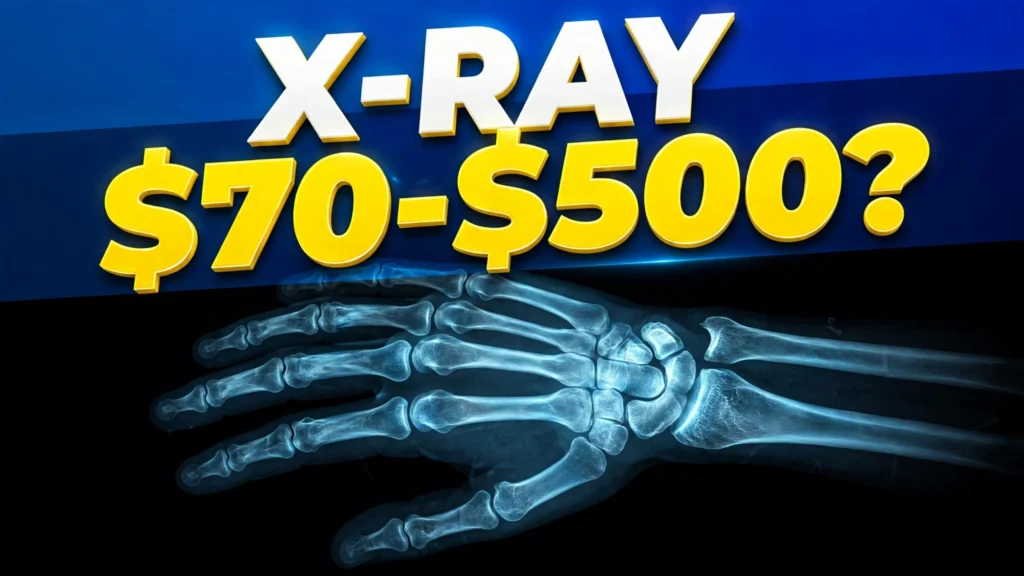
The Short Answer: $70 to $500+ — Location Decides
An X-ray without insurance typically costs $70–$250 at an independent imaging center, $100–$350 at urgent care (plus the visit fee), and $400–$1,000+ at a hospital or ER for the identical image. X-rays are the cheapest imaging test in medicine — but the facility you walk into can still multiply your bill several times over. For a non-emergency X-ray, the cheapest option is almost always a freestanding imaging center with a doctor’s order in hand.
X-Ray Cost by Type (Self-Pay, Without Insurance)
| X-ray type | Independent imaging center | Urgent care (X-ray only) | Hospital / ER |
|---|---|---|---|
| Chest (2-view) | $70–$150 | $100–$200 + visit fee | $400+ |
| Ankle / foot | $150–$300 | $175–$350 | $250–$500+ |
| Wrist / hand | $70–$200 | $100–$250 | $300–$600+ |
| Spine (single region) | $150–$300 | $150–$300 | $400–$800+ |
| Dental (panoramic) | $100–$250 | n/a | n/a |
These ranges cover the X-ray itself (technical fee + radiologist reading). At urgent care and the ER, the facility/visit fee is billed on top — which is where the real money goes.
The Facility Ladder: Same Image, Very Different Bill
| Setting | X-ray cost | Visit / facility fee | Typical total |
|---|---|---|---|
| Independent imaging center | $70–$250 | $0 (referral required) | $70–$250 |
| Primary care doctor | $75–$200 | $100–$200 | $175–$400 |
| Urgent care | $100–$350 | $80–$200 | $180–$550 |
| Emergency room | $400–$1,000+ | $500–$2,000+ | $900–$3,000+ |
The ER is 5–10× the price of urgent care for the same non-life-threatening injury. Go to the ER for severe symptoms, uncontrolled bleeding, or a suspected life-threatening problem — not for a sprained ankle that needs an X-ray.
Why Hospital X-Rays Cost So Much More
Hospitals charge facility fees that independent centers do not. A hospital’s price also reflects 24/7 staffing, emergency capability, and administrative overhead — none of which changes the quality of a routine X-ray. Research presented at the American College of Radiology found the average hospital price for a standard X-ray was $140 versus $76 at an imaging center — and that gap widens sharply for ER visits, where facility fees dominate the bill.
How to Pay Less: Cash-Pay Tactics
- Get a referral and go to an imaging center. If your condition is stable, ask your doctor for a written order and book a freestanding imaging center. It is the cheapest option by a wide margin.
- Ask for the all-in self-pay price. Confirm the quote includes the radiologist’s reading. Ask: “What is the total if I pay cash today?”
- Ask for the cash discount. Urgent care centers typically offer 15–40% off for self-pay patients who pay at time of service. Imaging centers routinely discount too. You must ask — the discount is rarely volunteered.
- Watch for add-ons. At urgent care, the visit fee covers the provider seeing you; the X-ray is billed separately on top. Ask for the all-in price for your specific need, not just the base fee.
- Beware the outside lab trap. If a sample or image is sent to an outside company, that company bills you separately — sometimes weeks later. Ask whether everything is done in-house.
- Use FQHCs and retail clinics where they fit. Federally Qualified Health Centers offer sliding-scale fees based on income; retail clinics are cheap for basic needs (though most do not do X-rays).
When the ER Is the Right Call Anyway
Cost should never override safety. Go to the ER if you have: a suspected fracture with visible deformity or bone through skin, uncontrolled bleeding, signs of a stroke or heart attack, severe head injury, or difficulty breathing. For everything else — a suspected simple fracture, a sprain, a persistent cough — urgent care or an imaging center is the financially sane choice.
Dental X-Rays: The One Exception to “Go to an Imaging Center”
Dental X-rays are the one category where the imaging center advice does not apply — your dentist’s office is the right place. A panoramic dental X-ray typically costs $100–$250 without insurance, and bitewing X-rays (the small ones during a cleaning) run $25–$75 each. Many dental offices bundle bitewings into the exam fee. If you need a dental crown, the X-rays are part of that treatment plan — ask whether they are included in the crown quote or billed separately.
What If You Need Multiple X-Rays?
Costs add up per image, not per visit. A spine series (3–5 views) costs more than a single wrist X-ray. Before you agree to a full series, ask: how many views are medically necessary, and what is the all-in price for the series? For follow-up X-rays (checking that a fracture is healing), ask whether fewer views would answer the question — doctors will often reduce the series if you ask.
Frequently Asked Questions
Do I need a referral for an X-ray at an imaging center?
Yes, in most cases. Imaging centers require a provider’s order. Your primary care doctor, urgent care, or specialist can provide one. The order also fixes the CPT code, which is what lets you compare prices apples-to-apples across facilities.
How much radiation is an X-ray?
Very little. A chest X-ray delivers roughly the radiation of a few days of natural background exposure. Dental X-rays are lower still. The dose is not a reason to skip a medically necessary X-ray.
Can I get my X-ray images on a disc or portal?
Yes — and you should. Having your images avoids paying for a repeat X-ray if you see a second doctor or a specialist. Ask for a copy (or portal access) before you leave.
What if I get billed separately for the reading?
That is normal — the “technical” fee (taking the image) and the “professional” fee (the radiologist’s interpretation) are often billed separately. The key is that your all-in quote should include both. If the reading arrives as a surprise bill, call and ask for it to be adjusted to the quoted total.
X-Ray vs. CT vs. MRI: When Each Makes Sense
X-rays are the cheapest and fastest imaging test, but they show the least detail. They are best for bones — fractures, joint problems, chest screening. A CT scan (roughly $300–$6,000+ without insurance) gives detailed cross-sectional images and is better for internal injuries, strokes, and abdominal problems, but it costs far more and uses more radiation. An MRI (roughly $400–$3,500+ without insurance) gives the most detailed soft-tissue images with no radiation, but it is the most expensive and slowest option. Your doctor picks the test that answers the question — but if cost matters, it is fair to ask: “Would a plain X-ray answer this, or do we need the CT/MRI?” Sometimes the answer is genuinely yes, the advanced scan is needed. Sometimes the X-ray is enough, and you just saved $1,000.
How to Read Your X-Ray Bill
An X-ray bill usually has two or three lines. Understanding them helps you spot errors:
- Technical component: the cost of taking the image (equipment, technician). This is the facility’s charge.
- Professional component: the radiologist’s fee for interpreting the image and writing the report. Often billed by a separate radiology group.
- Facility fee (hospital/ER only): the charge for using the facility. This is the line that turns a $140 X-ray into a $900 ER bill.
Common billing errors: being charged for more views than were taken, duplicate charges for the same image, and a facility fee from a freestanding center that should not charge one. Always request an itemized bill and compare it against the number of images actually taken.
The Bottom Line
An X-ray is a $70 test at an imaging center and a $900+ bill at the ER. For any non-emergency X-ray, get a referral, book an independent imaging center, and ask for the cash price before you go. The image is the same. The bill is not.