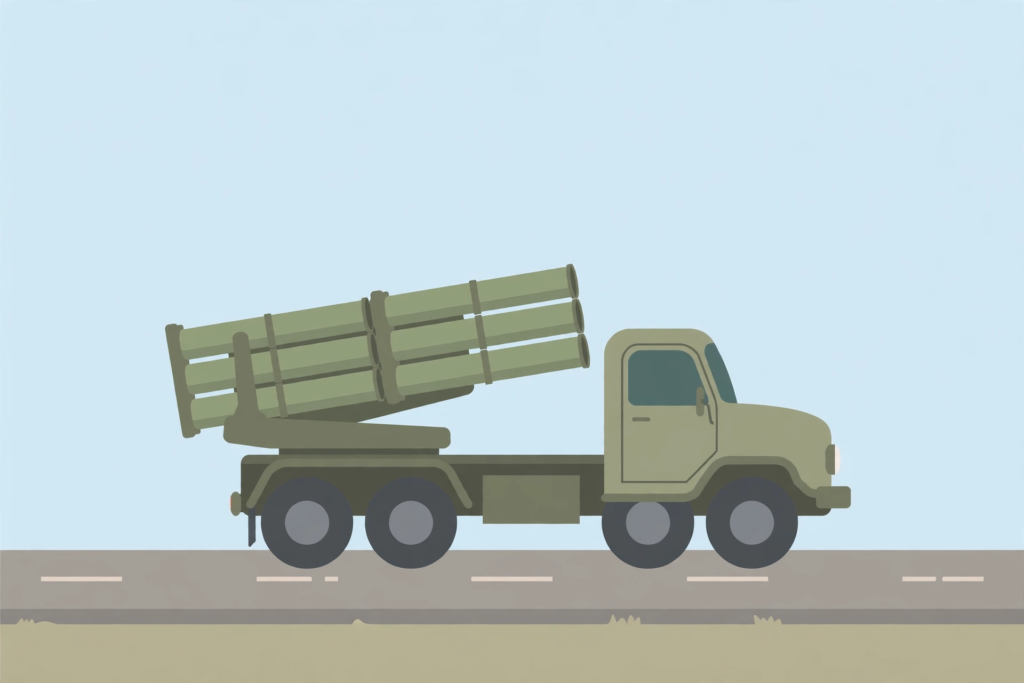
You keep seeing the name HIMARS in headlines, usually next to a claim about long-range strikes, and the article never stops to explain what the system actually is. Is it a missile? A truck? A rocket? The confusion is understandable, because HIMARS is none of those things on its own. It is a launcher, and what it can do depends entirely on what is loaded into it.
That distinction clears up most of the misleading headlines. A report that says HIMARS can strike 300 kilometres away is really talking about one specific missile load. A report that says it carries six rockets is talking about a different load. Once you know the vehicle, the pod, and the munitions, the rest of the story falls into place.
Quick Answer
HIMARS is the M142 High Mobility Artillery Rocket System, a wheeled truck-mounted launcher that carries one pod holding six guided rockets, one larger missile, or two newer missiles. Its firing range runs from about 92 kilometres with standard rockets to about 300 kilometres or more with missiles, depending on the load.
What Is HIMARS?
HIMARS, formally known as the M142 High Mobility Artillery Rocket System, is a light multiple rocket launcher developed for the United States Army. In simple terms, a multiple rocket launcher is a vehicle that can fire several rockets in quick succession from a single mounting. HIMARS takes that idea and puts it on a wheeled truck chassis, which is the key to understanding why it is different from many older artillery systems.
The vehicle is based on a standard military truck frame, the Family of Medium Tactical Vehicles, often shortened to FMTV. On the back of that truck sits a launcher that holds a single sealed pod. That pod is the heart of the system. Depending on the mission and the pod fitted, it can contain six guided rockets or one larger missile. The crew can therefore change the kind of firepower the vehicle carries by changing the pod, rather than by changing the vehicle itself.
HIMARS is mainly associated with guided rockets and missiles that use satellite navigation and inertial guidance to steer toward a set of coordinates. Guidance can be affected by weather, terrain, jamming, and other battlefield conditions, but the system is discussed as a tool for striking specific targets at long range rather than simply saturating a large area.
Key Points: How HIMARS Works in Plain English
At its simplest, HIMARS works like this: a wheeled launcher carries a pod of rockets or a missile to a firing location, raises the launcher, fires, and then can move again. Its value comes from combining a road-mobile truck, a standard pod, and guided munitions that reach far beyond most traditional artillery.
The launcher is operated by a small crew, publicly reported as three people: a driver, a gunner, and a section chief. The cab is armoured, and the vehicle is designed to be transportable by aircraft, including the C-130, which is one reason armies value it for rapid deployment. Fire control is handled through the vehicle computer systems, which manage the launcher and the munitions in the pod. This guide stays at that general level, since detailed crew procedures are not needed to understand what HIMARS is or why it matters.
Reloading means swapping an empty sealed pod for a full one, rather than loading individual rockets into open tubes. That pod design is shared with the larger tracked M270 Multiple Launch Rocket System, so both systems can use the same family of munitions, even though HIMARS carries only one pod while the M270 carries two.
What HIMARS Fires
The most important thing to understand about HIMARS is that it is a launcher, not a single weapon. Its range, its effect, and its cost all depend on what is loaded into its one pod. The main publicly known options are described below.
Guided Multiple Launch Rocket System rockets
The standard load is six Guided Multiple Launch Rocket System rockets, usually shortened to GMLRS. These are 227 millimetre rockets with guidance systems that help them fly toward a programmed target. Publicly reported ranges for standard GMLRS rockets are up to about 92 kilometres, although the effective range depends on the exact variant, the firing conditions, and the target location. These rockets are the workhorse load for HIMARS, and they are the munition most often meant when news reports talk about HIMARS rockets in general terms.
Extended Range GMLRS
A newer extended-range version, known as ER GMLRS, is publicly reported to reach about 150 kilometres. It uses the same six-rocket pod arrangement, but with a larger motor and other changes that extend its reach. As with all range figures, that is a publicly reported maximum, not a guarantee for every shot.
Army Tactical Missile System missiles
Instead of six rockets, a HIMARS pod can carry a single Army Tactical Missile System missile, usually shortened to ATACMS. This is a larger tactical ballistic missile, and publicly reported ranges for ATACMS variants reach up to about 300 kilometres. ATACMS gives HIMARS a much longer reach than its rocket loads, and it is the option that most often draws attention when longer-range strikes are discussed. Because only one missile fits in a pod, a launcher carrying ATACMS trades volume of fire for distance.
Precision Strike Missile
The Precision Strike Missile, usually shortened to PrSM, is a newer missile designed as a successor to ATACMS. A HIMARS pod can carry two PrSM missiles, offering longer range than GMLRS while still carrying more than one round per pod. Publicly reported ranges for PrSM are often given as up to about 499 kilometres, although figures for future variants should be treated with care, since specifications can change during testing and production.
HIMARS Specifications in Plain English
Public specifications for HIMARS vary slightly between sources, because different publications report the vehicle at different weights and configurations, and because the system has been produced over many years. The figures below are the widely reported ones, and they should be read as approximate public specifications rather than exact measurements for every vehicle in service.
The launcher is about 7 metres long, about 2.4 metres wide, and about 3.2 metres high. Its combat weight is publicly reported at about 16.25 tonnes, while some sources give a gross vehicle weight of about 13.5 tonnes, reflecting different ways of measuring the vehicle with and without its pod, fuel, and crew.
On the road, HIMARS is publicly reported to reach a top speed of about 85 kilometres per hour, with some sources giving up to about 94 kilometres per hour. Its driving range, meaning how far the truck itself can travel on its fuel, is publicly reported at about 480 kilometres. That is different from its firing range, which describes how far its rockets or missiles travel after launch.
The engine is a diesel unit, publicly reported at about 290 to 330 horsepower depending on the source and production batch. The broad picture is consistent: HIMARS is a medium truck with enough power to move quickly on roads and carry a heavy launcher and pod, even though it is not a tracked vehicle built for the roughest terrain. The crew is three people, and the rocket calibre is 227 millimetres for GMLRS rockets. The launcher can fire its six rockets individually, in pairs, in groups of four, or all six, depending on the mission.
Why Mobility Matters So Much
The word mobility is in the name of the system for a reason. In modern artillery, being able to move quickly is often as important as being able to fire far. A launcher that stays in one place after firing can be located by enemy sensors, radar, and drones, and can then be targeted in return. A launcher that can fire and then move to a new location is much harder to find and hit. Military writers often use the phrase shoot and scoot for this general idea, meaning fire and then relocate promptly.
Wheels are central to that mobility. A wheeled truck can travel on ordinary roads at highway speeds and move long distances without the heavy transporters that tracked vehicles often need. That makes HIMARS easier to deploy quickly and to support with ordinary truck maintenance and spare parts.
Air transport is another part of the mobility story. Because HIMARS is lighter and smaller than heavier tracked launchers, it can be carried by transport aircraft such as the C-130, flown into a region, and driven to a firing position far more quickly than a system that must travel by ship or heavy road transporter.
Mobility also affects logistics. A system based on a standard truck frame shares parts, fuel, and maintenance skills with other trucks in an army fleet, making it easier to keep running and repair than a unique vehicle with its own supply chain.
HIMARS Compared With Traditional Artillery
Traditional artillery usually means tube artillery: cannons and howitzers that fire shells from a barrel. These guns have been the backbone of armies for centuries, and they remain important today. Comparing HIMARS with traditional artillery helps explain what rocket artillery adds, and what it does not replace.
Range is the most obvious difference. A typical towed or self-propelled howitzer fires shells over distances measured in tens of kilometres, with longer-range shells and rocket-assisted projectiles extending that reach. HIMARS, by contrast, fires guided rockets to about 92 kilometres in its standard form, and missiles to about 300 kilometres or more. That longer reach lets HIMARS strike targets far behind the front line, such as supply depots, command posts, and air defence systems, that would be out of reach for most guns.
Accuracy is another difference. Modern guided artillery shells can also be very accurate, but HIMARS was designed around guided rockets and missiles from the start, with satellite and inertial guidance built into its standard munitions.
Volume and cost are where traditional artillery still has advantages. A gun can fire many shells relatively cheaply, while HIMARS carries only six rockets or one or two missiles per pod, and each guided round is far more expensive than a standard shell. HIMARS is therefore best understood as a complement to traditional artillery, not a replacement for it.
HIMARS Compared With Heavier Tracked Systems
The closest relative of HIMARS is the M270 Multiple Launch Rocket System, a tracked launcher that uses the same family of rockets and missiles. Comparing the two shows the trade-offs that designers make when they choose wheels over tracks, and a smaller vehicle over a larger one.
The M270 is a tracked, armoured vehicle that carries two pods instead of one, so it can carry twelve GMLRS rockets or two ATACMS missiles, compared with six rockets or one missile for HIMARS. In a single firing position, the M270 can therefore deliver twice the firepower before it needs to reload.
HIMARS, on the other hand, is lighter, faster on roads, and easier to transport by air. Tracked vehicles have advantages off road, since tracks spread weight over a larger area and can cross soft, muddy, or broken ground that might stop a wheeled truck.
Cost and fleet size are also part of the comparison. Because HIMARS is based on a standard truck, it is generally cheaper to buy and operate than a large tracked system, so armies can often afford more launchers spread across a wider area. That is why many armies operate both types.
In short, neither system is simply better than the other. The choice depends on the terrain, the road network, the transport available, the budget, and the kind of missions an army expects to carry out. HIMARS wins on mobility and deployability. The M270 wins on firepower per vehicle and off-road performance.
Worked Example: Reading a HIMARS Headline With the Pod in Mind
This is an illustrative example, using only the publicly reported figures given above, to show how one vehicle produces very different headlines depending on its load.
Take three HIMARS launchers, each carrying one pod. Loaded with standard GMLRS, the three vehicles together carry 18 rockets, each with a publicly reported maximum range of about 92 kilometres. Loaded with ATACMS instead, the same three vehicles carry only 3 missiles, but each reaches up to about 300 kilometres. Loaded with PrSM, they carry 6 missiles, with publicly reported ranges up to about 499 kilometres. The vehicles have not changed. Only the pods have.
Now compare that with three M270 launchers. Each M270 carries two pods, so three vehicles loaded with GMLRS carry 36 rockets, double the HIMARS total, before reloading. The trade is clear in the numbers: HIMARS gives up half the firepower per vehicle in exchange for a lighter, road-mobile, air-transportable truck. A headline that quotes a range without naming the munition, or a cost without saying what the package includes, is missing the part that decides what the number means.
Why HIMARS Appears in the News
HIMARS appears in the news for several reasons, and understanding those reasons helps readers separate the system itself from the headlines around it. First, it is a high-profile system supplied to allied countries, so decisions to provide it, to fund it, or to expand its production are newsworthy in themselves. Defence budgets, arms exports, and military aid packages are all topics that regularly bring HIMARS into public discussion. Government decisions of this kind sit within a wider legal and institutional framework, as explained in the Factaxy guide to the rule of law definition.
Second, HIMARS is often mentioned in coverage of conflicts where long-range precision fire matters. When strikes hit supply lines, depots, or command facilities far from the front line, analysts often ask which systems could reach those targets, and HIMARS is one of the best-known systems with that kind of range, even when the specific system used is not publicly confirmed.
Third, HIMARS is a useful shorthand for a broader change in artillery. A launcher that can strike far behind the front line changes how armies think about supply, because depots and routes once considered safe may now be within range.
Finally, HIMARS is a visible symbol of military support. Photographs of a distinctive wheeled launcher are easy to recognise, and that visibility can sometimes exaggerate its importance, since traditional artillery, drones, and aircraft also play major roles.
How Much Does HIMARS Cost?
Costs for HIMARS are often misunderstood, because headline figures for arms deals usually include far more than the launcher itself. A typical package can include launchers, rockets and missiles, training, spare parts, maintenance support, communications equipment, and transport. Dividing the total package price by the number of launchers therefore gives a misleading figure for the cost of one vehicle.
Public reporting has given an older unit cost figure for the launcher and its associated ammunition of about 5.1 million dollars, reported in 2014. That figure is now dated, and it should be treated as a historical estimate rather than a current price. Inflation, production changes, and different package contents all mean that a current launcher price would be higher, but no single, consistently reported current price exists in public sources. Any article that gives one exact current price for HIMARS without explaining what is included should be read with caution. The same caution applies to large government-funded programs in general: a headline total rarely equals the price of one item, as readers of the Factaxy guide to student loans in the USA will recognize from federal program reporting, and as the Factaxy guide to how to apply for a work permit in the USA shows for government application processes.
The cost of the munitions is a separate question, and it also varies widely. Guided rockets and missiles are far more expensive than standard artillery shells, because they contain guidance systems, motors, and other complex components. Public estimates for guided rockets and missiles vary a lot depending on the variant, the production batch, and whether the figure includes development costs, support, or only the unit price. For that reason, this guide does not present a single rocket price as fact. The safe summary is that HIMARS firepower is expensive per round, which is why armies use it selectively for targets where range and precision justify the cost, rather than for routine, high-volume fire.
The total cost of operating HIMARS also includes training, maintenance, pod storage and transport, and fire control upgrades over time, all of which rarely appear in headlines.
Who Uses HIMARS?
HIMARS was developed for the United States Army and Marine Corps, and it remains a central part of United States artillery forces. Over time, it has also been exported to a number of allied and partner countries, and public reporting indicates that it is now operated by armies in several regions around the world. The exact number of operators changes as new export deals are agreed and delivered, so any list of operators in a general guide can quickly become out of date.
What is more useful is why different countries choose HIMARS. Some value its mobility and air transportability, others value its compatibility with the M270 family of munitions, and others value its precision, which can reduce the number of rounds needed to strike a specific target compared with older unguided rockets.
Common Mistakes and Misconceptions
One common misconception is that HIMARS can fire unlimited rockets without reloading. In reality, a HIMARS vehicle carries only one pod, so it must reload after firing six rockets or one or two missiles, and sustained fire depends on a supply of fresh pods.
Another misconception is that guided rockets always hit their target. Guidance improves accuracy greatly, but it does not guarantee a hit: jamming, satellite navigation interference, weather, target movement, and errors in target location can all affect accuracy.
A third misconception is that HIMARS is invulnerable because it can move quickly. Mobility reduces risk, but it does not remove it: launchers can still be detected by drones, satellites, and radar, and protection also depends on air defence, camouflage, and dispersal.
Finally, HIMARS does not operate alone. Artillery works as part of a larger system that includes surveillance, target location, communications, logistics, and command, and a launcher without accurate target information or a supply of pods is far less effective. A related reader mistake is treating a headline range or price as a fixed fact. Always check which munition the range refers to, and what a quoted price includes.
Pros and Cons of the HIMARS Design
Pros
- Road mobility and air transportability allow faster deployment than heavier tracked launchers.
- One pod system supports several munition types, from standard rockets to longer-range missiles.
- Guided munitions allow specific targets to be struck at long range with fewer rounds than unguided fire.
- A standard truck chassis simplifies maintenance, parts, and fuel logistics.
Cons
- One pod per vehicle means half the firepower of a two-pod M270 before reloading.
- Wheels give up some off-road performance compared with tracks on soft or broken ground.
- Each guided round is far more expensive than a standard artillery shell.
- Guidance can be degraded by jamming, weather, and errors in target location.
- Mobility reduces risk but does not make a launcher invulnerable to detection.
Frequently Asked Questions About HIMARS
What does HIMARS stand for?
HIMARS stands for High Mobility Artillery Rocket System. The formal designation is M142 HIMARS. The name highlights the two ideas at the centre of the design: it is an artillery rocket system, and it is built for high mobility on wheels.
How far can HIMARS fire?
The answer depends on the munition loaded. Standard GMLRS rockets are publicly reported to reach up to about 92 kilometres. Extended-range GMLRS rockets are reported to reach about 150 kilometres. ATACMS missiles are reported to reach up to about 300 kilometres. The newer Precision Strike Missile is reported to reach up to about 499 kilometres. Those are publicly reported maximum ranges, not guaranteed ranges for every firing.
How many rockets does HIMARS carry?
HIMARS carries one pod at a time. That pod can hold six GMLRS or ER GMLRS rockets, one ATACMS missile, or two Precision Strike Missiles. The larger tracked M270 launcher carries two pods, which is why it can carry twice as many rockets or missiles in a single load.
Is HIMARS a missile or a rocket launcher?
HIMARS is a launcher. It is a vehicle that launches rockets and missiles, rather than a single rocket or missile itself. That distinction matters because the range and effect of HIMARS fire depend on which pod is loaded, not only on the vehicle.
Why is HIMARS wheeled instead of tracked?
Wheels give HIMARS speed on roads, easier air transport, and simpler logistics based on a standard truck. Tracks give heavier launchers better off-road performance and more firepower per vehicle, but at the cost of weight, transport difficulty, and maintenance. HIMARS trades some off-road ability and firepower for mobility and deployability.
Sources
Closing
HIMARS is best understood as a mobile, precision rocket and missile launcher mounted on a wheeled truck. Its single pod can carry six guided rockets, one larger missile, or two newer Precision Strike Missiles, with publicly reported firing ranges from about 92 kilometres to about 300 kilometres or more. Its road speed, driving range, and air transportability explain why armies value it for rapid deployment.
Compared with traditional artillery, HIMARS offers longer range and guided precision, but at higher cost per round and with less volume of fire. Compared with heavier tracked launchers, it offers better mobility and transportability, but less firepower per vehicle. For general readers, the most useful way to think about HIMARS is not as a single wonder weapon, but as one part of a modern artillery system where mobility, precision, and logistics matter together. Understood in those terms, HIMARS is less mysterious than its headlines suggest, and more interesting: a truck-based launcher whose real strength is not just how far it can fire, but how quickly it can move, reload, and fire again from somewhere new.