Drone warfare has quietly become one of the most important developments in recent conflict. A generation ago, military aircraft almost always carried a pilot. Today, unmanned aircraft watch battlefields for hours, guide artillery fire, carry sensors across long distances, and in some cases strike targets themselves. The change has not replaced every other kind of military power, but it has changed how armies see, how they strike, and how much risk they are willing to take.
This guide explains drone warfare in plain language. It covers what the term means, how military drones work, the main types of drones and their roles, why low-cost drones matter against expensive defences, what defences exist against them, and what may come next. No specialist knowledge is needed. The goal is a clear picture of a subject that is often described in dramatic headlines but rarely explained step by step. This is a descriptive explainer only: it does not give instructions for building, modifying, or operating any weapon, and it does not offer tactical advice.
Quick answer
Drone warfare is the use of unmanned aircraft, plus their operators, sensors, and data links, for military tasks. Most drone flights are surveillance, not strikes. Small cheap drones matter because they give armies persistent eyes over a battlefield at a cost far below traditional air power.
What is drone warfare?
Drone warfare is the use of unmanned aerial vehicles, commonly called drones, in military operations. The aircraft are controlled remotely by an operator, follow a preprogrammed route, or combine both methods. Some drones are small enough to be carried in a backpack. Others are as large as a small passenger aircraft and can stay airborne for more than a day.
The term covers much more than armed strikes. In fact, most military drone flights are not attacks at all. They are surveillance missions, communications relays, target spotting, damage assessment, and logistics support. A drone may watch a road for movement, map terrain, check whether a bridge is still standing, or help find people after a disaster. When people talk about drone warfare, they are usually talking about this whole system: the aircraft, the operators, the sensors, the data links, and the commanders who decide what to do with the information.
It helps to separate three ideas that are often mixed together. The first is the drone itself, the flying machine. The second is the payload, meaning the cameras, sensors, radios, or weapons it carries. The third is the wider system around it, including ground stations, satellite links, maintenance crews, and analysts who study the video feed. A drone without trained operators and a reliable data link is of limited use. A strong drone program is really a strong system, not just a strong aircraft.
How drone warfare changed the battlefield
To understand the impact of drone warfare, it helps to start with an old problem in war: seeing the enemy. For centuries, commanders struggled with limited information. Scouts and patrols could report what they saw, but their view was narrow and often out of date by the time a decision was made. Aircraft improved this in the twentieth century, but piloted reconnaissance flights were expensive, risky, and limited by fuel and pilot fatigue.
Drones changed that equation in several ways. First, they made persistent surveillance practical. A drone can circle over an area for hours, sending back live video the whole time. Commanders no longer need to guess what happened between two brief flyovers. They can watch patterns develop: vehicles moving at night, supply trucks using the same route, or troops gathering near a position.
Second, drones shortened the time between seeing a target and acting on it. In older systems, a scout might report a target, the report might travel up a chain of command, and artillery or aircraft might be sent hours later, by which time the target had moved. With a drone overhead, an operator can pass coordinates quickly, and in some systems the same drone can strike the target itself. That speed matters, because many targets are mobile and visible only for a short time.
Third, drones reduced the risk to pilots. Sending a piloted aircraft over defended territory risks the pilot as well as the aircraft. A drone mission risks the machine and, in some cases, the data link, but not a life in the cockpit. That lower human risk has made commanders more willing to fly missions over dangerous areas, and it has changed political calculations too, since the loss of a drone does not carry the same human cost as the loss of a pilot.
Fourth, drones lowered the cost of air power. A fighter jet program involves enormous development, purchase, training, and maintenance costs. A fleet of smaller drones can be built, bought, and operated for far less, even allowing for ground stations and support crews. This does not mean drones replace fighter jets. Jets are faster, carry heavier loads, and can survive in heavily defended airspace in ways most drones cannot. It does mean that air surveillance and light strike capability are no longer reserved for the wealthiest air forces.
Drone warfare and reconnaissance
Reconnaissance, meaning the gathering of information about an enemy or an area, is the oldest and still the most common military use of drones. A reconnaissance drone carries cameras and other sensors. Some use daylight video. Others use infrared cameras that detect heat, which helps at night or through smoke and light foliage. Some carry radar or signals sensors that can detect vehicles, communications, or movement from a distance.
The value of reconnaissance drones is not only in the pictures they take. It is in what those pictures allow an army to do. A drone can confirm whether a reported enemy position is real or a decoy. It can watch a supply route and reveal the times when convoys move. It can check the result of an artillery strike and show whether a second strike is needed. It can also reduce friendly casualties by warning troops about an ambush ahead or a road that has been blocked.
Reconnaissance drones also support other weapons. Artillery, for example, becomes far more accurate when a drone spots the target and adjusts fire in real time. Without that correction, artillery fire relies on maps, estimates, and earlier reports, which can be wrong. With a drone overhead, gunners can see where shells land and correct their aim. This partnership between drones and artillery is one of the most important developments in recent conflicts, and it explains why drones are valuable even when they carry no weapons at all.
Drone warfare and precision strikes
When most people hear the phrase drone warfare, they picture an armed drone striking a target. Armed drones do exist, and they have become an important tool, but their role is more specific than headlines sometimes suggest. A precision strike means attacking a particular target while trying to limit damage to everything around it. Drones can help with this because they can loiter, meaning they stay over an area and wait for the right moment, and because their sensors allow operators to study a target before deciding to strike.
Armed drones generally fall into two broad groups. The first group is made up of larger, reusable aircraft that carry guided weapons and return to base after a mission. These drones can fly long distances, stay airborne for many hours, and strike targets far from their launch point. They are often used against fixed positions, vehicles, and high-value targets where the operator has time to confirm the target. The second group is made up of loitering munitions, sometimes called kamikaze drones. These are smaller, single-use systems that fly to an area, search for a target, and then strike it by flying into it. Unlike a reusable drone, a loitering munition is destroyed in the attack. Their advantage is simplicity and lower cost. They can be launched by small teams, they can wait over a battlefield, and they can hit targets that appear suddenly, such as a vehicle moving into view.
Types of military drones and their roles
Military drones come in many shapes and sizes, and it is more useful to group them by role and range than by appearance alone. The categories below are general descriptions used by analysts and armed forces around the world. Exact definitions vary from country to country.
Small tactical drones
Small tactical drones are the workhorses of the modern battlefield. They are typically launched by hand or from a small rail, carried by infantry squads, and flown over short distances. Their main jobs are local reconnaissance, spotting for artillery, and checking what lies over the next hill or around the next building. Some small drones are fitted for short-range strikes, but most are unarmed eyes in the sky.
For scale, a 2025 Congressional Research Service report on the United States Army’s small uncrewed aircraft systems program primarily covers Group 1 and Group 2 systems, defined as those weighing less than 55 pounds and flying at or below 3,500 feet above ground level. That definition covers the small end of the military drone world, and it shows how much of modern drone warfare happens at low altitude and short range, close to the troops using the aircraft.
Medium and long-range surveillance drones
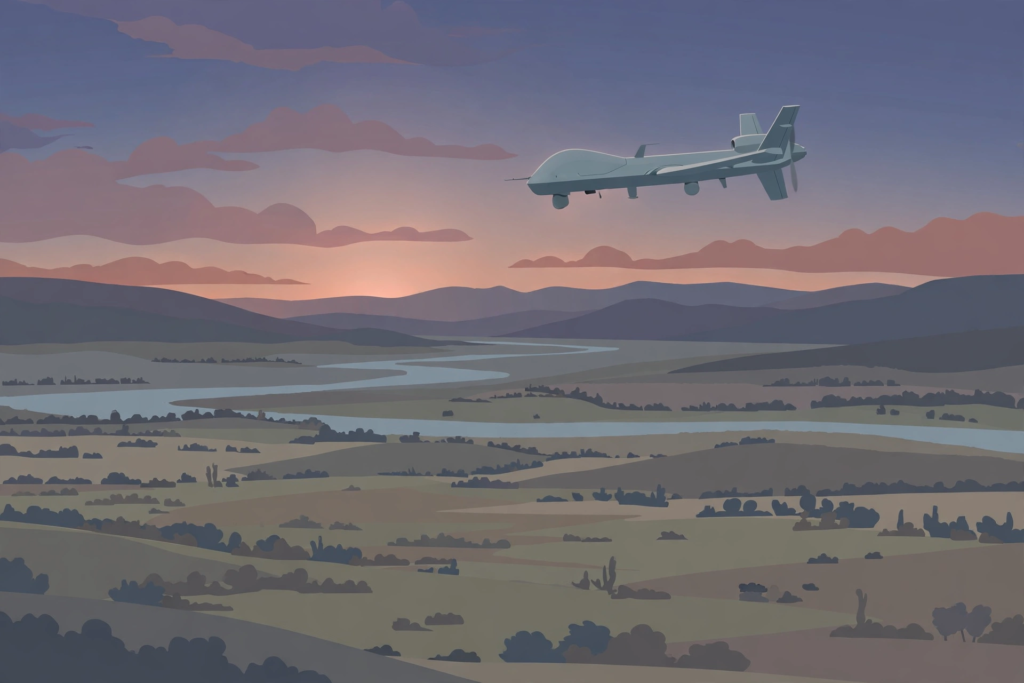
Medium and long-range drones fly higher and farther than tactical models. They can cover large areas, follow borders, monitor coastlines, and watch supply lines far behind the front. Some are used mainly for intelligence gathering over days and weeks, building a picture of enemy activity rather than supporting a single battle. Others support naval operations, searching for ships or patrolling maritime routes.
These drones often carry a mix of sensors, including high-resolution cameras, radar, and signals intelligence equipment. They usually require runways, larger ground stations, and more maintenance than small drones. In return, they offer endurance and coverage that small drones cannot match. They are the closest modern equivalent to the traditional reconnaissance aircraft, with the added benefit that no pilot is put at risk during long, routine patrols.
Armed drones
Armed drones are designed to carry and release weapons. Larger armed drones resemble small aircraft and can carry several guided weapons. They are used for strikes against vehicles, buildings, air defence systems, and other military targets, often after long surveillance flights. Because they are reusable, they are best suited to missions where the drone is expected to survive and return.
Armed drones require careful target identification, reliable communications, and trained operators. They are also more expensive and more vulnerable to air defences than small drones. Their value lies in combining long surveillance with the ability to strike without calling in a separate aircraft. In practice, armed drones are often used alongside fighter aircraft, artillery, and ground forces rather than as a replacement for them.
Loitering munitions
Loitering munitions blur the line between a drone and a missile. They are launched, fly to a target area, and wait for a target to appear. When a target is identified, the munition dives onto it. Some loitering munitions are operated by a person watching a live video feed until the final moment. Others can search an area using sensors and select a target based on programmed criteria, with varying levels of human oversight.
Loitering munitions are important because they combine the patience of a drone with the effect of a guided weapon, at a lower cost than a large armed drone. They have been used against vehicles, artillery, air defence systems, and troops in the open. Their limits include short range compared with larger drones, vulnerability to jamming and air defences, and the risk of striking the wrong target if identification is poor. The growth of loitering munitions is one of the clearest signs that drone warfare is not only about large aircraft. Small, single-use systems can shape a battle too.
Why cheap drones matter against expensive defences
One of the most discussed aspects of drone warfare is the cost imbalance between cheap drones and the defences used to stop them. The logic is simple to grasp. A small commercial-style drone, adapted for military use, can cost far less than a fighter jet, a tank, or an air defence missile. If a defender must use an expensive missile to shoot down a low-cost drone, the defender spends far more than the attacker. Over many attacks, that imbalance can strain even a well-funded military.
This imbalance has several effects. First, it forces defenders to rethink air defence. Traditional air defence systems were designed to shoot down fast jets and large missiles. They were not designed to track and destroy dozens of small, slow, low-flying drones at once. Defenders now need layered defences: radar that can detect small targets, electronic warfare to jam drone signals, guns and smaller missiles for close-range defence, and in some cases lasers or other new systems.
Second, it encourages attackers to use drones in large numbers. A single drone may be shot down, but a steady stream of drones can overwhelm defences, force defenders to reveal the positions of their air defence systems, or exhaust their supply of interceptor missiles. This is not a new idea in warfare, since saturation attacks have existed for a long time, but drones have made saturation cheaper and easier to attempt.
Third, the cost imbalance affects strategy beyond the battlefield. A state or group that cannot afford a modern air force may still be able to afford a drone fleet. That changes regional power balances, because air surveillance and strike capability are no longer limited to a handful of wealthy states. It also means that even a weaker force can threaten expensive assets, such as parked aircraft, fuel depots, or ships in port, if those assets are not well protected against small drones.
Drone warfare in publicly known conflicts
Drones have been used in conflicts for decades, but their role became widely visible in the last twenty years. Early military drones were mainly used for reconnaissance. Over time, armed drones were used in counterterrorism operations, and later in state-to-state conflicts, where both sides used drones at scale. Observers often point to a few widely reported cases to illustrate how drone warfare has developed. These cases are discussed here in general terms, without detailed tactical claims.
One widely discussed example is the conflict over Nagorno-Karabakh in 2020, where analysts noted the extensive use of armed drones and loitering munitions alongside artillery and ground forces. Commentators argued that drones helped locate and strike air defence systems, vehicles, and artillery, and that the side with better drone coverage and better integration of drones with other weapons gained an advantage. The case is often cited as a turning point in public awareness, because drone footage was widely shared and because the role of unmanned systems was more visible than in earlier wars.
Another widely discussed example is the war in Ukraine, where both sides have used drones on a very large scale. Small tactical drones are used for reconnaissance and artillery spotting, loitering munitions are used against vehicles and positions, and larger drones are used for longer-range surveillance and strikes. The conflict has also shown how quickly drone tactics change. When one side develops a new jammer, the other side changes frequencies, flight paths, or drone designs. When defences improve against one type of drone, operators shift to another. The war has become a testing ground for drone tactics, defences, and countermeasures, and lessons from it are studied by armed forces around the world.
The common lesson from these examples is not that drones alone win wars. In each case, drones worked alongside artillery, infantry, air defences, and intelligence systems. Armies that used drones well also tended to use other systems well. Drones amplified existing strengths and exposed existing weaknesses, rather than replacing the rest of an army.
Defences against drones
As drones have spread, so have defences against them. No single defence works against every type of drone, which is why modern defences are layered, meaning several different systems work together. Understanding these layers helps explain why drone warfare is a contest of adaptation, not a one-sided advantage.
The first layer is detection. A defender must find the drone before it can stop it. Radar, acoustic sensors, optical cameras, and radio-frequency sensors can all help detect drones, but small drones are hard to spot. They fly low, they are made of light materials, and they may be quiet or hard to distinguish from birds on a radar screen. Detection is often the hardest step, especially against small drones flying at low altitude over cluttered terrain.
The second layer is electronic warfare, meaning the use of radio signals to disrupt a drone. Jamming can block the link between a drone and its operator, forcing the drone to land, return to base, or crash, depending on its design. Spoofing, a related technique, sends false navigation signals to mislead a drone about its position. Electronic warfare is attractive because it can stop a drone without firing a shot, and it can work against many drones at once. Its limits are that skilled operators can change frequencies, use preprogrammed routes that do not need a live link, or use drones that are resistant to jamming.
The third layer is kinetic defence, meaning physically destroying the drone. This includes guns, missiles, and other weapons adapted for small targets. Short-range air defence guns can be effective against low-flying drones. Smaller, cheaper interceptor missiles and interceptor drones are being developed to reduce the cost imbalance described earlier. Some forces also use nets or other low-technology methods against very small drones, although these are niche solutions rather than general defences.
The fourth layer is passive defence, meaning steps that reduce the damage a drone can do even if it gets through. These include camouflage, decoys, dispersion of troops and vehicles, hardened shelters, and moving at night or in bad weather when drone sensors are less effective. Passive defences are less dramatic than missiles and jammers, but they are often the most practical response for smaller forces. A vehicle that is hidden, dispersed, or protected by overhead cover is a harder target for any drone.
The fifth layer is attacking the drone system itself, rather than the individual drone. This can mean striking launch sites, ground stations, supply depots, or communications infrastructure. It can also mean cyber operations against drone control networks. These actions are part of wider military operations, not a standalone anti-drone weapon, but they show why drone warfare is about systems. Destroying one drone matters less than disrupting the system that launches, controls, and maintains many drones.
Worked example: sorting three drones by the official small-systems definition
Example: use the United States Army small-systems definition from the 2025 Congressional Research Service report, which covers Group 1 and Group 2 systems weighing less than 55 pounds and flying at or below 3,500 feet above ground level. Now sort three illustrative aircraft against that line. Aircraft A weighs 20 pounds and flies at 1,000 feet: it sits inside the small-systems definition. Aircraft B weighs 50 pounds and flies at 3,000 feet: it also sits inside, just under both limits. Aircraft C weighs 1,000 pounds and flies at 25,000 feet: it sits far outside the definition, in the medium or long-range class, with a runway, a larger ground station, and a different mission.
The example shows why grouping by weight and altitude is useful. Aircraft A and B belong in the same conversation about squad-level reconnaissance, short range, and low cost. Aircraft C belongs in a different conversation about endurance, coverage, and infrastructure. Treating all three as simply “drones” hides exactly the differences that decide what each one can do, what it costs to operate, and what kind of defence can stop it. For the civilian side of drone costs, see how much drone insurance costs.
What comes next in drone warfare
Drone warfare is still developing, and several trends are likely to shape its future. The first trend is greater autonomy. Drones are already able to fly routes, avoid obstacles, and return to base without constant operator input. Future systems may be able to coordinate with each other, search an area as a group, or adapt to jamming without human help. Greater autonomy could make drones more effective, but it will also sharpen ethical questions, especially if machines take on more targeting decisions.
The second trend is swarming. A swarm is a group of drones that work together, sharing information and dividing tasks. A swarm could search a large area faster than a single drone, overwhelm defences by attacking from many directions at once, or continue a mission even if some drones are shot down. Swarming is still an emerging capability, and it faces practical limits in communications, coordination, and cost, but it is widely discussed as a future direction for drone warfare.
The third trend is better defences and better countermeasures in a continuing cycle. As drones become cheaper, faster, and more autonomous, defences are likely to include more directed-energy weapons, such as lasers, better sensors powered by artificial intelligence, and cheaper interceptor drones. The contest between drones and defences will probably continue, with neither side gaining a permanent advantage.
The fourth trend is the spread of drone technology to more actors. Commercial drone technology improves every year, and military adaptations of commercial designs are becoming easier. This spread means that drone warfare will not remain a capability of a few large states. Smaller states, and in some cases non-state groups, will continue to use drones, which increases the importance of defences, export controls, and international rules.
Common mistakes when reading about drone warfare
The first mistake is treating every drone story as a strike story. Most military drone flights are surveillance, spotting, or support. A report of drone activity does not automatically mean an attack happened.
The second mistake is treating a drone as a single weapon rather than a system. The aircraft gets the headlines, but the operators, analysts, ground stations, and data links decide whether the aircraft is useful. Judging a drone program by its aircraft alone misses most of the picture.
The third mistake is assuming that cheap drones make other forces obsolete. Drones amplify existing strengths and expose existing weaknesses, but they work alongside artillery, infantry, air defences, and intelligence systems. No widely reported conflict has been won by drones alone.
The fourth mistake is trusting dramatic footage at face value. Drone video is often shared without context, date, or location, and the same clip can be reused for different claims. Analysts wait for corroboration from multiple sources before treating footage as evidence of a specific event.
Pros and cons of drone capability for an armed force
The advantages are real. Drones give commanders persistent surveillance at a lower cost than piloted aircraft, they shorten the time between seeing and striking, they keep pilots out of danger, and they give smaller forces access to air capability they could not otherwise afford. They also support other weapons, especially artillery, by correcting fire in real time.
The disadvantages are equally real. Drones depend on data links that can be jammed or spoofed, and on operators and analysts who take time to train. Small drones are vulnerable to guns, jammers, and bad weather. Large drones are expensive and vulnerable to serious air defences. Autonomy raises ethical and legal questions that are far from settled, and the spread of drone technology means that any advantage can be copied, countered, or turned back on its owner.
Frequently asked questions
Are all military drones armed?
No. Most military drone flights are unarmed missions such as surveillance, reconnaissance, target spotting, damage assessment, and communications support. Armed drones and loitering munitions are a smaller, more specialised part of the picture.
Can a small commercial drone become a military drone?
Small commercial designs are sometimes adapted for military use, especially for short-range reconnaissance and spotting, because they are cheap and widely available. Adaptation does not make a commercial drone equal to a purpose-built military system, which has different sensors, links, and support behind it.
Why are drones hard to shoot down?
Small drones fly low, are made of light materials, and can be hard to distinguish from birds on radar. Detection is often the hardest step. Once detected, a defender still needs a suitable weapon, and using an expensive missile against a cheap drone creates the cost imbalance described in this guide.
Will drones replace fighter jets and tanks?
No, on the evidence of recent conflicts. Jets are faster, carry heavier loads, and survive in heavily defended airspace in ways most drones cannot. Tanks and infantry still hold ground. Drones change how those forces see and strike, but they work alongside them rather than replacing them.
What rules apply to civilian drones?
Civilian drone rules are set by national aviation authorities, not by military practice. In the United States, the Federal Aviation Administration publishes the rules for recreational and commercial drone use, including registration, airspace, and operating limits. Military drone operations follow separate military and legal frameworks. For household money planning around new technology, see how much emergency fund you need and how much a whole-house generator costs.
Final thoughts
Drone warfare is best understood as a system, not a single weapon. It includes small tactical drones that help infantry squads see over the next hill, long-range surveillance drones that watch borders for days, armed drones that combine surveillance with strikes, and loitering munitions that wait for a target to appear. It includes the operators, analysts, ground stations, and data links that make those aircraft useful, and the defences, from jamming to layered air defence, that try to stop them.
The impact of drone warfare comes from several changes at once: longer and more persistent surveillance, faster links between seeing and striking, lower risk to pilots, lower cost compared with traditional air power, and wider access to air capability. Those changes have not made other military forces obsolete, and they have not made war simple or clean. They have changed how armies see, how they strike, and how they protect themselves.
For further reading from authoritative sources, see the Congressional Research Service report on the Army small uncrewed aircraft systems program, the Federal Aviation Administration drone pages, and RAND research on unmanned aerial vehicles.