Searching for a steam room near you sounds simple. You type the phrase, pick the closest gym or spa, and go. In real life, that search often leads to a dead end. A gym chain can advertise steam rooms nationally while your local club has none. A spa can list a steam room on its website and then tell you it is closed for maintenance. A gym can have a steam room, but only on a premium membership tier that costs twice the advertised starting price.
This guide fixes that. It explains what a steam room actually is, where to find one near you, what day passes and memberships typically cost in 2026, what to ask before you pay, and what to expect on your first visit. Prices below are typical ranges reported in 2026, not quotes for any specific club. Prices vary by city, club, and promotion, so always confirm locally before you join.
This article is general information only, not medical advice. Heat exposure is not suitable for everyone. If you are pregnant, have a heart condition, have low blood pressure, have asthma or another breathing condition, or have any condition that affects how your body handles heat, talk to your doctor before using a steam room. The same advice applies if you take medication that affects blood pressure, heart rate, or sweating. A short talk with your doctor is cheaper and safer than guessing.
Quick answer
A steam room is a tiled room filled with moist heat near 100% humidity, at 110 to 120 degrees. To find one, check the club page, call the desk, and tour before joining, because listings often do not match the club. Expect a day pass around $15 to $30, or a membership tier that includes the steam area.
What a steam room is, and how it differs from a sauna and a hot tub
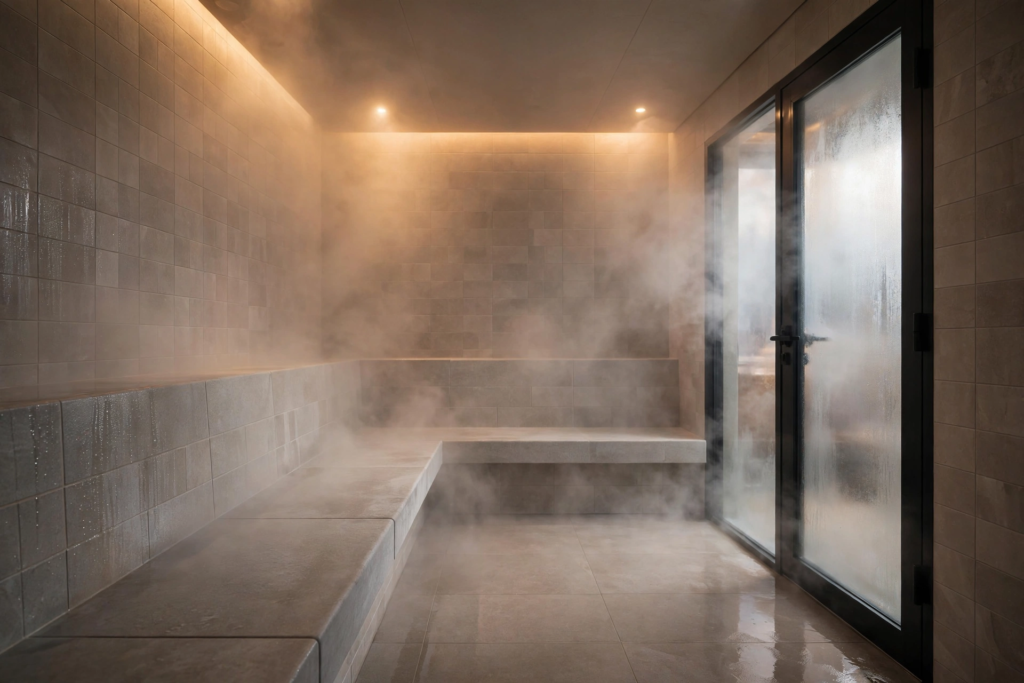
A steam room is a sealed, tiled room filled with moist heat. A generator boils water and releases steam into the room, so the air is close to 100% humidity. The air temperature is usually lower than in a sauna, often around 110 to 120 degrees Fahrenheit, but the humidity makes the heat feel intense. You sit on tiled benches, breathe warm moist air, and sweat quickly.
That moist heat is the key difference from the other heat rooms you will see listed next to steam rooms. A traditional dry sauna, sometimes called a Finnish sauna, heats dry air with a heater and stones. Air temperature is usually around 150 to 195 degrees Fahrenheit, and humidity is low unless you pour water on the stones. An infrared sauna uses radiant panels to warm your body directly while the air stays cooler, often around 110 to 150 degrees Fahrenheit, with dry air.
A hot tub is not a heat room at all. It is a pool of heated water, usually kept around 98 to 104 degrees Fahrenheit, where you soak rather than sit in steam. Hot tubs, saunas, and steam rooms are often grouped together under spa or wellness amenities, but they are not interchangeable. If a steam room is what you want, do not accept a sauna or a hot tub as a substitute without checking first.
How to find a steam room near you
Use several searches, not just one. Different gyms and spas describe the same amenity with different words, and search engines do not check amenities for you. Start with these searches, adding your city or ZIP code:
- steam room near you
- gym with steam room plus your city
- spa with steam room plus your city
- steam room day pass plus your city
- YMCA steam room plus your city, if a YMCA operates near you
- hotel spa steam room plus your city, if you want a one-off visit rather than a membership
Then open the page for the exact club or spa, not the national homepage. Look for an amenities list, a locker room description, or photos of the wet area. If the page only says spa, wellness, or relax and recover, that is not proof of a steam room. A spa label can cover massage chairs, tanning, red light booths, a dry sauna, a hot tub, or a steam room. You need the words steam room, steam bath, or Turkish bath on that specific location page, plus a phone call to confirm it.
Next, call the front desk, not just the sales line, and ask these five questions:
- Do you currently have a working steam room on site, and is it open today?
- Is steam room access included in the standard membership, or does it require a higher tier, a spa add-on, or a day pass upgrade?
- Is the steam room in the locker room area, the pool area, or a separate spa area, and who can use it?
- Are there age restrictions, time limits, or busy periods when the steam room is reserved for classes or treatments?
- What does a day pass cost, and does it include full steam room access?
Write down the name of the person who answered and the date you called. If the answer changes when you visit, you have a record of what you were told. Finally, take a tour before you sign anything. Free tours and day passes exist for exactly this reason. Walk to the steam room, confirm it exists, is heated, is clean, and looks maintained. A steam room listed on a website but switched off or roped off for repair is not an amenity you can use.
Where steam rooms are most common
No national chain guarantees a steam room at every location. Availability is a location decision, shaped by the size of the building, the age of the club, recent remodels, and the local market. Still, some types of facilities are far more likely to have one than others.
Large and mid-size gym chains
Gyms with pool areas and large locker rooms are the most likely commercial gyms to have a steam room. LA Fitness is a strong example. At its pool-equipped clubs, a steam room often sits alongside the sauna and whirlpool in the locker room area, and it is typically included in the standard membership rather than locked behind a premium tier. Availability still varies club by club, so check the exact location.
Life Time clubs are also very likely to have a steam room, often as part of a full spa and wet area with a sauna, a hot tub, and sometimes a cold plunge. The trade-off is price. Life Time is a premium club, and you pay for the whole package, not just the steam room.
Other mid-size chains, including 24 Hour Fitness at its larger Sport and Super Sport clubs, Gold’s Gym at selected clubs, EoS Fitness at clubs with a recovery area, and VASA Fitness where a wet area is listed, may have a steam room at some locations. At these chains, watch for tiering. The cheapest advertised plan is not always the plan that unlocks the locker room spa area. Ask which exact plan includes the steam room, and get that answer in writing if you can.
Budget gyms are the least likely place to find a steam room. Planet Fitness, for example, is famous for its Black Card Spa, but that spa means HydroMassage beds, massage chairs, tanning, and red light therapy, not a steam room and not a traditional sauna at standard clubs. If a steam room is your must-have feature, a budget gym is usually the wrong choice, no matter how low the monthly price looks.
YMCAs and community recreation centers
YMCA branches and community recreation centers are worth checking early, especially if cost matters. Many branches have pools, and a steam room or sauna in the locker room area is common at larger branches. Membership is often priced on a sliding scale based on household income, and financial assistance may be available. Hours, guest rules, and family access vary by branch, so use the same verification steps: check the exact branch page, call, and tour.
Day spas, hotel spas, and bathhouses
If you do not want a gym membership at all, a day spa, a hotel spa, or a bathhouse may be a better fit. Many day spas include steam room access with a treatment, or sell a spa day pass that covers the steam room, sauna, and relaxation areas. Hotel spas sometimes sell day passes to non-guests, which can be a good one-off option, especially when you are traveling.
Bathhouses and Korean spas, sometimes called jjimjilbang, often include a steam room as part of a larger wet area, with hot pools, cold pools, saunas, and resting rooms. These venues are usually priced per visit, and they can be excellent value if you want a longer, slower spa visit rather than a quick post-workout steam.
The price model matters here. A gym sells you a month of access. A spa sells you a visit. If you would use a steam room twice a month, a gym membership may win. If you would use it twice a year, a spa day pass almost certainly wins.
What a steam room typically costs in 2026
Steam room access is usually bundled into a gym membership or a spa visit, not sold as a separate line item at a big-box gym. That means the real question is: how much does the tier or ticket that includes the steam room cost, and what else does it include? The ranges below are typical reported ranges for 2026, labeled as estimates where they are based on published guides rather than a quote from a specific club. Always confirm locally.
- Budget gym, basic tier: about $10 to $30 a month. A steam room is often not included, or not offered at all.
- Mid-size gym, standard tier: about $25 to $50 a month. A steam room is included at some pool-equipped clubs, often in the standard tier.
- Mid-size gym, premium or recovery tier: about $30 to $70 a month. More likely to include a steam room, a sauna, and other recovery amenities where available.
- YMCA or community center: varies widely, often income-adjusted. A standard adult membership may fall in a similar range to a mid-size gym, but financial assistance can bring it well below that range.
- Premium club: often $100 a month or more, and can be much higher. A steam room is very likely, but you pay for pools, classes, courts, childcare, and spa services too.
- Gym day pass: typically about $15 to $30 for one visit, with full facility access at many mid-size clubs. This is the cheapest way to test a steam room before joining.
- Day spa or bathhouse visit: typically about $25 to $75 per visit, with wide variation. A basic bathhouse entry may sit at the low end, while a hotel spa day pass or a spa package with a treatment can sit well above it.
Now look at the first-year math, because the monthly price is never the whole price at a gym. Take a mid-size gym at $35 a month as an estimate. Twelve months at that rate is $420. Add an annual fee of about $49 to $69, which many chains bill once a year, and a possible initiation fee of up to about $99 outside a promotion, and the first year can reach roughly $470 to $590. The second year, without the initiation fee, drops back toward $470 to $490. A promotion that waives the initiation fee can save you the full amount, so if you can wait for one, do so.
Compare that with the upgrade math. At many chains, the step from a basic tier to the tier that includes the steam room and sauna area is about $10 to $15 a month, or $120 to $180 a year. A single spa or bathhouse visit often costs $25 to $50 or more. If you would use the steam room twice a month, the gym upgrade pays for itself quickly, at roughly $5 to $7 per steam session on the upgrade alone. If you would use it twice a year, the same upgrade costs $60 to $90 per session, and day passes or spa visits are far better value.
Worked example: the twice-a-month steam user
Example: suppose you would use a steam room twice a month, and your local mid-size gym charges $35 a month for the standard tier but $50 a month for the tier that includes the steam room and sauna area. The upgrade costs $15 a month, or $180 a year. At two sessions a month, that is 24 sessions a year, so the upgrade alone works out to $7.50 per steam session. Compare that with a spa day pass at $25 to $50 per visit: two spa visits a month would cost $600 to $1,200 a year, so the gym upgrade wins easily. Now flip the frequency: if you would go only twice a year, the same 180-dollar upgrade costs $90 per session, while two spa visits cost only $50 to $100 total. The example shows why frequency, not the monthly price, decides which option is cheaper.
Hidden fees and traps to watch for
The initiation fee is the first trap. Some chains charge zero dollars during a promotion and close to $100 at other times. If you can wait for a promotion, you can save the entire fee.
The annual fee is the second trap. It is billed once a year, often a few weeks after you join, and it is easy to forget. Budget gyms commonly charge about $49 a year, and larger chains charge about $69. Ask when it is billed so it does not surprise you.
The promotional rate that expires is the third trap. Some memberships advertise a low rate for the first months and then rise to the standard rate. Ask whether the monthly price you are quoted is the permanent rate, and for how long any discount lasts.
The where available clause is the fourth trap. Membership pages routinely say amenities are available where present or at participating locations. That clause means the chain is not promising your club has the amenity. Only the club page, the phone call, and your tour confirm it.
Maintenance closures are the fifth trap. Steam rooms close for cleaning, descaling, generator repairs, and tile work. Ask how often the steam room is closed and whether members are told in advance. A steam room that is closed one week in four is worth far less than you are paying for.
Cancellation terms are the final trap. Some plans require notice in person or by certified mail, and some charge a cancellation fee. Read that section before you sign, not when you want to leave. Also ask about age limits and guest rules. Some clubs restrict the steam room area to members aged 18 and older, and some keep it in a locker room area that only members of one sex can enter, which matters if you planned to visit with a partner.
What to expect on your first visit
Start with water. Drink water before you go in, and bring water to drink afterward. You will sweat a lot in a short time, even though the air feels moist. Do not go in dehydrated, and do not try to push through thirst, dizziness, or nausea to finish a session.
Shower first. Most clubs expect you to shower before entering the steam room, and it is also good practice for your skin. Rinse off sweat, lotions, and sunscreen. Sit on a towel, not directly on the tile, for comfort and hygiene. Most regulars bring a towel to sit on and a second towel for drying off afterward.
Wear what the club allows. At most gyms, swimwear is the norm in a shared steam room. At some spas and bathhouses, a towel wrap is the norm, and swimwear may not be allowed in certain areas. Check the posted rules or ask staff before you enter, so you do not have to guess in front of strangers.
Start short. A first session of about 10 to 15 minutes is plenty. Many clubs and general health guides suggest limiting steam room sessions to about 15 to 20 minutes, with breaks and water in between. Leave sooner if you feel dizzy, overheated, nauseous, short of breath, or unwell. There is no prize for staying longest, and stepping out early is the correct choice if your body tells you to.
Sit low at first if you can. Heat rises, so the upper benches feel hotter than the lower benches. Breathe slowly through your nose if you can. The moist air can feel heavy at first, and slow breathing helps you settle in.
Cool down gradually. Shower with lukewarm or cool water, drink water, and rest before you drive or work out hard. Do not jump straight from intense heat to very cold water if you have a heart condition or blood pressure concerns. Talk to your doctor first if that applies to you.
Common mistakes
- Trusting the national page. Amenities are decided club by club. Only the exact location page, a phone call, and a tour confirm a steam room exists.
- Accepting a sauna as a substitute without checking. Dry heat and moist heat feel different, and a sauna is not a steam room. Confirm the words steam room on the page.
- Joining on the cheapest tier. The advertised starting price often excludes the locker room spa area. Ask which exact tier includes the steam room.
- Forgetting the first-year fees. Initiation and annual fees can add $100 to $170 to year one. Price the full year, not just the month.
- Skipping the day pass test. Some people love moist heat and some find the humidity uncomfortable. A 15 to 30 dollar day pass answers that question before a contract does.
Is paying extra for a steam room worth it?
It depends entirely on how often you will use it. Do the honest math before you upgrade.
If you visit the gym three times a week and would use the steam room after most workouts, the upgrade is cheap per use. At $15 extra per month and twelve sessions a month, that is about $1.25 per session, far less than any spa visit.
If you visit twice a month and might use the steam room half the time, the same upgrade costs $15 per session, and a day pass or a standalone spa visit may be better value.
If you only want a steam room and do not want a gym at all, a bathhouse or spa day pass is usually the better buy. You pay only when you go, you get a longer visit, and you are not locked into a monthly contract for a facility you barely use.
There is also a comfort question that math cannot answer. Some people love moist heat and will use a steam room every visit. Others try it once, find the humidity uncomfortable, and never go back. A day pass answers that question for $15 to $30. Test first, then commit.
Cheaper ways to get steam room access
If no nearby gym with a steam room fits your budget, a few alternatives are worth checking:
- Community centers and YMCA branches. These often have pools and steam rooms at lower prices than commercial gyms, and many offer income-based pricing.
- Day passes. A day pass at a mid-size club typically costs $15 to $30 and lets you use the whole facility, including the steam room, for one visit. That is a good test before joining and a reasonable option if you only want a steam session a few times a year.
- Bathhouses and Korean spas. Entry is usually priced per visit, often in the 25 to 50 dollar range as an estimate, and includes a steam room plus pools and resting areas. For a long, slow spa visit, this can be better value than a gym upgrade you rarely use.
Pros and cons
Pros: a gym membership bundles steam access with workouts, pools, and classes; per-session cost drops fast if you go often; day passes let you test cheaply; YMCA and community pricing can be income-adjusted; bathhouses offer a longer, slower visit per ticket.
Cons: national listings often do not match the local club; the steam room may sit behind a pricier tier; initiation and annual fees inflate year one; maintenance closures can eat weeks of access; locker room location may restrict who can enter; moist heat is uncomfortable for some people.
Frequently asked questions
How much does a steam room near you cost?
It depends on how you access it. A gym day pass typically costs $15 to $30. A mid-size gym membership that includes a steam room typically costs $25 to $50 a month, plus initiation and annual fees in the first year. A spa or bathhouse visit typically costs $25 to $75. Always confirm the price and the steam room access for your exact location, because national prices do not guarantee local availability.
How long should you stay in a steam room?
Most clubs and general health guides suggest about 15 to 20 minutes per session, with breaks and water before and after. Start with 10 to 15 minutes on your first visit. Leave sooner if you feel dizzy, overheated, nauseous, or unwell. Check the posted rules at your club.
Is a steam room better than a sauna?
Neither is automatically better. A steam room uses moist heat at around 110 to 120 degrees Fahrenheit. A traditional sauna uses dry heat at around 150 to 195 degrees Fahrenheit. An infrared sauna uses radiant heat with dry air at around 110 to 150 degrees Fahrenheit. Try both, and choose the one you find comfortable and will actually use. If heat tolerance, pregnancy, a heart condition, or another health concern applies to you, talk to your doctor before using either.
What should you ask before joining a gym for its steam room?
Ask whether the steam room is currently working, whether it is included in the tier you would buy, whether there are age restrictions, how often it closes for maintenance, and what the total first-year cost is including initiation and annual fees. Then confirm it all on a tour before you sign.
Further reading
For more on health costs and habits, see these guides: highest fiber foods, blood test costs without insurance, and mammogram costs without insurance. For the heat itself, compare Verywell Health’s medically reviewed sauna versus steam room guide and Medical News Today’s steam room benefits and risks.
The bottom line
The best steam room near you is not the cheapest one and not the one with the flashiest advertisement. It is the specific club, spa, or bathhouse, verified by a visit, where the steam room exists, works, is included in the tier or ticket you can afford, and sits close enough to your home or work that you will actually use it.
Start with pool-equipped mid-size gyms, your local YMCA, and nearby day spas or bathhouses. Skip budget gyms if a real steam room is non-negotiable. Call before you visit, tour before you sign, and do the first-year math including every fee.