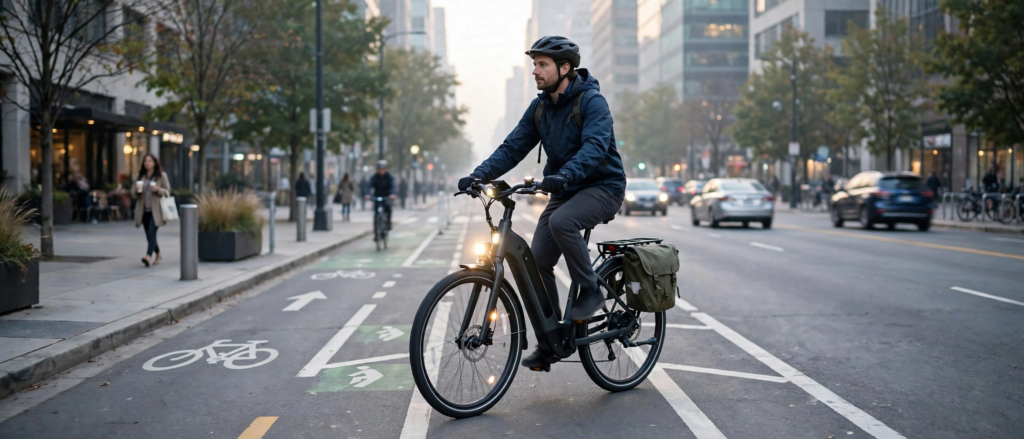
If your daily commute is five to fifteen miles through city streets, a commuter e-bike might be the smartest money move you make this year. Not because e-bikes are trendy, but because they sit in a sweet spot most vehicles miss: faster than a bus stuck in traffic, far cheaper than a car, and much less sweaty than a regular bike on a hot morning.
This guide is only about commuting. You will not find mountain trails, downhill gear, or off-road suspension talk here. Instead, you will get the practical answers a city rider actually needs: how far a commuter e-bike really goes, how charging fits into a workday, which locks and accessories are worth your money, and what the total cost looks like compared with driving or taking the bus.
Quick answer
A commuter e-bike makes sense if your ride is roughly 5 to 15 miles and you want to arrive without a car payment. Budget $1,500 to $3,000 for a bike with a lock and weather gear in the first year. Check range, not the advertised maximum, and compare the cost against driving or transit for your route.
What Makes a Bike a Commuter E-Bike
A commuter e-bike is built for the same trip, day after day, in traffic, in rain, and often in the dark. That job shapes every part of the bike.
First, the riding position is upright. You sit tall enough to see over parked cars and spot turning drivers early. Your back stays relaxed, and you arrive at work looking presentable rather than hunched over like a racer.
Second, the bike is ready for cargo and weather. A good commuter model comes with mounting points for a rear rack, full fenders, and bright lights, or it accepts those parts easily. If a bike has no rack mounts and no fender clearance, it is a leisure bike dressed up for the city, and you will feel that difference on the first rainy Monday.
Third, the gearing and tires favor stop-and-go city riding. You want smooth starts at green lights, steady cruising at 15 to 20 miles per hour, and tires wide enough to handle potholes, drain covers, and wet pavement without rattling your teeth. Skinny race tires and knobby trail tires both miss the mark for daily commuting.
Finally, the motor and battery are tuned for range and reliability, not top speed. Most commuter e-bikes sold in the United States use a 250-watt to 750-watt motor with pedal assist, meaning the motor helps only while you pedal. That keeps the ride feeling like cycling, keeps the bike legal on most bike paths, and stretches the battery further than a throttle-heavy setup.
How Much Range Do You Really Need
Range numbers on a product page are best-case figures. They usually assume a light rider, flat ground, the lowest assist level, and no headwind. Your real commute will include hills, traffic lights, a backpack, and days when you are tired and lean on the motor more. Plan for that.
A simple rule works well: buy a bike whose claimed range is at least double your round-trip distance. If you ride seven miles each way, your round trip is fourteen miles, so look for a claimed range of at least twenty-eight miles. That buffer covers cold weather, headwinds, battery aging, and the days you take a detour to the grocery store on the way home.
Most city commuters do well with a battery between 400 and 700 watt-hours. As a rough estimate, a 500 watt-hour battery on a typical commuter bike delivers about 25 to 45 miles of real city riding, depending on assist level, rider weight, hills, and wind. A larger battery costs more and weighs more, but it also means you can skip charging for a day or two without worry.
Think about your route honestly before you shop. Count the hills, not just the miles. A flat ten-mile ride is easy for almost any commuter e-bike. A ten-mile ride with one long climb at the end will drain the battery faster and deserves a stronger motor and a bigger battery. If you are unsure, test ride the actual hill, or at least a similar one, before you buy.
Battery size also affects long-term cost. Batteries wear out gradually, and most last several years of daily commuting before range drops noticeably. When you shop, check the replacement battery price for the exact model you are considering. A cheap bike with a costly or hard-to-find replacement battery can turn into an expensive bike later.
Charging Without the Hassle
Charging a commuter e-bike is simpler than most people expect, but the details matter for daily life.
Most commuter e-bikes charge from a regular wall outlet in three to six hours, depending on battery size and charger power. If you ride to work in the morning, you can plug in at your desk or in a bike room and have a full battery long before you leave. If your workplace has no charging spot, ask before you buy. Some offices welcome a small charger under a desk, while others have rules about batteries indoors.
A removable battery makes commuting much easier. You can take the battery inside to charge while the bike stays locked outside, which is safer and more convenient in bad weather. It also lets you store the battery at room temperature in winter, which helps battery life. If your bike has a built-in battery that cannot be removed, make sure you have a secure place to park the whole bike near an outlet.
Charging cost is one of the best parts of the math. A full charge of a typical commuter battery uses roughly half a kilowatt-hour of electricity. At common home electricity prices, that is only a few cents per charge, or well under a dollar in most cases. Even if you charge every workday, your yearly charging bill is likely under fifty dollars, which is a rounding error next to gas, parking, or bus fares.
A few charging habits will protect your battery. Avoid leaving it fully empty for weeks, avoid storing it in a freezing garage all winter, and use the charger that came with the bike. Fast chargers sound tempting, but frequent fast charging can shorten battery life, so save it for days when you truly need a quick top-up.
Choosing the Right Motor and Gears for City Riding
You do not need the most powerful motor on the market to commute well. You need the right motor for your hills, your weight, and your cargo.
Hub motors, mounted in the front or rear wheel, are common on affordable commuter e-bikes. They are quiet, simple, and easy to maintain. They work well on flat and gently rolling routes. Mid-drive motors, mounted near the pedals, use the bike gears to climb more efficiently, which helps on steep hills and with heavy loads. They usually cost more, but they feel more natural on hilly routes and tend to climb with less strain.
For a flat city route, a 250-watt to 500-watt hub motor is usually plenty. For a hilly route, a heavier rider, or regular cargo like a laptop bag plus groceries, a mid-drive motor or a stronger hub motor is worth the extra cost. Test riding matters more than spec sheets here. A motor that feels smooth and quiet on your route is better than a stronger motor that surges or whines.
Gears matter just as much as motor power. A commuter bike with seven to eleven gears gives you a low gear for hill starts, a middle gear for cruising, and a high gear for flat stretches with a tailwind. Single-speed e-bikes look clean and need less maintenance, but they force the motor to do more work on hills, which drains the battery faster. Unless your route is truly flat, geared bikes are the safer choice.
Brakes deserve special attention on a commuter e-bike. You are heavier and faster than on a regular bike, especially with a bag and a lock on board. Hydraulic disc brakes stop reliably in rain and need less hand effort than mechanical brakes. If you ride in wet weather or down hills, hydraulic disc brakes are worth paying for. At minimum, insist on disc brakes rather than rim brakes, which lose grip when wet.
The Accessories That Actually Matter for Commuting
Accessories can turn a decent bike into a great commuter, but only a few are essential. Spend on these first, and add the rest later.
A rear rack is the single most useful commuter accessory. It carries your bag, keeps weight off your back, and keeps you cooler and drier on warm days. Pair it with a pannier bag that clips on and off quickly, so you can walk into the office without wrestling straps. A rack rated for at least 40 pounds covers a laptop, clothes, lunch, and a lock with room to spare.
Full fenders are non-negotiable if you ride in rain. Without them, your rear tire sprays a stripe of road grime up your back, and your front tire soaks your shoes. Look for fenders that cover most of the wheel and sit close enough to block spray without rubbing the tire. Clip-on fenders that only cover part of the wheel are better than nothing, but full fenders are far better for daily riding.
Lights are safety gear, not decoration. A bright front light lets drivers see you and lets you see potholes after dark. A rear light with a steady mode plus a flashing mode keeps you visible from behind. If your bike has built-in lights powered by the main battery, that is ideal, because you never forget to charge them separately. If not, buy rechargeable lights and make charging them part of your weekly routine.
A bell, a mirror, and a phone mount round out the essentials. A bell warns pedestrians on shared paths far more politely than shouting. A small bar-end or helmet mirror helps you check traffic behind you without turning your head in busy lanes. A phone mount keeps navigation visible without holding your phone in one hand.
Locks and Theft Protection: Where Not to Cut Corners
A commuter e-bike is a theft target, and the lock is the worst place to save money. Budget at least one hundred dollars for locking, and more if you park in a high-theft area or leave the bike outside all day.
The strongest practical setup for daily commuting is a high-quality U-lock through the rear wheel and frame, plus a second lock for the front wheel. Thieves usually go for the easiest bike on the rack, and two locks make your bike a harder target than the one next to it. A heavy chain lock is a good alternative if you often lock to varied street furniture, since it wraps around thicker posts more easily than a U-lock.
Locking technique matters as much as lock quality. Always lock the frame, not just a wheel, to a fixed object that cannot be lifted or cut easily. Avoid thin signposts, short railings, and anything a thief could unbolt. Lock in a visible, well-lit spot near foot traffic when possible, and vary your parking spot if you leave the bike in the same place every day.
Protect the parts thieves strip quickly. Quick-release wheels and seat posts are convenient, but they also let a thief walk away with a wheel in seconds. Replace quick releases with locking skewers or bolted axles, and use a small cable or a second lock for the front wheel. If your battery is removable, take it with you or lock it with the battery lock that comes with the bike, and never leave it on the bike overnight.
Registration and insurance complete the picture. Write down your frame serial number, take photos of the bike, and register it with your city bike registry or the manufacturer if one is offered. Check whether your home insurance or renter insurance covers e-bikes, and ask what lock standard it requires. Some insurers require a specific lock rating, and using a cheaper lock could void a claim. For an expensive commuter bike, a dedicated e-bike policy can be worth the yearly premium, especially if you park outside daily.
Total Cost vs Car and Bus Commuting
This is where a commuter e-bike earns its keep. The purchase price looks high until you compare it with what a car or even a bus pass costs over a year.
A solid commuter e-bike typically costs between 1,200 and $2,500. Add a rack, fenders if not included, lights, a good lock setup, a pannier, and a helmet, and your first-year total is often $1,500 to $3,000. That is real money, but it is mostly a one-time cost, and the yearly running costs after that are low.
Compare that with driving. A car commuter pays for gas, insurance, maintenance, tires, registration, and parking. Even a modest car can easily cost $300 to $500 a month in those combined costs, and city parking alone can exceed $100 a month in many areas. Over a year, that is $3,600 to $6,000 or more, before loan payments. A commuter e-bike, by contrast, typically costs a few hundred dollars a year after purchase: a yearly tune-up, replacement brake pads, tires every year or two, chain and drivetrain parts as they wear, and a few dollars in charging.
Bus commuting sits in the middle. A monthly transit pass in many US cities costs roughly $60 to $130, or $720 to $1,560 a year. That is cheaper than driving, but it is a cost you pay forever, and it buys you a fixed schedule and crowded rides. A commuter e-bike often pays for itself against bus fares in about two years, and after that it saves money every month, while also giving you door-to-door flexibility and exercise.
Do the math for your own route with this simple formula. Add up your yearly car or transit costs, including parking and fares. Subtract your estimated yearly e-bike running costs, which for most commuters fall between 200 and $400 as an estimate. Divide the purchase and accessory cost by that yearly saving. The result is your payback time in years. For many city riders who replace a car commute, payback lands in under a year. For riders replacing a bus pass, payback often lands in one to three years, depending on the bike price and the local fare.
There are also savings that do not show up in a spreadsheet. You skip traffic jams, you skip hunting for parking, and you arrive at work awake and alert instead of drained by a stop-and-go drive. Those benefits are hard to price, but commuters consistently name them as the reason they stick with e-bike commuting long after the novelty wears off.
Maintenance: Keeping a Daily Commuter Reliable
A commuter e-bike needs regular care, but far less than a car. A simple routine keeps it safe and extends the life of every part.
Check tire pressure weekly. E-bikes are heavy, and soft tires wear faster, puncture more easily, and waste battery range. Pump to the pressure printed on the tire sidewall, and top up more often in cold weather. Keep a small pump and a spare tube or a tire repair kit in your pannier, and learn to fix a flat at home once, so a roadside flat does not ruin your morning.
Clean the chain every few weeks, more often in rain or winter. Wipe it, apply bike chain lubricant, and wipe off the excess. A clean chain shifts better, lasts longer, and keeps your trousers cleaner. Check brake pads every month or two. When the pad material gets thin, replace it before it damages the rotor or weakens your stopping power.
Book a professional tune-up at least once a year, ideally before your wettest or coldest season. A shop can check spoke tension, headset bearings, brake alignment, and motor connections that are hard to judge at home. If you ride daily through winter road salt, rinse the bike after salty rides and have the drivetrain inspected more often.
Store the bike as dry as you can. Indoor storage is best, but a covered porch or a bike room works if the bike is locked and the battery is brought inside in extreme cold or heat. If you must park outside daily, a waterproof cover helps, and a regular wipe-down prevents rust on the chain and bolts.
Buying Checklist for a Commuter E-Bike
Use this checklist on every bike you consider, and do not skip the test ride.
First, ride your real route or the closest version of it. Pay attention to hill climbing, braking from speed, and comfort after twenty minutes, not just around the shop parking lot. A bike that feels fine for five minutes can feel harsh or underpowered after a full commute.
Second, confirm the practical details. Does it have rack and fender mounts. Is the battery removable. How much does a replacement battery cost. What is the warranty on the motor, battery, and frame. Does a local shop service this brand, or will every repair mean shipping the bike away.
Third, add up the true price. The sticker price is only the start. Add the lock, rack, fenders, lights, pannier, helmet, and any upgrades like better tires or a more comfortable saddle. Compare total ready-to-ride prices, not bare bike prices, or a cheap bike with costly add-ons will look better than it really is.
Fourth, think about size and weight. A bike that fits well is safer and more comfortable, especially in traffic. If you carry the bike up stairs or onto a train, weight matters a lot. Many commuter e-bikes weigh 45 to 60 pounds, which is manageable to ride but heavy to carry. If you must lift it daily, look for a lighter model or a place to park at ground level.
Finally, buy from a seller you can reach after the sale. E-bikes have electrical parts that occasionally need diagnosis, and a local shop or a responsive brand makes that far less stressful. A bargain from an unknown seller with no service network can cost more in downtime and shipping than the money you saved upfront.
Worked example: charging costs for a 10-mile commute
Example: all figures here are planning estimates. You ride 10 miles each way, 5 days a week, for 48 weeks, which is 4,800 miles a year. A 500 Wh battery holds about half a kilowatt-hour, so at an illustrative electricity price of 17 cents per kilowatt-hour, one full charge costs about 9 cents. If one charge covers roughly 25 miles, your 20-mile round trip takes about one charge a day, or about 45 cents a week and about $22 a year in charging. Compare that with a monthly transit pass at roughly $60 to $130, or $720 to $1,560 a year, and you can see why the guide says a commuter e-bike often pays for itself against bus fares in about two years.
Mistakes New Commuter Riders Make
The most common mistake is buying too little range. A bike that barely covers your commute on a warm day will leave you anxious on a cold, windy day, and you will end up driving on the days you most wanted to ride. Buy the range buffer described earlier, and you will ride more often.
The second mistake is under-spending on the lock. A forty-dollar cable lock might hold a cheap regular bike, but it will not protect a two-thousand-dollar e-bike parked downtown all day. Spend on the lock first, and treat it as part of the bike price, not an optional extra.
The third mistake is skipping fenders and a rack to save money, then riding with a sweaty backpack and a muddy back for months. Those two accessories cost far less than the frustration they prevent, and they pay for themselves in comfort from the first rainy week.
The fourth mistake is ignoring weather gear. A lightweight rain jacket, waterproof pannier cover, and gloves for cold mornings make the difference between riding four days a week and riding only on perfect days. You do not need expensive cycling clothing, but a basic rain layer and warm gloves extend your riding season by months.
Pros and cons
Pros:
- Cheaper than driving: a few hundred dollars a year in running costs after purchase.
- Faster than a bus in traffic, with door-to-door flexibility and no fixed timetable.
- Charging costs almost nothing: a full charge is well under a dollar.
- Daily riding builds fitness into a trip you have to make anyway.
Cons:
- Upfront cost of $1,500 to $3,000 in the first year is real money.
- Theft is a serious risk: a cheap lock can cost you the whole bike.
- Range falls in cold weather, hills, and headwinds, and advertised range is optimistic.
- Rain, snow, and limited parking or charging at work can complicate the routine.
Frequently asked questions
How far can a commuter e-bike really go on one charge?
Advertised range assumes low assist, a light rider, and flat ground. For planning, use the lower end of the range in this guide and test your own route, because hills, cold weather, and headwinds all cut range.
Can I charge an e-bike battery at work?
In most cases yes, if the battery is removable and your workplace allows it. A full charge takes a few hours from a normal outlet, and a partial top-up over a workday is usually plenty for the ride home.
What lock should I buy for a commuter e-bike?
Spend properly on locks and never rely on a single cable lock. The locks section in this guide explains the two-lock approach and why the lock budget is the wrong place to save money.
Is a commuter e-bike cheaper than a bus pass?
Over time, usually yes. A monthly transit pass runs roughly $60 to $130, while a commuter e-bike costs a few hundred dollars a year after purchase, so the bike often pays for itself against bus fares in about two years.
Do I need a licence to ride a commuter e-bike?
For a standard pedal-assist e-bike within the usual power and speed limits, no licence is normally required, but rules vary by state and locality, so check your local rules before buying.
Is a Commuter E-Bike Right for You
A commuter e-bike fits best if your commute is roughly three to fifteen miles, your route has bike lanes or quiet streets for most of the way, and you have a safe place to park at work. It also fits if you want exercise without arriving drenched in sweat, since you can dial the assist up on hot days and down when you want a workout.
It fits less well if your commute is mostly highway with no safe cycling route, if you must carry the bike up several flights of stairs every day, or if your workplace has no secure parking at all. In those cases, a folding e-bike, a mixed bike-plus-transit commute, or a different route might solve the problem, so check those options before ruling e-bikes out entirely.
A commuter e-bike is not a perfect vehicle, but for city commuting it is one of the rare purchases that saves money, saves time, and improves your day at the same time. Choose for range and reliability over flash, spend properly on locks and weather gear, and do the cost math for your own route. If the numbers work, and for many city riders they do, your commute may become the best part of your workday.
Further reading: for the wider e-bike picture, see the electric bike guide, for the car-cost comparison see how to lower car insurance, and for gig work on two wheels see what DoorDash drivers make. Outside Factaxy, the League of American Bicyclists covers cycling advocacy and safety, and PeopleForBikes tracks e-bike policy and infrastructure.