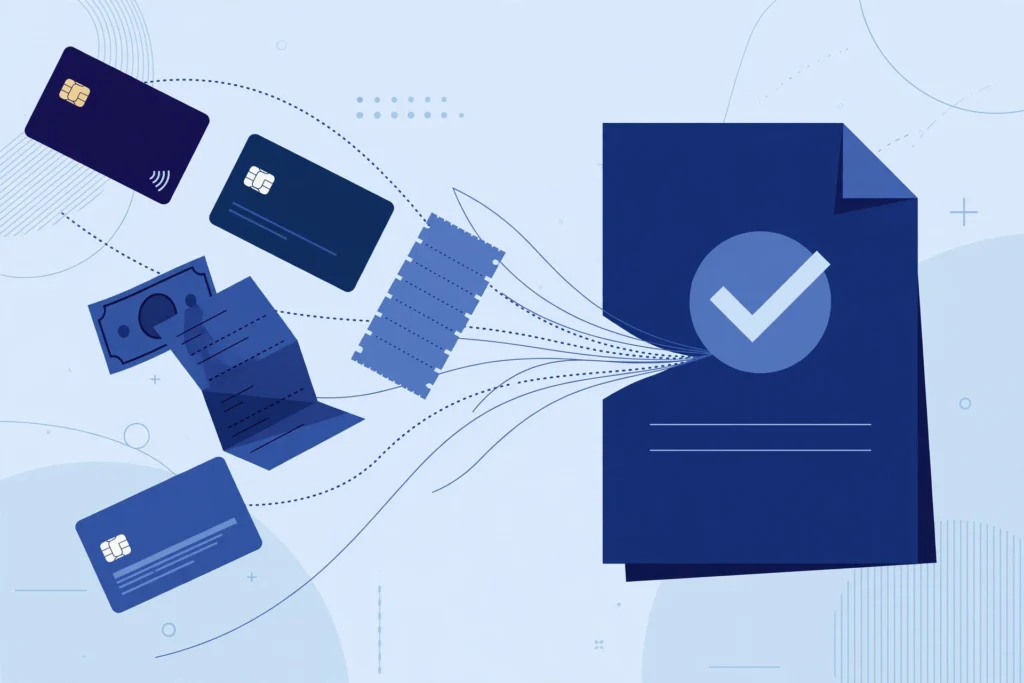
Five cards, five due dates, five minimum payments, and most of each payment disappearing into interest. That is the situation a debt consolidation loan is designed to fix. It replaces several debts with one loan, one payment, and one fixed payoff date. Whether that actually saves money depends on one thing above all: whether the new interest rate is lower than the average rate on the debts it replaces. This guide explains how these loans work, what they cost, and when they help versus when they make things worse.
Quick answer
A debt consolidation loan is a personal loan used to pay off other debts, leaving one fixed monthly payment over two to seven years. It saves money only when the new rate beats the average rate on the old debts, after fees.
How a debt consolidation loan works
The mechanics are simple. The borrower takes out a personal loan large enough to cover existing balances, such as credit card balances, medical bills, or other unsecured debts, and uses the loan funds to pay those balances off. Some lenders send the money to the borrower, and some pay creditors directly. From that point, the borrower owes one lender, at one fixed interest rate, with one fixed monthly payment, over a set term, usually two to seven years. The total amount owed does not change at the moment of consolidation. What changes is the interest rate, the payment structure, and the payoff date.
Most consolidation loans are unsecured, meaning no house or car is put up as collateral. Approval and pricing depend mainly on credit score, income, and debt-to-income ratio. A stronger credit profile means a lower rate. Minimum credit scores vary by lender, generally around 580 to 670 for the lenders that serve this market at all.
Consolidation is not the same as settlement. Settlement negotiates debts down to less than the full balance, usually with serious credit damage. Consolidation repays the full balances, restructured into one loan. That distinction matters for credit scores and for tax treatment, since forgiven debt in a settlement can count as taxable income in some situations.
What it costs: rates by credit tier
Rates vary sharply by credit score. Based on LendingTree user data for typical loan amounts and terms in the fourth quarter of 2025, average debt consolidation loan APRs ran about 14.76% for excellent credit (800 and above), 17.01% for very good credit (740 to 799), 22.75% for good credit (670 to 739), 27.59% for fair credit (580 to 669), and 30.02% for poor credit (under 580). For comparison, average credit card APRs were around 24%, while the average APR on a 24-month personal loan from a commercial bank was 11.65% as of November 2025.
Fees matter too. Origination fees typically run 1% to 10% of the loan amount, and on many loans the fee is deducted upfront, so a 10,000 dollar loan with a 5% fee actually delivers $9,500. Late fees and prepayment penalties vary by lender, so the APR, not just the monthly payment, is the number to compare. Some lenders charge no origination fee at all, which can make a slightly higher rate the cheaper deal overall.
The other consolidation routes have their own price tags. A balance transfer card offers 0% for 12 to 21 months, then jumps to a regular rate above 20%, plus a transfer fee of 3 to 5%. A home equity loan usually carries a lower rate than an unsecured loan, but it puts the house at risk if payments stop, and it takes weeks to close with an appraisal and full underwriting, versus as little as one business day for some personal loans.
Steps to get one
- List every debt: balance, interest rate, and minimum payment for each card, loan, and bill.
- Work out the weighted average interest rate across those debts. That is the number the new loan must beat.
- Check your credit score and credit reports, and fix any errors before applying.
- Pre-qualify with several lenders. Pre-qualification uses a soft credit check and does not lower the score.
- Compare APRs, origination fees, terms, and monthly payments, not just the payment amount.
- Read the fine print on fees, late charges, and whether the lender pays creditors directly.
- After funding, confirm every old balance is actually paid to zero, and do not run the old cards back up.
Example: three cards into one loan
Consider a borrower with $18,000 across three credit cards at an average APR of 23%, paying about $560 a month in minimums. At that pace, minimum payments stretch roughly 15 years and add more than $16,000 in interest. Consolidating the same balance into a 48-month loan at 13% APR gives a fixed payment of about $483 a month, with total interest of about $5,170 and a firm finish date four years out. That is a saving of roughly $10,000 in interest plus eleven years of payments. This is an illustrative example using published averages, not a quote, and the real result depends on the rate actually offered. If the same borrower only qualified at 27%, consolidation would cost more than the cards, and the right move would be to skip the loan and attack the highest-rate card first.
Common mistakes
The most common mistake is consolidating and then running the old cards back up, ending with both the loan and fresh card balances. The second is comparing monthly payments instead of APRs: a longer term lowers the payment while raising total interest. The third is ignoring the origination fee, which can quietly erase the first months of savings. The fourth is consolidating debts that are already cheap, such as a low-rate student loan or a 0% promotional balance, into a higher-rate loan. The fifth is borrowing to consolidate while the spending pattern that created the debt is unchanged. A loan fixes the structure of debt, not the habits behind it.
Pros and cons
The advantages are real: one payment instead of many, a fixed rate instead of variable card rates, a firm payoff date, and often a lower monthly payment and lower total interest. A single on-time payment is also easier to manage than five, which reduces missed-payment risk. The disadvantages are equally real: borrowers with fair or poor credit may be offered rates no better than their cards, origination fees add cost, a longer term can mean more total interest even with a lower payment, and secured options put an asset at risk. Consolidation also does not reduce the amount owed, so anyone expecting a smaller balance will be disappointed.
When it helps and when it does not
Consolidation helps most when the borrower has fair to good credit or better, can qualify for a rate clearly below the weighted average of the old debts, has stable income to make the fixed payment, and will not reuse the paid-off cards. It helps least when the offered rate is close to or above the old average, when the debts are small enough to clear in a few months anyway, or when the real problem is ongoing overspending rather than the interest rate. In that last case, a budget review or a nonprofit credit counseling session is a better first step than a new loan.
Frequently asked questions
Does a debt consolidation loan hurt my credit?
Applying triggers a hard inquiry, which can dip the score briefly. Over time, on-time payments on an installment loan and lower card utilization usually help the score, as long as the old cards are not run back up.
How much can I borrow with a consolidation loan?
Personal loans for consolidation typically range from $1,000 to $100,000, with most borrowers in the 5,000 to 50,000 dollar range. The amount depends on credit, income, and debt-to-income ratio.
Is a balance transfer card better than a consolidation loan?
It can be, for balances that can realistically be cleared inside the 0% window, usually 12 to 21 months. After that window the rate jumps, and the 3 to 5% transfer fee still applies.
Can I consolidate with bad credit?
Some lenders approve scores from around 580 upward, but rates at that tier often run 25 to 36%, which may not beat the cards being replaced. Comparing the APR honestly is essential.
What happens if I miss a payment on the consolidation loan?
Late fees apply, the credit score takes a hit, and the fixed payoff schedule slips. Missing several payments can lead to collections, which is why the payment must fit the monthly budget before signing.
Final thoughts
A debt consolidation loan is a tool, not a rescue. Run the numbers before applying: list the debts, find the weighted average rate, and only take a loan that clearly beats it after fees. Pre-qualify with several lenders, compare APRs rather than payments, and make a plan for the paid-off cards so they stay at zero. Done that way, one payment can replace five and cut thousands in interest. Done carelessly, it just rearranges the problem. The guides linked below cover the related choices, including the pros and cons in more detail and the snowball versus avalanche payoff methods.
Related guides: debt consolidation loan pros and cons, credit score needed for a debt consolidation loan, debt snowball versus avalanche, and how much credit card debt is too much. Sources: Credible on consolidation versus settlement, National Debt Relief on personal loans for consolidation, and LendingTree debt consolidation rates.
Sources and methodology
The figures, rules, and rates in this guide come from the authoritative sources linked throughout the article, including credible.com, nationaldebtrelief.com, staging.lendingtree.com. Where a figure is an estimate or a worked example, the article says so.