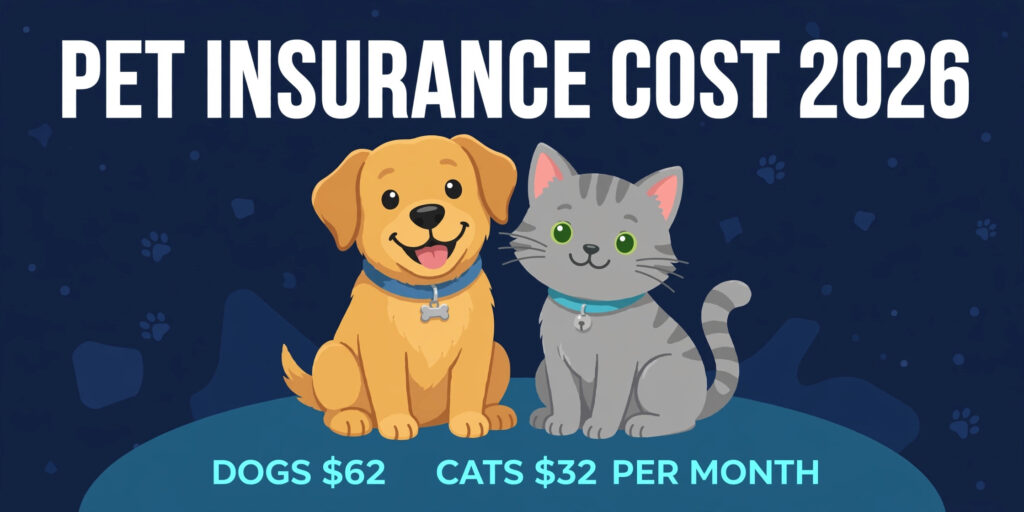
Pet insurance turns a scary vet bill into a predictable monthly payment. The question every owner asks first is simple: how much does it actually cost? The short answer is that most dog owners pay around 62 dollars a month and most cat owners pay around 32 dollars a month for a standard accident and illness policy in 2026. The real answer depends on your pet’s species, age, breed, and where you live, and the range is wide enough that two owners can pay very different prices for the same coverage.
This guide breaks down the current average costs, what moves your premium up or down, and how to tell whether a cheap quote is actually a good deal.
Average pet insurance cost in 2026
The North American Pet Health Insurance Association tracks what owners actually pay. Its 2025 industry report puts the average comprehensive accident and illness premium at 62.44 dollars per month for dogs and 32.21 dollars per month for cats. That works out to about 749 dollars a year for a dog and about 386 dollars a year for a cat.
| Policy type | Dogs per month | Cats per month |
|---|---|---|
| Accident and illness (standard) | 62 dollars | 32 dollars |
| Accident only | 16 dollars | 9 dollars |
| Accident and illness plus wellness | 72 to 92 dollars | 42 to 62 dollars |
Accident only plans are the cheapest option, but they only pay when your pet is hurt, not when your pet gets sick. Illness is where the big bills live: cancer treatment, diabetes management, and chronic disease care. Most vets recommend the standard accident and illness policy, and most owners buy it.
Wellness add-ons cover routine care such as checkups, vaccines, and dental cleanings. They add roughly 10 to 30 dollars a month. A wellness add-on is a budgeting tool more than insurance, since routine care costs are predictable and the add-on rarely pays back more than it costs.
Why dogs cost about twice as much as cats
Dogs are bigger animals with bigger medical problems. A large dog that tears a cruciate ligament can face a 7,000 dollar surgery. A cat with a similar injury costs far less to treat. Breed risk adds to the gap: golden retrievers face hip dysplasia, bulldogs battle breathing problems, and German shepherds develop degenerative myelopathy. Cats cluster around a narrower set of conditions, such as urinary tract disease and dental problems, that tend to cost less to treat.
Size matters inside the dog world too. Small dogs typically cost 20 to 40 dollars a month to insure. Medium dogs run 30 to 60 dollars. Large and giant breeds can run 50 to 90 dollars a month, and some high risk breeds pay two to three times the baseline average.
What moves your premium
Age. Puppies and kittens are cheapest at roughly 15 to 40 dollars a month. Adult dogs run 30 to 60 dollars and adult cats 15 to 35 dollars. Senior pets cost 50 to 100 dollars a month or more, because older animals file more claims.
Breed. Insurers price on expected lifetime claims. French bulldogs, English bulldogs, Bernese mountain dogs, and Great Danes sit at the expensive end. Mixed breed dogs usually cost less than purebreds with known hereditary problems.
Location. Vet care costs more in big cities and high cost states, and premiums follow. The same dog can cost 15 dollars a month more in California than in a lower cost state.
Your plan choices. Three dials control your price: the annual deductible, the reimbursement rate, and the annual limit. A 1,000 dollar deductible with 70 percent reimbursement and a 5,000 dollar limit is the cheapest combination. A 250 dollar deductible with 90 percent reimbursement and unlimited coverage costs far more. Raising your deductible is the fastest way to cut a premium without losing catastrophic protection.
How much do the big insurers charge
Carrier averages for dogs show a wide spread. Pets Best starts around 31 dollars a month at the low end, while MetLife ranges up to about 80 dollars. ASPCA, Embrace, Fetch, Lemonade, Spot, Pumpkin, and Prudent Pet mostly fall between 36 and 79 dollars for dogs. For cats the spread is tighter, roughly 19 to 57 dollars across the same carriers.
These are starting points, not quotes. Your actual premium depends on your pet, your zip code, and your plan design. Getting quotes from three or more carriers is the single easiest way to save money, since the same dog can draw quotes 20 dollars a month apart.
Is the average the right number for you
Use the average as a starting point, then adjust. A young, healthy, mixed breed dog in a low cost area will land below average. An older purebred dog in an expensive city will land above it. Dog premiums rose about 11 percent in 2025 alone, so budget for annual increases as your pet ages, not just the first year price.
The cheapest policy is not always the best value. Check the annual limit, the deductible, and whether the policy covers hereditary conditions and chronic illness. A 25 dollar policy with a 2,000 dollar annual limit stops helping exactly when a real emergency arrives.
Frequently asked questions
How much is pet insurance per month for a dog?
About 62 dollars a month on average for accident and illness coverage in 2026, with a realistic range of 37 to 73 dollars depending on breed, age, and location.
How much is pet insurance per month for a cat?
About 32 dollars a month on average for accident and illness coverage, with a realistic range of 24 to 50 dollars.
What is the cheapest pet insurance?
Accident only plans are cheapest at roughly 16 dollars for dogs and 9 dollars for cats, but they do not cover illness. Among full coverage carriers, Pets Best posts the lowest starting prices for both dogs and cats.
Does pet insurance get more expensive as my pet ages?
Yes. Premiums rise with age because older pets claim more. Senior pets commonly cost 50 to 100 dollars a month or more.
Does pet insurance cover routine vet visits?
Not on a standard policy. Checkups, vaccines, and dental cleanings need a wellness add-on, which costs roughly 10 to 30 dollars extra per month.