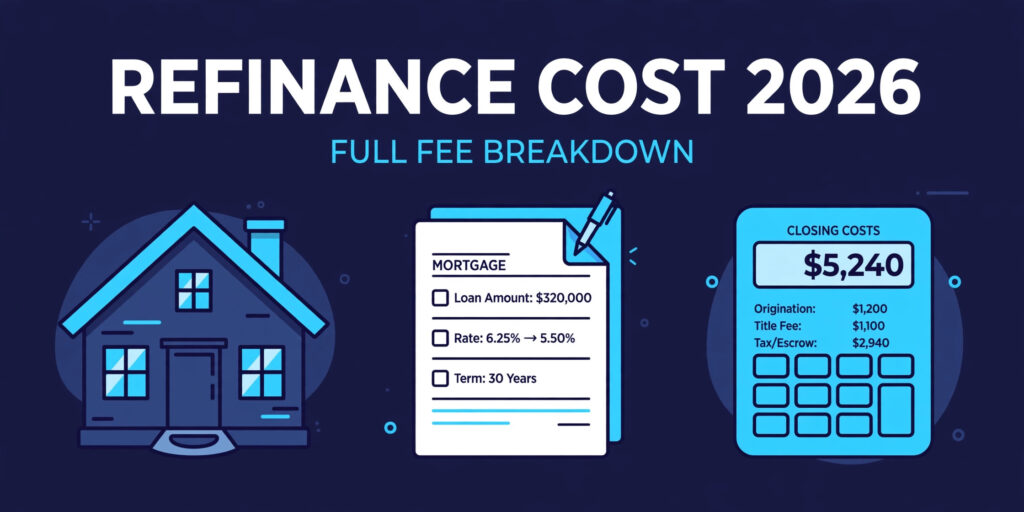
Refinancing can save hundreds of dollars a month, but it is not free. Refinancing a mortgage in 2026 typically costs 2 to 6 percent of the loan amount, with average closing costs around 5,000 to 6,000 dollars nationwide. On a 300,000 dollar loan, that is 6,000 to 18,000 dollars depending on where you live and what kind of loan you get.
This guide breaks down every fee, explains why published averages disagree, and shows the break-even math that decides whether refinancing is worth it.
Why refinance averages disagree
You will see two very different average numbers quoted side by side, and both are honest. One dataset counts only lender and third party fees, putting the national average around 2,207 dollars. Broader estimates fold in prepaid taxes, insurance, and interest, landing at 6,000 to 10,000 dollars all in. Neither number is wrong. They answer different questions: what the lender charges versus what leaves your pocket at closing.
Location does most of the heavy lifting. States that charge a mortgage recording tax or documentary stamp tax on the new loan amount, such as New York, Florida, and Pennsylvania, sit well above the national average. States with no such tax, such as California and Arizona, land near the low end.
Refinance closing costs by loan size
| New loan amount | At 2 percent | At 4 percent | At 6 percent |
|---|---|---|---|
| 200,000 dollars | 4,000 dollars | 8,000 dollars | 12,000 dollars |
| 300,000 dollars | 6,000 dollars | 12,000 dollars | 18,000 dollars |
| 400,000 dollars | 8,000 dollars | 16,000 dollars | 24,000 dollars |
Fee by fee breakdown
Origination fee: 500 to 2,500 dollars. What the lender charges to make the loan, often 0.5 to 1 percent of the loan amount.
Appraisal: 300 to 700 dollars. Required to confirm your home’s current value. In 2026, roughly 15 to 25 percent of conventional rate and term refinances qualify for an automated appraisal waiver, skipping this cost entirely.
Lender title insurance: 500 to 1,500 dollars. Protects the lender against title defects. Title search and recording fees add 100 to 400 dollars more.
Settlement fee: 200 to 600 dollars. The closing agent’s charge for handling the paperwork and money.
Prepaid interest and escrow setup. Interest from closing day to month end, plus prepaid taxes and insurance for the escrow account. These are the items that push the all-in figure to 6,000 to 10,000 dollars.
Discount points (optional). Each point costs 1 percent of the loan and lowers your rate. Points on a refinance are deducted over the life of the loan, not all in year one.
Costs by loan type
FHA refinances run higher because of the 1.75 percent upfront mortgage insurance premium. VA interest rate reduction loans are often the cheapest, with no appraisal and a 0.5 percent funding fee. Cash out refinances run highest, because loan amounts are larger and lenders price in more risk. Conventional rate and term refinances fall in the middle.
The break-even math
Divide your total closing costs by your monthly savings. That is your break-even point in months: the month you start actually saving. If you will keep the home past break-even, refinancing pays. If you might move or refinance again before then, it does not.
Example: 6,000 dollars in closing costs divided by 200 dollars a month in savings equals a 30 month break-even. If you plan to stay at least three years, the refinance wins. If you might move in two years, it loses.
Watch the reset clock too. Refinancing a 30 year loan you are eight years into back to a new 30 year loan stretches your payoff date, which can cost more in total interest even at a lower rate. Consider a shorter term, or keep making your old payment amount.
No closing cost refinances
A no closing cost refinance has the lender cover the fees in exchange for a slightly higher rate, typically 0.125 to 0.25 percent higher. You preserve cash but pay more over the life of the loan. It makes sense if you plan to sell or refinance again within three to five years, and less sense if you plan to stay put for decades.
Frequently asked questions
How much does it cost to refinance a mortgage?
Typically 2 to 6 percent of the loan amount, averaging 5,000 to 6,000 dollars in lender and third party fees, or 6,000 to 10,000 dollars all in with prepaids.
Are refinance closing costs tax deductible?
Mostly not. Points on a refinance are deducted over the loan life, and prepaid mortgage interest is deductible, but origination, appraisal, title, and recording costs generally are not.
Can I refinance with no closing costs?
Yes, but the lender recovers the fees through a higher rate, usually 0.125 to 0.25 percent above the standard rate.
How long does refinancing take?
Fast digital lenders close in about 21 days. Traditional banks and credit unions typically take 30 to 45 days.