You do not need a gym membership to get your heart pumping. You do not need a treadmill, a spin bike, or a wall of machines with blinking screens. You need a little floor space, a pair of shoes you already own, and about twenty to thirty minutes.
That is good news for your health, and it is even better news for your wallet. A gym can be a great tool, but it is also a monthly bill that keeps charging whether you go or not. Home cardio flips that deal around. You pay nothing to start, nothing to keep going, and nothing when life gets busy for a week and you miss a session.
This guide gives you the exercises, a simple weekly plan, and an honest look at what each one would cost you in a gym setting versus what it costs at home: nothing. All prices in this article are rough estimates to help you compare, not quotes from any one gym. Your local prices will vary.
A quick health note before you start: this article is for general information only. It is not medical advice, and it is not a diagnosis or a treatment plan. If you have a heart condition, breathing problems, joint pain, diabetes, high blood pressure, or any other health concern, or if you have been inactive for a long time, talk to your doctor before starting a new exercise routine. Stop and rest if you feel dizzy, short of breath in a worrying way, or sharp pain.
Quick answer
You can get a full cardio workout at home for free, with no gym and no equipment. Aim for 150 minutes of moderate activity a week, or about 30 minutes on five days, using moves like marching, jumping jacks, and stair climbing. Start gently, build gradually, and pick moves your knees and neighbors can live with.
What Counts as Cardio, Really
Cardio is short for cardiovascular exercise. In plain language, it is any activity that raises your heart rate and your breathing for a sustained stretch of time. Walking fast counts. Dancing in your kitchen counts. Marching in place while you watch the news counts. You do not need to be gasping or drenched in sweat for it to count.
A common target used in many public health guidelines is around 150 minutes of moderate activity per week, or about 75 minutes of vigorous activity, or a mix of the two. Moderate means you can talk but not sing. Vigorous means you can only get a few words out at a time. You can split that total into short sessions across the week. Three sessions of thirty minutes, or five sessions of thirty minutes, both get you there. Shorter is fine too when you are starting out. Ten minutes is better than zero minutes, and it builds the habit that makes longer sessions possible later.
The Money Angle: What a Gym Really Costs
Let us do the math with round, clearly labeled estimates. Suppose a basic gym membership costs about $30 to $50 a month in your area. That is an estimate, and prices vary widely by city and by gym, but it gives you a useful comparison point.
At $40 a month, you pay $480 a year. Add a sign-up fee, which many gyms charge, and you could be looking at $500 or more in year one. Group fitness classes are often extra, or they are bundled into a higher tier that costs $60 to $80 a month, which is an estimate of $720 to $960 a year. A single drop-in cardio class can cost $15 to $25 as an estimate.
Now compare that with home cardio. Your cost is zero dollars a month and zero dollars a year, because you are the instructor. You may already own everything you need: comfortable clothes, supportive shoes, a water bottle, and a phone or laptop for music or a free timer. A jump rope, if you want one, is a one-time purchase that often costs under $15 as an estimate, and it is optional, not required.
Over one year, skipping a 40-dollar monthly membership saves an estimated $480. Over three years, that is an estimated $1,440, before you count gas, parking, or the workout clothes you might have bought to feel gym-ready. That money could go to debt, savings, groceries, or anything else that matters more to you than a monthly debit you barely use.
None of this means gyms are a waste of money for everyone. If you love classes, use the pool, or need the social push of a gym community, a membership may be worth every cent. But if your main goal is cardio, and you are paying for a gym you rarely visit, home workouts are the obvious money move.
There is also a hidden cost: time. A thirty-minute gym workout can easily become a ninety-minute outing once you add driving, parking, and changing. At home, thirty minutes means thirty minutes.
12 Cardio Exercises You Can Do Free at Home
Here is your core list. Each exercise includes a beginner version, so you can start where you are and build up. Do each one for thirty to sixty seconds, rest for fifteen to thirty seconds, and move to the next. That circuit takes about ten to fifteen minutes. Repeat it once or twice for a full session.
1. Marching in Place
This is the friendliest starting point, and it is genuinely effective, especially if you are new to exercise, returning after a break, or dealing with stiff knees.
Stand tall, lift one knee to about hip height, then the other, and swing your arms naturally, as if you are walking with purpose. Pick up the pace until your breathing deepens. To make it harder, lift your knees higher, pump your arms faster, or march for two minutes without stopping.
Gym equivalent: walking on a treadmill at a brisk pace. At home, you get the same marching motion for free, with no machine and no waiting.
2. Jumping Jacks
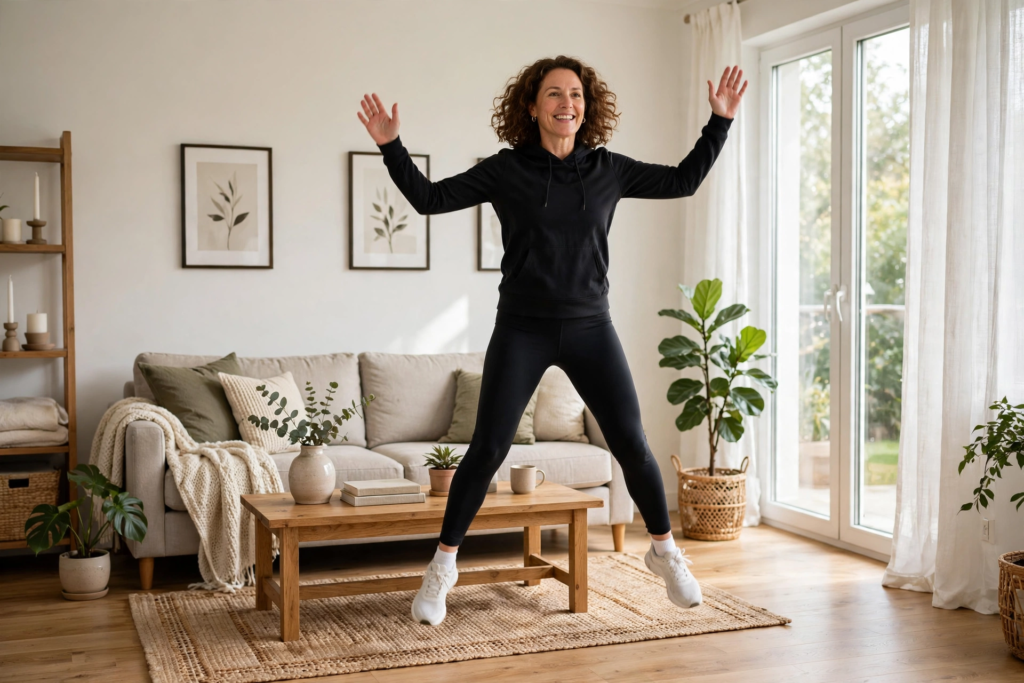
The classic school gym move still works, and it works fast. Stand with feet together and arms at your sides, jump your feet out wide while raising your arms overhead, then jump back to the start. Keep your knees slightly soft when you land.
Beginner version: step one foot out at a time instead of jumping, and raise your arms only to shoulder height. This low-impact version still raises your heart rate without stressing your joints or your downstairs neighbors.
Gym equivalent: a cardio class warm-up or a treadmill interval. Cost at home: nothing.
3. High Knees
Stand in place and drive one knee up toward your chest, then the other, as quickly as you can while staying in control. Pump your arms in rhythm. Think of running in place with exaggerated knees.
Beginner version: slow it down and lift your knees to a comfortable height, even if that is well below hip level. Speed is not the goal at first. Steady rhythm is.
High knees are excellent for short bursts. Try twenty seconds on, ten seconds off, repeated four times, and you will feel why this move shows up in so many paid workout programs.
4. Butt Kicks
This is the mirror image of high knees. Jog in place and kick your heels back toward your glutes, one foot at a time. Keep your posture upright and your core gently braced, not hunched forward.
Beginner version: walk in place and kick back slowly, holding onto a chair or countertop for balance if you need it. There is no prize for wobbling.
Butt kicks warm up the front of your thighs and pair well with high knees in a short interval circuit.
5. Mountain Climbers
Start in a plank position, hands under your shoulders, body in a straight line from head to heels. Drive one knee toward your chest, return it, then drive the other knee in. Alternate quickly, like running horizontally.
Beginner version: slow the movement right down, step one foot in at a time, and pause in the plank between steps. You can also raise your hands onto a sturdy chair, bench, or step to reduce the load on your shoulders and wrists.
Mountain climbers are a gym staple in boot camp and high-intensity classes, which often cost $15 to $25 per drop-in session as an estimate. At home, the same move costs nothing and takes thirty seconds.
6. Burpees, the Gentle Way
A full burpee has a reputation for a reason. You squat down, jump back to a plank, do a push-up, jump forward, and jump up. It is a lot. The good news is that you do not have to do the full version to get the benefit.
The gentle version: stand, squat down and place your hands on the floor, step back one foot at a time into a plank, step forward one foot at a time, stand up, and reach your arms overhead. No jump, no push-up, no pressure. This still works your legs, arms, and heart in one flowing move.
Do five to eight gentle burpees, rest, and repeat. That is a real workout, even if it does not look dramatic on camera.
7. Skaters
Stand on one foot, hop sideways to the other foot, and land softly with a slight bend in your knee, letting your free leg swing behind you. Then hop back. Swing your arms for balance, like a speed skater.
Beginner version: step sideways instead of hopping, and tap your toe down for balance each time. You still get side-to-side movement, which most forward-only cardio misses, and that helps your balance and coordination.
The side-to-side rhythm feels more like a game than a grind.
8. Dancing
Put on three songs you love and dance. That is the whole workout, and it counts completely. Dance raises your heart rate, loosens your joints, and lifts your mood in a way that few other exercises can match.
You do not need choreography. Step side to side, sway your hips, add arm movements, and move to the beat. A living room dance session is free, joyful, and repeatable.
Gym equivalent: a dance fitness class, which often costs extra on top of a membership. Your version costs nothing and lets you pick the playlist.
9. Shadow Boxing
Stand with feet shoulder-width apart, knees slightly bent, hands up near your chin. Punch forward, alternating left and right, and add the occasional uppercut or hook. Move your feet, bob slightly, and keep your core engaged.
Beginner version: punch slowly and lightly, focus on form, and keep your shoulders relaxed. You are not trying to knock anyone out. You are trying to move continuously for two or three minutes.
Shadow boxing is surprisingly tiring, and it works your shoulders, arms, and core at the same time as your heart.
10. Stair Climbing
If you have stairs at home, you have a free cardio machine built into your house. Walk up and down at a steady pace for five to ten minutes. Use the handrail for safety, especially on the way down, and wear shoes with grip.
Beginner version: climb up, walk back down slowly, and rest at the bottom for a few breaths before the next climb. Even five climbs count as a solid start.
A gym stair machine does the same basic job, but you already own the real thing. Be careful with loose rugs and socks on smooth stairs.
11. Jump Rope, the Optional Extra
A jump rope is the one piece of equipment worth mentioning, because it is cheap, portable, and brutally effective. Jump for thirty seconds, rest for thirty seconds, and repeat. Even a minute of rope jumping can leave you breathing hard.
No rope, no problem. Mimic the motion with your wrists and small hops, and you get most of the benefit. Or swap in jumping jacks for the same time slot. The point is the jumping, not the rope.
If you do buy a rope, that one-time estimated cost of under $15 replaces a gym membership for this exercise forever.
12. Fast Walking Around Your Home
When the weather is bad, or you do not feel like a structured workout, walk fast laps around your home. Hallway to kitchen to living room, repeat. Add arm swings, walk on your toes for a stretch, or carry light water bottles to add a little effort.
This sounds too simple to count, and that is exactly why people skip it. Do not skip it. Brisk walking is one of the most recommended forms of cardio, and doing it indoors removes every excuse about rain, cold, or darkness. Ten minutes of fast indoor walking is a real session.
How to Structure a Home Cardio Session
Use this simple template for almost any session.
Warm up for three to five minutes. March in place, roll your shoulders, and swing your arms gently. Your warm-up should feel easy, like you are waking your body up, not testing it.
Work for fifteen to twenty-five minutes. Pick four to six exercises from the list above. Do each one for thirty to forty-five seconds, rest for fifteen to thirty seconds, and move to the next. When you finish the list, rest for one minute, then repeat the circuit if you have time and energy.
Cool down for three to five minutes. Slow your marching to a gentle walk, stretch lightly, and let your breathing return to normal. Drink water.
That is it. No app subscription, video course, or special clothing is required beyond something you can move in.
For intervals, start with twenty seconds of work and forty seconds of rest, then shift to thirty seconds of work and thirty seconds of rest as you get fitter. You are progressing when the same workout feels easier.
Talk to your doctor if you notice chest pain, unusual breathlessness, dizziness, or joint pain that does not settle with rest. Pushing through warning signs is never the money-saving move, because an injury costs far more than any gym membership ever would.
A Simple Weekly Plan
Here is a balanced week that mixes easier days with harder ones. Swap days around, shorten sessions, or repeat your favorite day. Consistency beats perfection, every time.
- Monday: twenty minutes of marching, jumping jacks, and dancing. Easy start, full body, fun.
- Tuesday: rest, or a gentle ten-minute walk around your home. Rest days are part of training, not a failure.
- Wednesday: twenty-five minutes of high knees, butt kicks, mountain climbers, and skaters. This is your interval day, with short bursts and real rests.
- Thursday: ten to fifteen minutes of stair climbing or fast indoor walking. Low fuss, steady pace.
- Friday: twenty minutes of shadow boxing and dancing. This is the stress-relief session, and it is a good way to end the work week.
- Saturday: thirty minutes, your longest session. Mix six exercises, repeat the circuit twice, and finish with a slow cool-down. Or take a brisk walk outside if the weather is kind.
- Sunday: rest, or a gentle dance session to your favorite songs. Keep it light and enjoyable, so Monday feels inviting rather than dreaded.
That plan adds up to roughly 120 to 150 minutes of activity across the week, depending on session length. If you are starting from zero, cut every session in half for the first two weeks. You will still be building the habit, and you will be far more likely to stick with it.
Small Space, Downstairs Neighbors, and Quiet Cardio
A common worry is that home cardio needs a big room or will annoy the neighbors. It does not. Most of these exercises need only enough space to stand with your arms out and take one step in each direction.
For quiet, low-impact options, choose marching in place, step-out jumping jacks, gentle burpees without jumps, shadow boxing, dancing with soft steps, and fast indoor walking. Avoid repeated jumping on hard floors late at night.
If you live in a very small apartment, use the largest clear patch you have, even if that is the gap between your bed and your door. The best workout space is the one you will actually use.
How to Progress Without Spending a Dollar
Progress does not require new gear. It requires small, steady increases over time. Here are free ways to make the same exercises harder.
- First, increase your time. Add two minutes to a session each week until you reach thirty minutes.
- Second, shorten your rests. If you started with thirty seconds of rest between moves, try twenty seconds, then fifteen.
- Third, increase your intensity. March faster, lift your knees higher, or dance with bigger movements.
- Fourth, add a second circuit. When one round feels comfortable, add a second round with a one-minute rest between rounds.
Track your progress for free with a notebook or a notes app. Write down the date, the exercises you did, and how long you lasted. After a month, you will have visible proof that you are fitter.
Free progress still needs patience. In two to four weeks, you should notice that your breathing recovers faster and the workout that once left you exhausted now feels doable. That is real progress, and it cost you nothing.
Worked example: a 30-minute session that hits the weekly target
Example: a 30-minute session built from the moves in this guide. Start with 5 minutes of marching in place as a warm-up. Then do four rounds of 5 minutes: 2 minutes of jumping jacks, 2 minutes of high knees, and 1 minute of rest. Finish with 5 minutes of slow marching and stretching as a cool-down. That is 5 plus 20 plus 5, or 30 minutes. Do that five days a week and you reach 150 minutes, the moderate-activity target used in the guidelines quoted above. If 30 minutes feels like too much at first, do 15 minutes and add 5 minutes each week until you reach 30.
Common Mistakes to Avoid
Skipping the warm-up is the first mistake. Cold muscles and a cold heart rate do not like sudden sprints. Three minutes of gentle marching saves you a pulled muscle and a miserable session.
Going too hard on day one is the second mistake. If you cannot walk comfortably the next day, you probably overdid it. Soreness that fades in a day or two is normal. Pain that sharpens, swells, or lingers is a sign to rest and, if needed, talk to your doctor.
Holding your breath is the third mistake. Breathe naturally, even during hard intervals. If you cannot breathe and move at the same time, slow down until you can.
Finally, the most expensive mistake is the all-or-nothing mindset. Missing one day does not ruin the week. Just start again with the next session. A free workout you actually return to beats a paid membership you quit early.
Pros and cons
Pros:
- Free, with no membership, no commute to a gym, and no equipment required.
- Flexible: a session fits into 20 to 30 minutes at home, any time of day.
- Easy to scale: start with marching and build toward harder moves as fitness improves.
- Covers the guideline target of about 150 minutes of moderate activity a week.
Cons:
- No coach watching your form, so poor technique can go unnoticed.
- Impact moves can bother knees, ankles, and downstairs neighbors.
- Motivation is harder at home, where distractions are everywhere.
- No access to heavy weights or machines if you later want them.
Frequently Asked Questions
Do I need to buy equipment to do cardio at home?
No. Every exercise in this guide works with no equipment at all. A jump rope is a nice, cheap option, and a mat is comfortable, but neither is required. Your body weight is the equipment.
How many days a week should I do cardio at home?
Aim for three to five days a week, with rest days in between, especially when you are starting. That pattern gives your body time to recover and keeps the habit sustainable. More is not automatically better, and rest is part of getting fitter.
Can home cardio really replace a gym?
For cardio, yes, for most people. A gym adds machines, classes, weights, and a social setting, and those have real value if you use them. But if your goal is to raise your heart rate, improve stamina, and stay consistent, home cardio covers it fully, at zero cost.
What if I have bad knees?
Choose low-impact moves: marching in place, step-out jumping jacks, shadow boxing, dancing with soft steps, stair climbing at a slow pace, and fast indoor walking. Avoid deep jumps and sudden direction changes until your knees feel stronger. Talk to your doctor or a physical therapist if knee pain is ongoing, and stop any move that causes sharp pain.
How long before I see results?
Most people notice better stamina within two to four weeks of consistent sessions, meaning they recover faster and feel less winded during the same workout. Visible body changes take longer and depend on diet, sleep, and overall activity, not on cardio alone.
The Bottom Line
Cardio does not have to cost money to work. It has to be regular, it has to raise your heart rate, and it has to be something you will actually do again next week. Home cardio checks all three boxes, without a monthly bill, a commute, or a contract.
Start today, not Monday. Pick three exercises from this list, do each one for thirty seconds, rest, and repeat once. That is ten minutes, it is free, and it is a real start. Tomorrow, do it again, or dance to three songs in your kitchen. In a month, check your notebook and see how far you have come.
You could spend an estimated $480 a year on a gym membership you barely use. Or you could spend nothing, move in your own living room, and put that money toward something that actually improves your life. Your heart will not know the difference between a treadmill and your living room floor. Your bank account will.
If you are unsure whether a new exercise routine is safe for you, talk to your doctor first. Then lace up your shoes, press play on your favorite song, and start moving. Your future self, and your wallet, will thank you.
Further reading: for the food side of a healthier routine, see MyPlate explained and the highest-fiber foods, and for the bigger fitness picture see fitness and disease prevention. Outside Factaxy, the American Heart Association activity recommendations and the CDC physical activity basics for adults set out the weekly targets used in this guide.
Sources and methodology
The figures, rules, and rates in this guide come from the authoritative sources linked throughout the article, including heart.org, cdc.gov. Where a figure is an estimate or a worked example, the article says so.