The short answer: budget $10,000–$16,000 installed
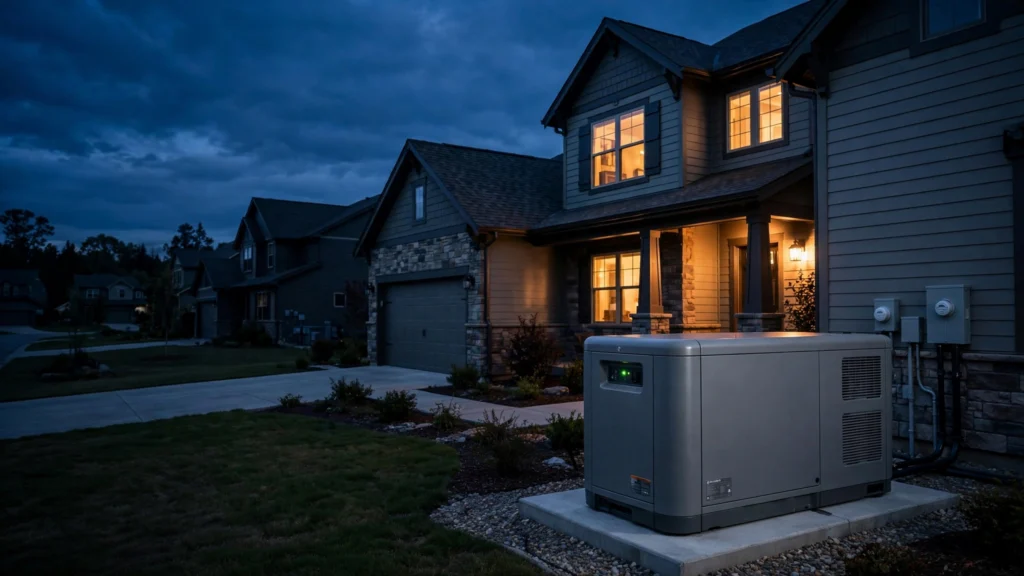
A whole-house standby generator — the kind that sits on a pad outside, fires up automatically when the grid drops, and runs on natural gas or propane — typically costs $10,000 to $16,000 fully installed in 2026 for the most common 22kW size. Smaller 10–14kW systems that cover essentials only can land between $5,000 and $10,500 installed, while large homes with 26kW+ liquid-cooled units, long gas runs, or panel upgrades can push past $20,000.
The surprise for most buyers is that the generator itself is only about half the project cost. When people search for a “Generac generator” price, the $5,500–$7,000 sticker they see is equipment only. Generator installation — the transfer switch, electrician and plumber labor, gas line, pad, permits, and startup — commonly adds another $4,000 to $9,000. Below is every piece of the bill, with realistic 2026 ranges drawn from current installer and cost-aggregator data.
Whole-house generator cost by size
Standby generators are sized in kilowatts (kW). Bigger is not automatically better: oversizing raises the purchase price, the install cost, and your fuel burn during every outage. Here is what each size class typically costs and covers:
| Size | Unit price (equipment only) | Typical installed cost | What it covers |
|---|---|---|---|
| 10kW | $2,000–$3,500 | $5,000–$8,000 | Essential circuits: fridge, furnace fan, lights, sump pump, a few outlets |
| 14kW | $4,000–$5,000 | $7,000–$10,500 | Most of a smaller home, including one AC unit with load management |
| 22kW | $5,000–$7,000 | $10,000–$15,000 | A full 2,000–3,500 sq ft home, including central AC and electric range |
| 24kW | $5,500–$7,500 | $11,000–$16,000 | Full-home coverage with more headroom for large or multiple AC systems |
| 26kW+ | $6,500–$15,000 | $15,000–$25,000+ | Large homes, dual HVAC, workshops, well pumps and heavy loads |
The 22kW class is the best seller for a reason: it is the smallest size that comfortably runs an entire typical American home — air conditioning included — without circuit-by-circuit compromises. The 24kW models cost only a few hundred dollars more than the 22kW and have become many installers’ default quote.
Generac vs Kohler vs Cummins: brand prices compared
Three brands dominate residential standby generators. All three are credible; they differ mainly in dealer network, noise, and how premium the engineering feels.
| Brand and popular model | Unit price | Typical installed range | Best known for |
|---|---|---|---|
| Generac Guardian 22kW | $5,200–$7,000 | $10,000–$15,000 | Largest dealer and service network in the US; widest model range |
| Kohler 20kW RCA | $5,000–$6,800 | $10,000–$14,000 | Quieter operation and a reputation for long service life |
| Cummins QuietConnect 20kW | $5,500–$7,500 | $11,000–$16,000 | Commercial-grade engines; very quiet for its class |
Generac holds the biggest share of the US market, which matters more than spec sheets: parts are everywhere, and nearly every generator installer services them. Generac’s 22kW unit with a 200-amp whole-house transfer switch carries a list price around $6,979, with street prices often a few hundred lower. Kohler typically runs a modest premium for comparable output and is a favorite in noise-sensitive neighborhoods. Cummins prices at the top of the three but brings an industrial engine pedigree — its QuietConnect line is built by a company whose main business is commercial power. Briggs & Stratton and Champion are worth a quote too, usually landing a little under Generac at the same size.
Generator installation cost breakdown
Here is where the money goes on a typical 22kW natural gas install. Your quote should itemize most of these lines — if it does not, ask why.
| Line item | Typical cost | Notes |
|---|---|---|
| Generator unit | $5,000–$7,000 | Often bundled with the transfer switch in a package price |
| Automatic transfer switch | $500–$1,500 | Frequently included with the unit; priced separately on some quotes |
| Electrical labor and materials | $1,500–$4,000 | Licensed electrician: wiring, breakers, panel work, load management |
| Gas line and plumbing labor | $750–$3,000 | The swing factor — depends on distance from the gas meter |
| Concrete or composite pad | $200–$800 | Some installs use a pre-cast pad at the low end |
| Permits and inspections | $100–$500 | Electrical and gas permits; varies by city and county |
| Factory startup and commissioning | $150–$400 | Documents the install for warranty coverage — do not skip it |
| Propane tank (if no natural gas) | $700–$2,500 | Purchase price; leasing is cheaper upfront but locks you to one supplier |
| Electrical panel upgrade (if needed) | $1,500–$4,500 | Only when the existing service cannot support the system |
Add those up and a straightforward 22kW project lands right in the $10,000–$16,000 band. The two most common budget-busters are a long gas run (trenching across a yard adds up fast) and a panel upgrade on an older home.
Running costs: what fuel burns during an outage
A standby generator’s fuel appetite depends on load. A 22kW unit at half load — a realistic outage scenario — burns roughly 228 cubic feet of natural gas per hour, or about 2.5 gallons of propane. At full load those numbers climb to roughly 327 cubic feet and 3.9 gallons.
| Fuel | Cost per hour (half to full load) | Cost per 24-hour outage |
|---|---|---|
| Natural gas | About $3–$5 | About $80–$120 |
| Propane | About $7–$14 | About $170–$330 |
Natural gas is the cheaper and simpler fuel wherever a gas line exists — no tank, no deliveries, and an effectively unlimited runtime. Propane costs roughly two to three times more per outage day and your runtime is capped by tank size: a 250-gallon tank (about 200 usable gallons) lasts around three to four days at half load. Diesel is rare in residential standby systems and mostly appears in larger liquid-cooled units and commercial installs.
Maintenance costs: the annual bill nobody quotes
Standby generators exercise themselves weekly and need real servicing to be there when it counts. Budget $200–$400 per year for a professional annual service — oil and filter change, spark plugs, air filter, battery check, and a load test — with many dealers selling service plans in the $150–$300 range. Angi and HomeGuide data puts professionally maintained units in roughly the same band, and skipping service is the most common reason a generator fails to start mid-outage (and can void warranty terms).
Also plan on a replacement battery every three to five years ($100–$300), occasional repairs as the unit ages, and — if you finance — interest. Over a 15–20 year service life, maintenance typically adds up to a few thousand dollars, which is real money but small next to the install.
Total first-year cost: a worked example
Put it together for a typical 22kW Generac on natural gas:
- Installed project: about $12,500 (mid-range quote)
- First annual service: about $300
- Fuel for two outage days: about $200
- Total first-year cost: roughly $13,000, with a realistic range of $10,500–$17,000 across most homes
After year one, ownership is mostly the $200–$400 annual service plus whatever fuel your outages burn. If a five-figure project does not fit this year’s budget, a partial-home 14kW system or building the purchase into your emergency fund plan over a year or two are both sensible paths — outages are an emergency-fund category of expense either way.
What size generator do you actually need?
Start from what must stay on. Refrigeration, heating system fans, a sump pump, medical equipment, lights, and internet gear draw surprisingly little — an essentials setup often fits in 10–14kW. The big loads are central air conditioning (especially 4–5 ton systems), electric ranges, electric water heaters, well pumps, and hot tubs. Add one or two of those and you are in 22kW territory.
Load-management modules let a smaller generator punch above its weight by pausing big appliances in rotation instead of running everything at once — one reason a 14kW can cover a mid-size home with a single AC unit. Any reputable installer will do a load calculation during the site visit; be wary of a quote given sight unseen.
Who needs a whole-house generator (and who does not)
The strongest cases: someone in the home relies on powered medical equipment; your basement floods without a sump pump; you lose power several times a year or for days at a stretch (hurricane, ice storm, and wildfire-shutoff country); you work from home and outages cost you income; or you have a well pump, meaning no power also means no water. In those situations a standby system is closer to insurance than luxury — and it pairs with, rather than replaces, solid home insurance coverage for the damage outages can cause.
On resale, cost-vs-value studies regularly find that a standby generator recoups a meaningful share — often cited around half — of its installed cost, and in outage-prone markets it can be a listing feature that moves a home faster. If your outages are rare and brief, though, a $800 portable generator and a transfer inlet may cover your real needs for a tenth of the price.
FAQs
How long can a whole-house generator run continuously?
On natural gas, effectively as long as the outage lasts — the fuel supply does not run out. Manufacturers still recommend checking oil every 24–48 hours of continuous running and shutting down briefly for service during multi-day events. On propane, runtime is limited by tank size: roughly three to four days for a typical 250-gallon tank at half load.
Does a whole-house generator increase home value?
It usually helps. Appraisal and cost-vs-value data commonly credit a standby generator with recouping around half of its installed cost at resale, and buyers in storm- and outage-prone regions actively look for them. The effect is strongest where outages are frequent and weakest where the grid is reliable.
Can a 22kW generator run central air conditioning?
Yes — a 22kW unit can typically start and run a 4–5 ton central AC alongside the rest of a normal home’s loads, especially with a soft-start kit or load management on the AC. This is the main reason 22kW became the standard whole-house size.
How long does generator installation take?
The physical install is usually one to two days of work, but the full project — site visit, permits, possible gas-line scheduling, and inspection — commonly takes two to six weeks from signed quote to a commissioned system. Order early if you are buying ahead of storm season.
Do I need a permit to install a standby generator?
Almost always, yes. Expect an electrical permit and usually a gas/plumbing permit, plus a final inspection. A licensed installer handles this as part of the job; an unpermitted install can create problems with your insurer, your warranty, and a future home sale.