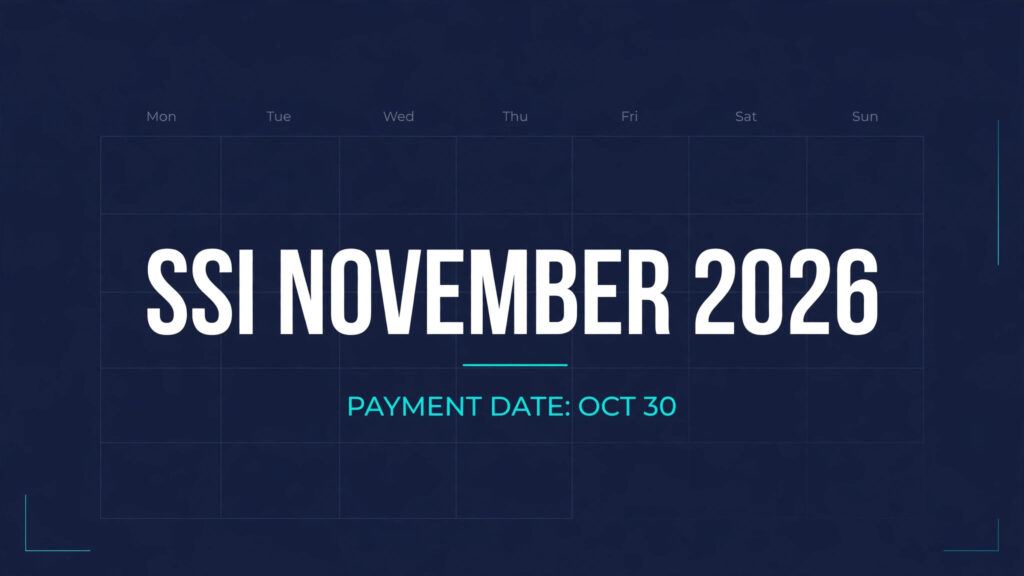
When Does the November 2026 SSI Payment Arrive?
If you receive Supplemental Security Income, your November 2026 payment arrives early. It will be deposited on Friday, October 30, 2026, not on November 1. That is because November 1, 2026 falls on a Sunday, and the Social Security Administration moves the payment to the last business day before the scheduled date.
The practical result catches many recipients by surprise: you will see two SSI deposits in October (your regular October payment on October 1, plus the November payment on October 30) and no SSI deposit at all during November. Nothing is lost and nothing is extra. The October 30 deposit is your November benefit, arriving a few days early because of where the calendar falls.
Why the Date Shifts
SSI payments are normally issued on the first day of each month. The Social Security Administration has a simple rule for months when the first lands on a weekend or a federal holiday: the payment moves to the closest preceding business day. In November 2026, the first is a Sunday, and Saturday, October 31 is also a weekend day, so the last business day before it is Friday, October 30.
This is a routine calendar adjustment, not a bonus, not a special relief measure, and not an advance on savings. Treating the second October deposit as found money is the most common budgeting mistake in these months, because December bills still arrive before the next deposit.
Remaining SSI Payment Dates for 2026
| Deposit date | Payment for | Why this date |
|---|---|---|
| Friday, October 30, 2026 | November 2026 | November 1 is a Sunday |
| Tuesday, December 1, 2026 | December 2026 | Regular first-of-month date |
| Thursday, December 31, 2026 | January 2027 | January 1 is a federal holiday |
Note the same pattern repeats at year end: because New Year Day, January 1, 2027, is a federal holiday, the January 2027 payment arrives early on December 31, 2026. That means two SSI deposits in December (December 1 and December 31) and none dated in January until February 1, 2027.
Who Receives SSI?
Supplemental Security Income is a needs-based program for people with limited income and limited resources who are aged 65 or older, blind, or living with a qualifying disability. It is different from regular Social Security retirement or disability benefits, which are based on work history. For 2026, the maximum federal SSI benefit is $994 per month for an individual and $1,491 per month for a married couple, though many recipients receive less depending on income, living arrangements, and other factors.
What About Regular Social Security Payments in November?
Only the SSI date moves. Regular Social Security retirement, survivor, and disability benefits still arrive in November on their usual schedule, which is based on the birth date of the person whose work record the benefit is paid on. If you receive both Social Security and SSI, your regular Social Security payment for November still arrives on its normal date (the 3rd of the month schedule for dual recipients lands on November 3, 2026), even though your November SSI benefit arrived on October 30.
Do not confuse the two programs when checking your bank account in November: a missing SSI deposit in November is expected, but a missing regular Social Security deposit is not.
How to Budget Across the Gap
The stretch from October 30 to December 1 is 32 days with no new SSI deposit in between. Three steps make it manageable:
- Set the November money aside mentally. The October 30 deposit covers November expenses, not October extras. If it helps, move it to a separate account or envelope on arrival.
- Pay November fixed bills first. Rent, utilities, and phone bills due in early November should come out of the October 30 deposit before discretionary spending.
- Mark December 1 on the calendar. That is the next SSI deposit after October 30. Any bill you can shift to early December is easier to cover than one due in late November.
What to Do If Your Payment Does Not Arrive
If the October 30 deposit does not show up when expected, check the calendar shift first, then check your bank account and your Social Security online account. If the payment is still missing after a few business days, contact the Social Security Administration directly at 1-800-772-1213. Have your Social Security number and bank details ready. Never share your full Social Security number by email or with anyone who contacts you claiming to be from the agency.
Frequently Asked Questions
Is there really no SSI check in November 2026?
Correct. There is no SSI deposit dated in November 2026, because the November benefit is paid early on October 30. You are not missing a payment.
Is the October 30 payment extra money?
No. It is your full November benefit, paid early. There is no second November payment coming later.
Does this affect my regular Social Security check?
No. Regular Social Security payments follow a separate schedule and still arrive in November as usual.
When is the next SSI payment after October 30?
Tuesday, December 1, 2026, which covers December. After that, Thursday, December 31, 2026, which covers January 2027.
What if I just started receiving SSI?
New recipients follow the same calendar. Your first payment date depends on when your claim was approved, but once you are on the regular schedule, the October 30 and December 31 early dates apply to you as well.
The Bottom Line
Circle Friday, October 30, 2026 on the calendar. That is your November SSI payment, arriving early because November 1 is a Sunday. Budget it for November, expect no SSI deposit during November itself, and look for the next deposit on December 1.