The Short Answer: Usually Several Parties at Once — and That’s Good for You
In a car crash, liability is usually one driver versus another. In a truck crash, the person behind the wheel is often just the first name on a longer list: the motor carrier that hired or leased the driver, the freight broker that arranged the load, the shipper that loaded it, the company that maintained the rig, and the manufacturer of any part that failed. Each of those parties can carry its own insurance policy — which means each additional liable party raises the ceiling on what you can recover.
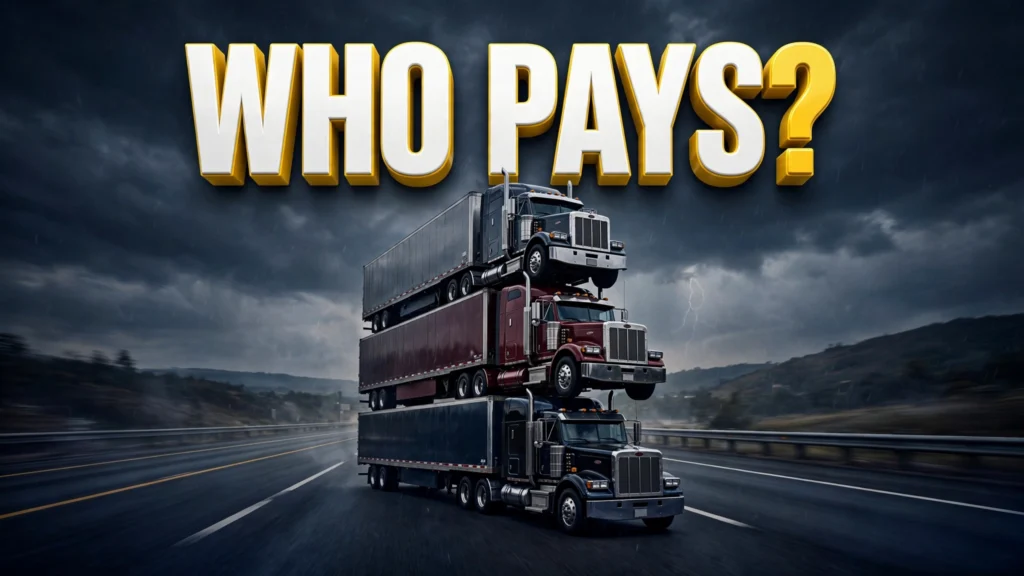
This is the single most important structural fact about truck litigation: more defendants means more stacked insurance pools. A case against the driver alone might be capped at a $750,000 federal-minimum policy. Add the carrier’s umbrella, the broker’s contingent policy, and the shipper’s liability, and the available coverage can multiply. Here is who can be liable, under what theory, and how to think about the stack.
Party 1: The Truck Driver
The driver is liable the same way any motorist is: for negligence — speeding, distracted driving, fatigued driving past hours-of-service limits, following too closely, improper lane changes, driving under the influence. Driver negligence is the foundation of nearly every truck case.
But suing the driver alone is usually a mistake. Individual drivers rarely have meaningful personal assets, and their personal auto policy typically excludes commercial driving. The driver’s real value to your case is as the thread that pulls in everyone above him.
Party 2: The Motor Carrier (the Company on the Door)
The carrier — the company whose name and DOT number are on the truck — is where the serious money usually lives, under several overlapping theories:
Vicarious liability (respondeat superior)
Employers are liable for negligence their employees commit within the scope of employment. If the driver was an employee running the carrier’s load, the carrier owns the driver’s negligence automatically.
The “independent contractor” defense — and why it often fails
Carriers love to say the driver was an independent contractor, not an employee. Courts look past the label to control: who set the schedule, who owned the truck, who dictated the routes, whose placards were on the door. Under federal leasing regulations, carriers operating leased equipment are generally treated as employers of the driver for liability purposes regardless of the contract language. The label on the paperwork rarely decides the case.
Direct negligence: negligent hiring, training, supervision, and retention
Separate from vicarious liability, carriers can be directly negligent: hiring a driver with a terrible safety record, skipping required background checks, failing to train, pushing unrealistic delivery schedules that all but require hours-of-service violations, or keeping a driver after repeated crashes. These claims matter because they open the door to punitive damages in states that allow them — and juries punish companies, not drivers.
Negligent maintenance
Carriers must systematically inspect, repair, and maintain their vehicles under FMCSA rules. Bald tires, worn brakes, faulty lights, unsecured cargo — when maintenance records show skipped inspections, the carrier’s own paperwork becomes the plaintiff’s best exhibit.
Party 3: The Freight Broker — the Twist Most Explainers Bury
Between the shipper with freight and the carrier with trucks often sits a freight broker — a middleman that arranges the transportation for a fee without ever touching the freight. Brokers carry their own insurance (often $1M+ contingent policies), and reaching them can add an entire fresh policy to your stack.
Broker liability is the most contested frontier in truck litigation, and theories vary by state:
- Negligent selection / hiring. The broker chose an unsafe carrier — one with terrible safety scores, lapsed insurance, or a history of violations — when safer options were available. FMCSA safety data is public; a broker that hired a carrier with an atrocious record without checking faces a straightforward negligence argument.
- Vicarious liability theories. Some courts have held brokers liable for the carrier’s negligence where the broker exercised enough control over the shipment. This is hotly litigated and jurisdiction-dependent — but it is live law in several states, not a fringe theory.
- Federal preemption defense. Brokers routinely argue that federal law preempts state-law negligence claims against them. Courts are split, and the law is evolving — which is exactly why broker claims need to be evaluated under the specific state’s current case law rather than assumed away.
The practical takeaway: always investigate the broker. Even where broker liability is an uphill fight, the investigation itself often uncovers the carrier-selection documents that strengthen the negligent-hiring case against everyone else.
Party 4: The Shipper (and Loader)
The company whose freight was on the truck can share liability when:
- It overloaded the trailer beyond legal weight limits, affecting braking and stability.
- It improperly loaded or secured cargo — shifting freight causes rollovers and jackknifes. Federal cargo-securement rules set the standard.
- It hired the carrier directly and negligently selected an unsafe one (the same negligent-selection theory as brokers).
- Hazmat was involved and the shipper misclassified, mislabeled, or improperly packaged it.
Party 5: Maintenance Contractors and Parts Manufacturers
Many carriers outsource maintenance. If a third-party shop signed off on brakes that failed a week later, the shop shares liability. And when a component itself was defective — a tire blowout from a manufacturing defect, a faulty coupling, a failed brake chamber — the manufacturer faces a product-liability claim, which is strict liability in most states: no negligence to prove, only a defective product and causation.
The Decision Table: Cause → Who to Pursue
| If the crash was caused by… | Pursue | Why |
|---|---|---|
| Driver error (speeding, distraction, fatigue) | Driver + carrier | Vicarious liability; carrier’s deeper policy |
| Hours-of-service violation | Driver + carrier | Unrealistic schedules = direct carrier negligence |
| Bad hiring (terrible driver record) | Carrier (+ broker if one selected the carrier) | Negligent hiring/selection; punitive-damage potential |
| Mechanical failure | Carrier + maintenance shop + parts manufacturer | Negligent maintenance + strict product liability |
| Overloaded / shifting cargo | Shipper/loader + carrier | Cargo-securement violations |
| Unsafe carrier selection | Broker and/or shipper | Negligent selection; additional insurance pool |
How the Insurance Stacks
Each liable party brings its own coverage to the table. A realistic stack on a serious case:
- Carrier primary liability: $750,000 federal minimum, often $1M
- Carrier umbrella/excess: $1M–$10M+ on larger fleets
- Broker contingent liability: often $1M
- Shipper CGL policy: $1M+
- Your own UIM coverage: fills gaps if the stack still falls short
This is why early investigation matters more in truck cases than car cases: every additional defendant identified is another policy added to the pool. A lawyer who sues only the driver has left most of the money on the table before the case even starts.
Frequently Asked Questions
The truck had the carrier’s logo but the driver says he’s independent. Who do I sue?
Both — and let the court sort out the employment question. Federal leasing rules and the control test mean the “independent contractor” label fails more often than carriers admit, and you lose nothing by naming the carrier.
Can I sue the broker if I don’t know who it was?
The bill of lading and dispatch records identify the broker. That paperwork is exactly what early discovery targets — another reason to move fast before records scatter.
What if the carrier is a tiny company with minimum insurance?
That is precisely when broker, shipper, and UIM theories matter most. Small carriers are also the most likely to have hired unsafe drivers and skipped maintenance — which strengthens direct-negligence claims.
Does it matter which state’s law applies?
Enormously. Vicarious liability, broker-liability theories, comparative fault, damage caps, and punitive-damage availability all vary by state. Interstate truck cases routinely involve choice-of-law fights — file strategically.
How long do I have to identify all these parties?
The statute of limitations (typically 2–3 years depending on the state) applies to every defendant. Parties discovered late can sometimes be added, but waiting is how claims against deep-pocket defendants die on technicalities.
The Bottom Line
Truck-accident liability is a stack, not a single name: driver negligence at the base, carrier liability (vicarious and direct) above it, broker and shipper theories adding fresh insurance pools, and maintenance and product claims at the margins. The hub question — driver vs. carrier vs. broker — is really a question about how many policies you can bring to bear on your damages. Investigate every layer early, name every viable defendant, and let the stacked coverage do what a single minimum-limits policy never could.