The Short Answer: The Fine Is Just the Start
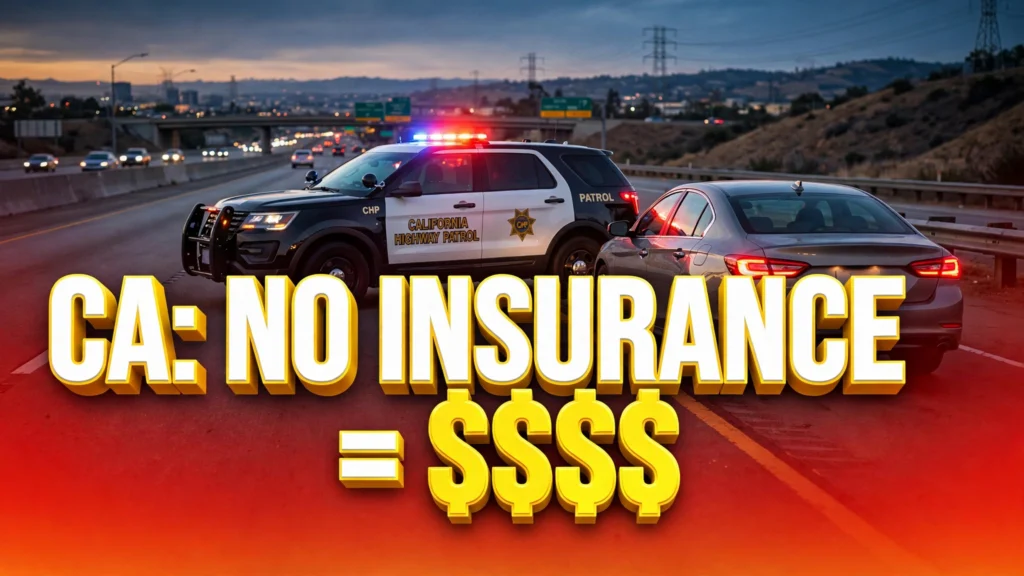
California requires every driver to carry minimum liability insurance — 15/30/5, meaning $15,000 per person and $30,000 per accident in bodily injury coverage plus $5,000 in property damage. Drive without it and Vehicle Code §16029 sets a base fine of $100 to $200 for a first offense, rising to $200 to $500 for repeat offenses within three years. That sounds manageable until California’s penalty assessments kick in: the state and counties stack surcharges on top of the base fine that typically multiply the total several times over, so a first offense commonly costs drivers several hundred dollars out of pocket. And the money is only half the problem — your car can be impounded on the spot, your license can be suspended, and you’ll likely be filing SR-22 certificates for the next three years.
First Offense: What the Ticket Actually Costs
The base fine under §16029 is only the headline number. California adds a stack of penalty assessments — state penalty, county penalty, court construction fees, DNA surcharges, and more — to nearly every traffic fine. The practical result:
| Component | First offense | Repeat offense (within 3 years) |
|---|---|---|
| Base fine (VC §16029) | $100–$200 | $200–$500 |
| Penalty assessments & surcharges | Typically multiply the base fine several times over | |
| Realistic out-of-pocket total | Commonly several hundred dollars, often $400+ | |
That “realistic total” is deliberately hedged — the exact multiplier varies by county — but the pattern is consistent: nobody in California pays just the base fine. On top of the ticket itself, expect tow and impound fees if the officer has your car towed, which can add hundreds more before you get the vehicle back. And if you cannot show proof of insurance when the officer asks, the citation issues on the spot; “I’ll buy a policy tomorrow” is not a defense, though getting insured quickly can sometimes help with the judge.
Your Car Can Be Impounded Immediately
Many drivers are surprised to learn the punishment starts at the roadside. An officer who stops you and finds no valid insurance may have your vehicle towed and impounded on the spot — you walk home and pay storage fees for every day it sits in the lot. Getting it back requires showing valid insurance and paying the tow and daily storage charges, which accumulate fast. For a driver already skipping insurance to save money, a single stop can easily turn into a four-figure problem within a week.
License Suspension: How It Works and How Long It Lasts
A conviction for driving without insurance goes on your record, and the DMV can suspend your driving privilege until you file proof of insurance — in practice, an SR-22 certificate — and pay a reissue fee. The situation gets much worse if you were uninsured in an accident:
- Accident while uninsured: the DMV can suspend your license for up to four years or until you satisfy any resulting judgment or reach a settlement — whichever comes first.
- Injury or death involved: the financial exposure behind that suspension can run into the tens or hundreds of thousands of dollars, all of it coming out of your pocket because there is no insurer to absorb it.
- Getting reinstated: you will need to file an SR-22, maintain it continuously (usually three years), and pay the DMV’s reissue fee. Any gap in SR-22 coverage restarts the clock and can trigger a new suspension.
The license math is what makes uninsured driving so expensive over time: one ticket can mean years of elevated premiums plus SR-22 filing fees, dwarfing whatever you “saved” by skipping coverage.
SR-22: Three Years of Paperwork and Higher Premiums
An SR-22 is not insurance itself — it is a certificate your insurer files with the DMV proving you carry the state’s minimum coverage. After an uninsured-driving conviction, California typically requires you to maintain SR-22 filings for three years. What it costs you:
- Filing fee: insurers typically charge around $15–$50 to file the certificate.
- The real cost is the premium: you are now rated as a high-risk driver, and high-risk premiums commonly run 50% to well over double what a clean-record driver pays for the same coverage. On a $150/month baseline policy, that can mean an extra $75–$200+ per month — for three years, that is $2,700 to $7,200+ in surcharges alone.
- No lapses allowed: if your policy cancels or lapses, the insurer notifies the DMV, your SR-22 drops, and your license can be suspended again.
Not every insurer writes SR-22 policies, so comparison shopping matters even more than usual. Some carriers specialize in high-risk drivers and price meaningfully lower than the big standard-market names.
Prop 213: The Penalty Nobody Warns You About
Here is the California rule that quietly costs uninsured drivers the most money. Under Proposition 213 (passed in 1996), a driver who was uninsured at the time of an accident cannot recover non-economic damages — pain, suffering, inconvenience, emotional distress — even when the other driver was 100% at fault. You can still recover economic damages like medical bills and lost wages, but the pain-and-suffering portion of a claim, which is often the largest component, is off the table entirely.
Put numbers on it: if a drunk driver hits you and your case would have been worth $60,000 — $20,000 in medical bills and lost wages plus $40,000 in pain and suffering — being uninsured at that moment costs you the $40,000, through no fault of your own in the crash. That single rule makes driving uninsured in California uniquely expensive compared to most other states.
How to Get Legal Again: A Checklist
If you are currently uninsured, the cheapest day to fix it is today. Every day you drive uninsured is another day of exposure:
- Buy at least the 15/30/5 minimums immediately — liability coverage can be bound the same day, often online in minutes.
- Shop at least three quotes. California’s market is competitive; the cheapest and most expensive quotes for identical coverage routinely differ by 40% or more.
- Ask about low-cost options. California’s Low Cost Auto Insurance Program offers liability coverage to income-eligible drivers for as little as roughly $100–$300 per year depending on the county — far cheaper than any ticket.
- Keep proof in the car and on your phone. An officer who cannot verify coverage will cite you; digital proof on your phone counts.
- Never let it lapse. Set autopay. A one-day gap that happens to coincide with a traffic stop is legally the same as never having insurance.
Frequently Asked Questions
Is driving without insurance a misdemeanor in California?
A first offense under VC §16029 is an infraction, not a misdemeanor — but do not let that comfort you. The financial consequences (fine plus assessments, impound, SR-22, premium hikes) routinely exceed the cost of many misdemeanors, and repeat offenses and accident involvement escalate everything.
Can I get the ticket dismissed if I buy insurance after?
Sometimes partially. Judges have discretion, and showing up with a valid policy you bought promptly after the citation can lead to a reduced fine in some courtrooms — but it is not a legal defense, there is no guarantee, and the assessments and DMV consequences often apply regardless.
Does California’s Low Cost Auto Insurance Program really exist?
Yes. The state-run program provides minimum-liability policies to drivers who meet income and vehicle-value requirements, with annual premiums that are typically a fraction of standard market rates. If cost is why you are uninsured, check your eligibility before risking a ticket.
How long does an uninsured-driving conviction stay on my record?
The conviction itself and the associated SR-22 requirement typically run three years, and insurers can surcharge for it for three to five years depending on the carrier. The cheapest way to shorten the pain is to maintain continuous coverage from the day of the ticket forward.
The Bottom Line
California’s $100–$200 base fine is a decoy — assessments, impound fees, license suspension, three years of SR-22 filings, and years of high-risk premiums turn one ticket into a multi-thousand-dollar event. And Prop 213 means that if someone hits you while you are uninsured, you forfeit pain-and-suffering damages no matter how clearly the other driver was at fault. Minimum liability coverage in California can cost less per month than a single tank of gas. There is no version of this math where driving uninsured wins.