The Short Answer: It Depends on the Injury Tier — and the Policy Behind the Truck
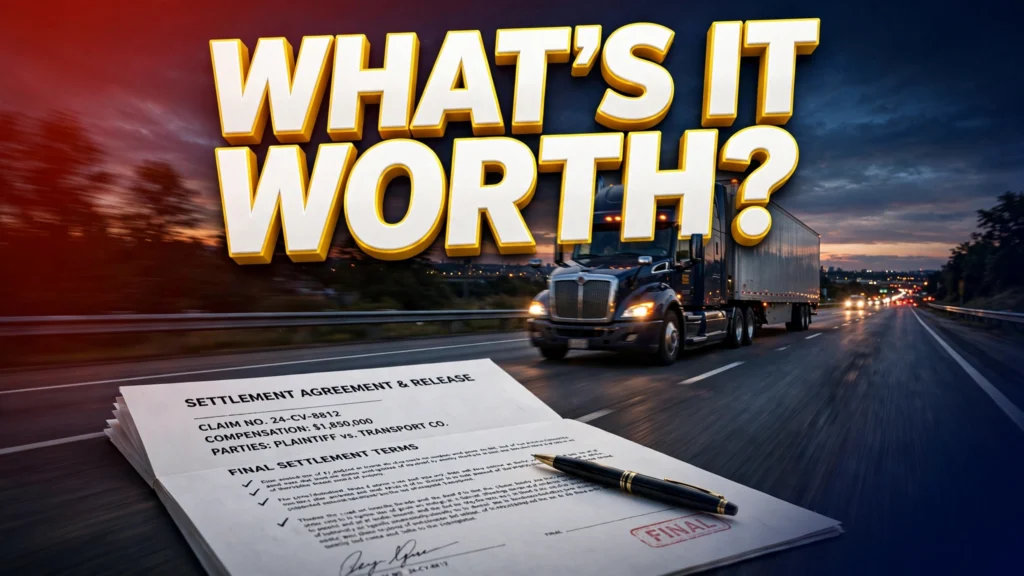
If you were hit by a semi-truck, you have probably seen settlement figures online ranging from $30,000 to several million dollars. Both ends are real. As a rough, hedged picture of how these claims typically break down by injury severity:
| Injury tier | Typical settlement range |
|---|---|
| Soft-tissue / whiplash, full recovery | $20,000–$75,000 |
| Fractures, surgery required | $100,000–$500,000 |
| Permanent disability, TBI, spinal injury | $500,000–$2,000,000+ |
| Wrongful death | $1,000,000–$5,000,000+ |
These are broad ranges, not promises — no two cases settle alike. But here is the part most articles bury: the single biggest factor in what you actually collect is often not how badly you were hurt, but how much insurance sits behind the truck. A catastrophic injury against a carrier with minimum limits can be worth less in hand than a moderate injury against a well-insured fleet. Understanding that mechanic is how you read your own claim’s value honestly.
Why Truck Settlements Run Higher Than Car-Accident Settlements
Three structural reasons push truck-claim values above ordinary car crashes:
- Bigger policies. Federal law (FMCSA regulations) requires interstate carriers to carry at least $750,000 in liability coverage — and $1M to $5M for hazardous materials. Many large fleets carry $1M–$2M primary plus umbrella layers. A typical at-fault driver in a car crash may carry a state minimum of $25,000–$50,000. The available pool is simply larger.
- More severe injuries. An 80,000-pound rig at highway speed produces forces no passenger car can match. Catastrophic injuries — traumatic brain injuries, spinal cord damage, amputations — are disproportionately common, and damages scale with injury severity.
- Corporate defendants with compliance paper trails. Trucking companies are regulated: hours-of-service logs, maintenance records, driver qualification files, drug-and-alcohol testing. When a carrier cut corners, the paper trail proves it — and juries punish companies, not just drivers.
The Real Decider: Commercial Policy Limits vs. State Minimums
Think of your claim’s value as the lower of two numbers: what your damages are worth, and what insurance actually exists to pay them.
Scenario A: Big fleet, big policy
A national carrier with a $2M primary policy and a $5M umbrella hits you and causes $800,000 in medical bills, lost wages, and pain and suffering. The money is there. Your case settles near full value — often $700,000 to $1M+.
Scenario B: Small carrier, minimum limits
An owner-operator running on the federal minimum $750,000 policy causes the same $800,000 in damages. Even with a perfect case, collection is capped near the policy unless the carrier has reachable assets — which small carriers often do not. Your recovery may land at $500,000–$750,000 despite identical injuries.
Scenario C: The underinsured gap
If the at-fault truck’s coverage falls short of your damages, your own underinsured motorist (UIM) coverage can fill the gap — one more reason high UIM limits on your personal auto policy are worth every penny of premium.
This is also why identifying every liable party matters so much: the driver, the carrier, the broker, the shipper, the maintenance contractor — each can bring its own insurance policy into the pool. More defendants, more coverage, higher ceiling.
What Moves Your Number Up
- Clear regulatory violations. Hours-of-service violations, skipped inspections, a driver with a bad safety record the carrier hired anyway — each converts a “he said, she said” crash into a corporate-negligence case.
- Permanent impairment. Anything that changes your earning capacity — a back that will never be the same, cognitive deficits, chronic pain — multiplies damages because future losses get calculated in.
- Strong evidence preserved early. Black-box (ECM) data, dashcam footage, and driver logs captured before they are overwritten or “lost” can be the difference between a policy-limits demand and a lowball offer.
- A venue that holds carriers accountable. Some jurisdictions are friendlier to plaintiffs than others; where the case is filed genuinely affects settlement posture.
What Drags Your Number Down
- Comparative fault. If you were speeding, distracted, or cut off the truck, most states reduce your recovery by your percentage of fault — and a few bar recovery entirely above 50%.
- Gaps in medical treatment. Waiting weeks to see a doctor, or stopping treatment early, lets the insurer argue you were not really hurt.
- Pre-existing conditions in the same body part — not fatal to a claim, but they give the defense an argument that requires strong medical testimony to overcome.
- Recorded statements given too early. Anything you tell the carrier’s insurer in the first days can be used to minimize the claim. You are not obligated to give one.
- Social media. Photos of you hiking three weeks after a “debilitating” back injury will surface. Assume everything is discoverable.
How the Money Breaks Down: Where the Settlement Goes
A $500,000 settlement is not $500,000 in your pocket. A typical distribution looks like this:
| Slice | Typical share |
|---|---|
| Medical liens (health insurer, hospital, Medicare/Medicaid) | Often 20–40% — negotiated down by your attorney |
| Attorney’s contingency fee | Usually 33–40% |
| Case costs (experts, depositions, filing fees) | $5,000–$50,000+ on big cases |
| You | Whatever remains — this is why lien negotiation matters as much as the top-line number |
Two cases with identical $500,000 settlements can put wildly different amounts in the client’s pocket depending on lien negotiation. When people ask “what is my case worth,” the honest answer is the net, not the headline.
What to Do After a Semi-Truck Crash
- Get medical care immediately — adrenaline masks injuries; documentation starts the clock on your damages.
- Call the police and get the report. Make sure the truck’s DOT number and the carrier’s name are recorded.
- Photograph everything — the scene, the truck’s placards and DOT number, your vehicle, your injuries.
- Do not give a recorded statement to the trucking company’s insurer.
- Preserve the truck’s data fast. Send (or have counsel send) a spoliation letter demanding preservation of the black box, dashcam, and driver logs — this data can be overwritten in weeks.
- Track every expense and missed workday from day one.
Frequently Asked Questions
How long does a semi-truck settlement take?
Straightforward cases with clear liability can settle in 6–12 months. Cases with disputed fault, catastrophic injuries (where full prognosis takes time), or multiple defendants often run 18 months to 3+ years. Rushing a catastrophic-injury case before your medical picture is stable almost always costs you money.
Will my case go to trial?
Probably not — the large majority of truck cases settle. But carriers pay more when they believe your side is actually prepared to try the case. Trial readiness is leverage, not just a threat.
What if the truck driver was an independent contractor?
The “independent contractor” label does not end the inquiry. Carriers are frequently still liable under federal leasing regulations and agency theories — and the broker or shipper may share liability too. Multiple defendants mean multiple policies.
Can I still recover if I was partly at fault?
In most states, yes — your recovery is reduced by your share of fault. In a handful of states, being more than 50% at fault bars recovery entirely. The truck’s insurer will push hard to inflate your share; evidence decides it.
What is my case worth if I only had soft-tissue injuries?
Typically in the tens of thousands, driven mostly by medical bills and documented pain and suffering. These cases settle faster but for less — and inflated treatment can backfire with juries and adjusters alike.
The Bottom Line
The average semi-truck accident settlement is less a single number than a range set by your injury tier — tens of thousands for soft-tissue injuries, deep six figures for surgical cases, seven figures for catastrophic harm. But the ceiling on your recovery is set by the insurance behind the truck, which is why identifying every liable party and preserving evidence early matters as much as the medicine. Document everything, protect the black-box data, and evaluate any offer on the net in your pocket — not the headline.