Roth vs Traditional IRA: Pros and Cons
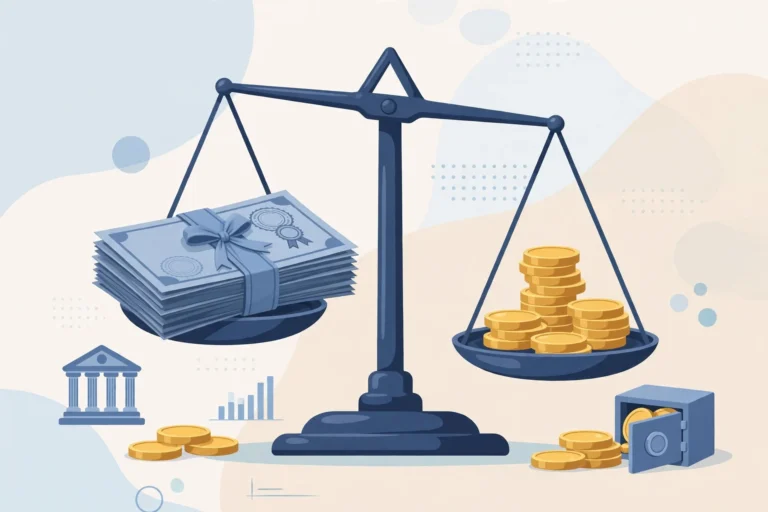
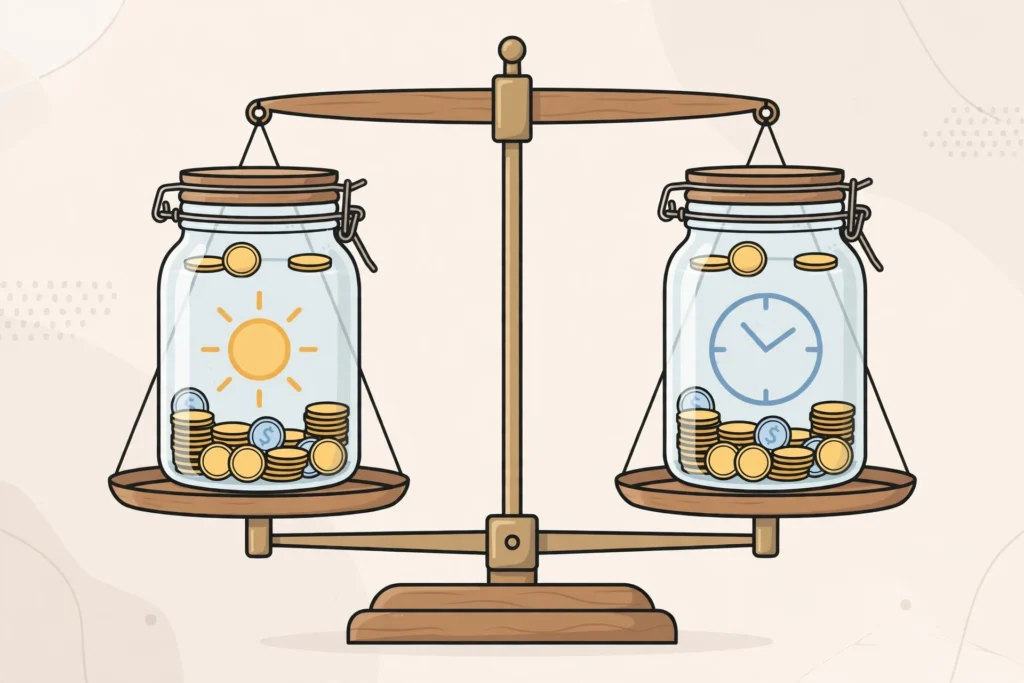
Choosing between a Roth IRA and a traditional IRA comes down to one question: do you want to pay tax now, or pay tax later? Both accounts hold the same kinds of investments, share the same annual contribution limit, and let your money grow without a yearly tax bill on dividends and gains inside the account. The difference is timing, and that timing can change how much money you actually keep in retirement.
This guide compares the pros and cons of a Roth IRA versus a traditional IRA, covers the 2026 contribution and income limits, explains the withdrawal rules, and lays out when each account usually makes more sense. It is general information only, not personalized financial or tax advice. Tax rules change, and limits are adjusted for inflation, so confirm the current figures with the IRS or your IRA provider before you contribute.
The Core Difference: Tax Now vs Tax Later
A traditional IRA gives you a tax break now. Contributions may be deductible from your taxable income in the year you contribute, your money grows tax-deferred, and you pay ordinary income tax on withdrawals in retirement.
A Roth IRA flips that order. You contribute with after-tax dollars, so there is no deduction now. In exchange, qualified withdrawals in retirement are tax-free, including decades of growth.
Here is the simple rule that drives most decisions: if your tax rate today is higher than your expected tax rate in retirement, a traditional IRA usually comes out ahead. If your tax rate today is lower than your expected rate in retirement, a Roth IRA usually comes out ahead. If the rates turn out to be the same, the two accounts can leave you with roughly the same after-tax amount, because the math works out the same whether tax is taken at the start or at the end.
That last point surprises many people. A Roth account can look like a landslide winner in examples that show a large traditional IRA balance being taxed on withdrawal but forget to count the tax the Roth saver already paid on the way in. A fair comparison always counts tax on both sides.
Roth IRA Pros and Cons
Roth IRA Pros
- Tax-free withdrawals in retirement. Once you meet the qualified withdrawal rules, described below, you pay no federal income tax on contributions or earnings when they come out. That makes retirement income easier to plan, because the number you see in the account is the number you keep, at least for federal tax purposes.
- No required minimum distributions during your lifetime. A traditional IRA forces withdrawals starting at a set age, whether you need the money or not. A Roth IRA has no required minimum distributions for the original owner, so the money can keep growing tax-free for as long as you leave it there.
- Flexible access to contributions. You can withdraw your original contributions at any time, tax-free and penalty-free, because you already paid tax on that money. Earnings are a different story, and the rules for earnings are stricter, but the contribution flexibility makes a Roth IRA a quiet backup source of funds in a pinch. It should not replace a dedicated emergency fund, but the flexibility is real.
- Tax diversification in retirement. Having some tax-free money alongside taxable income gives you more control. In a year when other income is high, drawing from a Roth account does not add to your taxable income. That can matter for tax brackets, Medicare premiums, and how much of your Social Security benefits are taxed.
- Helpful for heirs. Heirs who inherit a Roth IRA generally receive tax-free withdrawals, although non-spouse heirs are typically required to empty the account within 10 years under current rules. Heirs who inherit a traditional IRA usually owe ordinary income tax on withdrawals, often during their own peak earning years.
Roth IRA Cons
- No tax deduction now. Every dollar you contribute has already been taxed. If you are in a high tax bracket today, giving up the deduction is a real cost, especially if you expect a lower bracket in retirement.
- Income limits restrict direct contributions. Roth IRAs phase out at higher incomes, as detailed in the 2026 limits section below. Above the phase-out range, you cannot contribute directly, although some savers use a conversion strategy. That route has its own tax rules and is worth understanding fully before using it.
- Earnings rules are strict. Tax-free treatment of earnings requires two conditions: you must be at least age 59 and a half, and your first Roth contribution must have been at least five tax years earlier. Withdraw earnings before meeting both conditions and you may owe ordinary income tax plus a 10 percent penalty on the earnings portion, with some exceptions.
- Paying tax now hurts if your rate falls later. If you pay tax at a high rate today and retire into a much lower bracket, you paid more than you needed to. That is the main risk of choosing a Roth IRA during peak earning years.
Traditional IRA Pros and Cons
Traditional IRA Pros
- A tax deduction now. If you qualify, a deductible contribution lowers your taxable income in the year you contribute. For a high earner, that deduction can be worth hundreds or even thousands of dollars in a single year, depending on the contribution amount and tax bracket. The money you save on tax can itself be invested, which is part of the traditional IRA advantage when the deduction rate is higher than the withdrawal rate.
- No income cap on contributing. Anyone with earned income can contribute to a traditional IRA, regardless of income level. The deduction may phase out at higher incomes if you or your spouse are covered by a workplace retirement plan, but the ability to contribute itself has no income limit.
- Tax-deferred growth. Like a Roth IRA, a traditional IRA lets investments grow without yearly tax on dividends and gains inside the account. You only pay tax when money comes out.
- A good fit for peak earning years. If you are in a high bracket now and expect lower income in retirement, for example after you stop working and before other income sources begin, the deduction now and lower tax later combination is the traditional IRA sweet spot.
Traditional IRA Cons
- Withdrawals are taxed as ordinary income. Every dollar that comes out of a deductible traditional IRA, contributions and earnings alike, is taxed as ordinary income in the year of withdrawal. That includes money that would have been taxed at lower capital gains rates in a regular taxable account.
- Required minimum distributions. Traditional IRA owners must start taking required minimum distributions, known as RMDs, starting at age 73, or age 75 if born in 1960 or later under current law. Miss an RMD and the penalty can be steep, generally 25 percent of the amount you failed to withdraw, reduced to 10 percent if corrected within a set window. RMDs also raise your taxable income each year, whether you need the money or not.
- Early withdrawals are costly. Withdrawals before age 59 and a half are generally taxed as ordinary income plus a 10 percent penalty on the full amount, with narrow exceptions such as disability, certain medical expenses, and up to 10,000 dollars for a first home purchase. That makes a traditional IRA a poor source of early emergency cash.
- The nondeductible trap. If you are covered by a workplace plan and your income is above the deduction phase-out range, your contribution may not be deductible at all. A nondeductible traditional IRA still grows tax-deferred, but its earnings are taxed on withdrawal, so it gives you the downside of both accounts: no deduction now and taxable growth later. In that situation, a Roth IRA, if you qualify, is usually the cleaner choice.
Roth vs Traditional IRA: Side-by-Side Comparison
| Feature | Roth IRA | Traditional IRA |
|---|---|---|
| Tax break timing | None now, tax-free qualified withdrawals later | Possible deduction now, taxable withdrawals later |
| 2026 contribution limit | 7,500 dollars combined across all IRAs, 8,600 dollars at age 50 or older | Same combined limit |
| Income limit to contribute | Yes, phases out at higher incomes | None |
| Deduction limits | No deduction to phase out | Deduction phases out if covered by a workplace plan |
| Tax on growth inside the account | None while money stays in the account | None while money stays in the account |
| Tax on retirement withdrawals | Tax-free if qualified | Taxed as ordinary income |
| Early access to contributions | Contributions withdrawable anytime, tax-free and penalty-free | Withdrawals before 59 and a half generally taxed plus 10 percent penalty |
| Required minimum distributions | None during the owner’s lifetime | Yes, starting at age 73, or 75 if born in 1960 or later |
| Best for | Lower bracket now, higher bracket later, flexibility, legacy planning | Higher bracket now, lower bracket later, deduction value now |
2026 Contribution and Income Limits
For 2026, the IRS set the IRA contribution limit at 7,500 dollars across all your IRAs combined, or 8,600 dollars if you are age 50 or older, including catch-up contributions. The limit is also capped at 100 percent of your compensation if that is less. Splitting is allowed: for example, you could put part of the limit in a Roth IRA and part in a traditional IRA, but the combined total cannot exceed the limit.
Roth IRA direct contributions phase out based on modified adjusted gross income. For 2026, the phase-out ranges are 153,000 to 168,000 dollars for single filers and head of household filers, and 242,000 to 252,000 dollars for married couples filing jointly. Below the range, you can contribute the full amount. Inside the range, your allowed contribution shrinks. Above the range, you cannot contribute directly.
Traditional IRAs have no income cap on contributing, but the deduction is a separate question. If neither you nor your spouse is covered by a workplace retirement plan, the deduction is generally available regardless of income. If you are covered by a workplace plan, the 2026 deduction phases out from 77,000 to 87,000 dollars for single filers and from 123,000 to 143,000 dollars for married couples filing jointly. Check the current IRS phase-out tables for your exact filing status and coverage situation, because these ranges change every year.
The deadline for a given tax year contribution is generally the tax filing deadline in the following spring, typically April 15, so you have time after year-end to decide and fund the prior year contribution.
Withdrawal Rules in Plain Language
Both accounts allow penalty-free withdrawals after age 59 and a half, but the details differ.
For a Roth IRA, your contributions come out first and are always tax-free and penalty-free. Earnings are tax-free only once you are 59 and a half and your first Roth contribution was at least five tax years ago. That five-year clock starts with your first Roth contribution, not with each new contribution, which is an important detail for new Roth savers.
For a traditional IRA, withdrawals after 59 and a half are penalty-free but fully taxable as ordinary income. Withdrawals before 59 and a half are generally taxed plus a 10 percent penalty, with limited exceptions. And as noted above, required minimum distributions begin at age 73, or 75 for those born in 1960 or later, and continue every year after that.
One practical tip: because Roth contributions are accessible at any time, some savers open a Roth IRA early, even with a small amount, to start the five-year clock. That is a reasonable planning step, but it does not change the earnings rules for conversions, which carry their own five-year clocks.
When a Roth IRA Usually Wins
A Roth IRA usually wins when your tax rate today is low relative to what you expect in retirement. Common examples include early-career workers in lower brackets, students and part-time workers with modest income, savers in a temporarily low-income year, and anyone who expects a pension, rental income, or other retirement income that will keep their bracket high later. A Roth IRA also tends to win when flexibility matters most: you want tax-free income options in retirement, you want to leave money to heirs without a tax bill attached, or you want to avoid forced withdrawals in your seventies and beyond.
When a Traditional IRA Usually Wins
A traditional IRA usually wins when you are in a high bracket now, you qualify for the full deduction, and you expect a lower bracket in retirement. That pattern fits many peak earners, especially those who plan to retire to a lower-tax state, draw down gradually, or spend several low-income years between retiring and claiming other benefits. The larger the gap between today’s deduction rate and tomorrow’s withdrawal rate, the stronger the traditional IRA case. A gap of several percentage points, sustained over many years, can outweigh the appeal of tax-free withdrawals.
Can You Split Between Both?
Yes, and splitting is a reasonable hedge, because nobody knows future tax rates with certainty. Tax law itself can change, your income path can surprise you, and retirement spending rarely matches a neat forecast. Contributing to both accounts gives you both kinds of money in retirement: taxable traditional IRA withdrawals you can draw in low-income years, and tax-free Roth withdrawals you can draw when other income is high. The combined limit still applies, so splitting means dividing the same annual amount, not doubling it.
A sensible way to think about splitting is to ask which tax rate you are more confident about. If you are fairly sure today’s rate is unusually low, lean Roth. If you are fairly sure today’s rate is unusually high, lean traditional. If you are unsure, or your income swings from year to year, splitting removes the pressure of getting one forecast exactly right.
Common Mistakes to Avoid
First, do not assume a Roth IRA is always better because withdrawals are tax-free. Tax-free later is only a win if the tax you paid now was lower than the tax you would have paid later. Second, do not contribute to a traditional IRA and assume the deduction is automatic. If a workplace plan covers you, check the phase-out range first. Third, do not forget the combined limit. Contributing the full limit to both accounts in the same year is an excess contribution that must be corrected. Fourth, do not ignore RMDs. Traditional IRA owners should plan for forced withdrawals and their tax effect well before age 73. Finally, do not treat either account as an emergency fund by default. Roth contributions are accessible, but raiding retirement savings early sacrifices decades of compounding, and traditional IRA early withdrawals add tax and penalties on top.
The Bottom Line
There is no single winner in the Roth versus traditional IRA debate, because the right answer depends on your tax rate today versus your tax rate in retirement. A Roth IRA trades a deduction now for tax-free withdrawals, flexibility, and no lifetime required distributions. A traditional IRA trades taxable withdrawals later for a deduction now and tax-deferred growth. If you are early in your career or in a low bracket, the Roth case is usually stronger. If you are at peak earnings with a deductible contribution and expect a lower bracket later, the traditional case is usually stronger. And if you are unsure, splitting between the two is a defensible middle path.
The bigger win, whichever account you choose, is contributing regularly, every year, and letting the money compound. A well-chosen account that you fund consistently will beat a perfect account choice that you never get around to funding.
Frequently Asked Questions
Can I have both a Roth IRA and a traditional IRA?
Yes. You can hold both accounts, and you can contribute to both in the same year. The annual contribution limit applies to your combined IRA contributions, not to each account separately, so the total across both cannot exceed the limit for that year.
What is the difference between a Roth IRA and a traditional IRA in one sentence?
A traditional IRA may give you a tax deduction now and taxes withdrawals in retirement, while a Roth IRA gives you no deduction now but lets qualified withdrawals come out tax-free.
Do Roth IRAs have required minimum distributions?
No, not during the original owner’s lifetime. Traditional IRAs require minimum distributions starting at age 73, or age 75 if you were born in 1960 or later. Inherited IRAs of both types have distribution rules for beneficiaries, so heirs should check the current rules when they inherit an account.
Can I withdraw Roth IRA contributions before retirement without penalty?
Yes, your original contributions can be withdrawn at any time, tax-free and penalty-free, because you already paid tax on them. Earnings are different: withdrawing earnings before age 59 and a half and before the five-year rule is met may trigger tax and a 10 percent penalty, with some exceptions.
What if I earn too much for a direct Roth IRA contribution?
Above the Roth income phase-out range, you cannot contribute directly, but you may still be able to contribute to a traditional IRA. Some savers then convert that contribution to a Roth IRA, a strategy often called a backdoor Roth IRA. Conversions have tax rules of their own, including how existing pre-tax IRA balances affect the tax bill, so understand the rules or get qualified tax guidance before using this strategy.