The Short Answer: $300 to $6,000+ — and Where You Go Matters Most
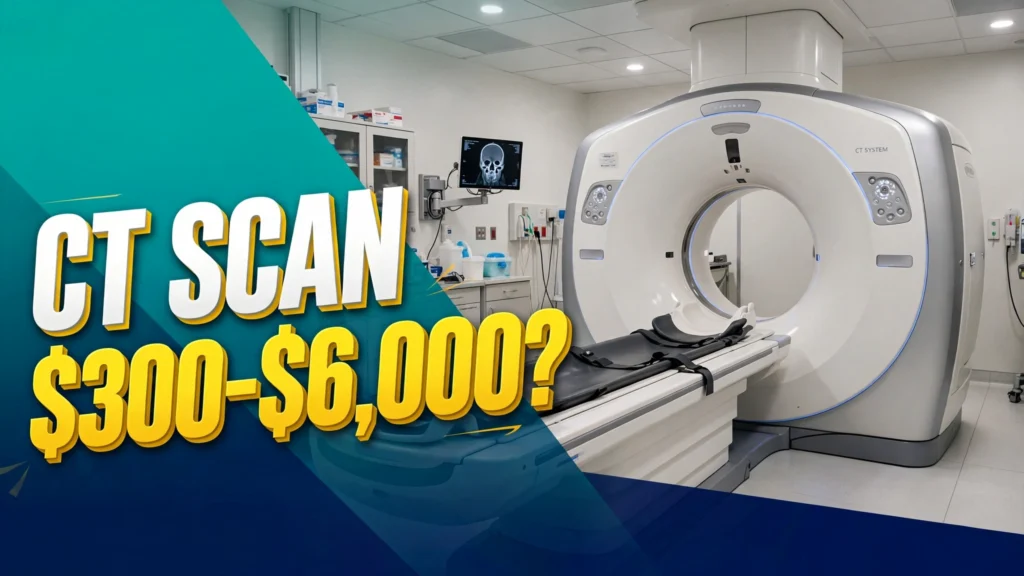
A CT scan without insurance typically costs $300 to $1,200 at an independent imaging center and $1,200 to $6,000+ at a hospital. The same scan, the same machine quality, the same board-certified radiologist reading it — but the hospital bill can be five times higher. Published self-pay prices checked in 2026 run from about $300 for a basic non-contrast scan at an independent center to over $6,600 for a complex hospital scan. If your scan is not an emergency, where you get it is the single biggest lever on your bill.
CT Scan Cost by Type (Self-Pay, Without Insurance)
Prices vary by body part, whether contrast dye is used, and how many regions are scanned. Contrast adds cost — and sometimes a separate charge for the contrast material itself.
| Scan type | Independent imaging center | Hospital outpatient |
|---|---|---|
| Head / brain (no contrast) | $300–$600 | $1,000–$2,500 |
| Head / brain (with contrast) | $400–$900 | $1,500–$3,500 |
| Chest | $400–$800 | $1,500–$3,000 |
| Abdomen / pelvis (with contrast) | $500–$1,200 | $2,000–$6,000+ |
| Abdomen / pelvis (no contrast) | $400–$900 | $1,500–$4,000 |
| Spine (single region) | $400–$800 | $1,500–$3,000 |
These are self-pay ranges for the complete scan. Always confirm whether the quote includes the radiologist’s reading fee — some quotes cover only the “technical” scan, and the reading arrives as a separate bill.
Hospital vs. Independent Imaging Center: The 2–5× Gap
This is the lever that matters. Hospitals carry emergency departments, inpatient units, and surgical services — and their facility fees reflect that overhead. Independent imaging centers run leaner, compete on price, and use the same accredited equipment and board-certified radiologists. The diagnostic quality is comparable; the price is not.
- Independent center: $300–$1,200 for most scans. Often faster scheduling. No facility fee games.
- Hospital outpatient: $1,200–$6,000+. Facility fees alone can add hundreds of dollars.
- Hospital ER: The most expensive setting — averages around $4,750 for a CT in emergency/inpatient settings, before any other ER charges.
Rule of thumb: if it is not an emergency, do not get your CT at a hospital. A freestanding center in a nearby suburb is often worth the drive.
What Else Moves the Price?
- Contrast dye: Adds $100–$400+ to the bill, sometimes billed separately as a material charge.
- Number of regions: Scanning two areas (e.g., abdomen and pelvis) costs more than one — ask whether your order covers both.
- Radiologist fee: The “professional” reading fee ($100–$300) may or may not be included in the quote.
- Geography: Big-city hospital prices run far higher than the same scan in a smaller market.
- Urgency: Emergency scans cost more and leave no room to shop around. Scheduled scans are where you save.
How to Cut the Bill: Self-Pay Negotiation
- Ask for the all-in cash price — technical fee + radiologist reading + contrast, in writing, before you book. Get the CPT code from your doctor’s order so every facility quotes the same thing.
- Ask for the self-pay discount. Many freestanding centers offer 20–40% off list price for cash payment at time of service. Hospitals often have self-pay discounts too — but you have to ask.
- Use cash-price marketplaces. Services like MDsave let you buy a bundled, upfront-priced scan at a local facility — no surprise bills.
- Check the hospital’s price transparency file. Hospitals are required to publish machine-readable price lists. Search the hospital name + “price transparency” for the shoppable-services file.
- Ask about financial assistance. Nonprofit hospitals must offer charity-care / financial-assistance programs. If your income qualifies, the bill can drop to a fraction of list price — sometimes to zero.
- Negotiate after the fact. If you already got the scan, call billing, ask for an itemized bill, dispute anything duplicated or wrong, and offer a lump-sum cash settlement. Billing departments routinely accept 30–50% less for prompt payment.
CT Scan vs. Other Imaging: When Is a CT the Right Call?
A CT is fast, detailed, and widely available — which is why doctors order it for strokes, lung problems, injuries, and abdominal emergencies. But it uses ionizing radiation, and for some questions a cheaper test answers just as well: an X-ray for a suspected fracture, an ultrasound for gallbladder or pregnancy questions, an MRI for detailed soft-tissue images without radiation. If cost is a factor, it is fair to ask your doctor whether a lower-cost imaging option would answer the same question.
Does Insurance Cover CT Scans? (For Readers Who Have It)
If you do have insurance, a CT scan is usually covered when medically necessary and ordered by a provider — but “covered” does not mean free. Most plans apply the scan to your deductible first, then coinsurance (commonly 10–30%) kicks in. A typical insured patient who has not met their deductible pays the plan’s negotiated rate, often $300–$1,000. If your deductible is met, a copay of $25–$75 is common. Prior authorization is frequently required — get it in writing before the scan, because a denied authorization can leave you owing the full list price.
One trap: an in-network hospital’s scan can still generate an out-of-network bill if the radiologist who reads it is out of network. Ask whether the reading radiologist is in-network too.
CT Scan Cost by Setting: A Worked Example
Same scan — a CT of the abdomen/pelvis with contrast, CPT 74177 — priced three ways:
- Independent imaging center, cash price: roughly $500–$900 all-in.
- Hospital outpatient, cash price: roughly $2,000–$6,000+.
- Hospital ER, insured: billed at full hospital rates; even insured patients can face a large deductible + coinsurance share.
Published self-pay prices checked in mid-2026 ranged from $300 at an independent center to $6,669 for the same CPT code at a hospital. That is not a typo — that is the same billing code, two facilities, a 20× spread.
Frequently Asked Questions
How much radiation is a CT scan?
A single CT delivers a low but non-trivial radiation dose — roughly comparable to 1–3 years of natural background radiation depending on the scan. The risk from one medically necessary scan is small, but it is one reason doctors do not order CTs casually, and why asking about alternatives is reasonable.
Can I get a CT scan without a doctor’s order?
Generally no — facilities require a provider’s order. Urgent care and primary care doctors can order one. Some direct-to-consumer imaging services exist, but they still route the order through a licensed provider.
What if I get the bill and it is way more than the quote?
First, request an itemized bill and compare it to the written quote. Dispute duplicate charges and anything you did not receive. Then call billing, reference the quote, and offer a lump-sum cash settlement. If the facility is a nonprofit hospital, ask for a financial-assistance application — it can reduce the bill to a fraction of list price.
Is a low-dose CT different in price?
Low-dose CT (used mainly for lung cancer screening) is priced similarly to a standard CT at most facilities, but screening scans may be covered differently by insurance — and Medicare covers annual lung cancer screening CTs for eligible patients.
The Bottom Line
A CT scan without insurance is a $300 scan at an independent center or a $6,000 bill at a hospital — and the difference is almost entirely where you get it. For any non-emergency scan: get the CPT code, get three all-in cash quotes (at least one from an independent center), and ask for the self-pay discount before you book. That one afternoon of comparison shopping is routinely worth $1,000 or more.