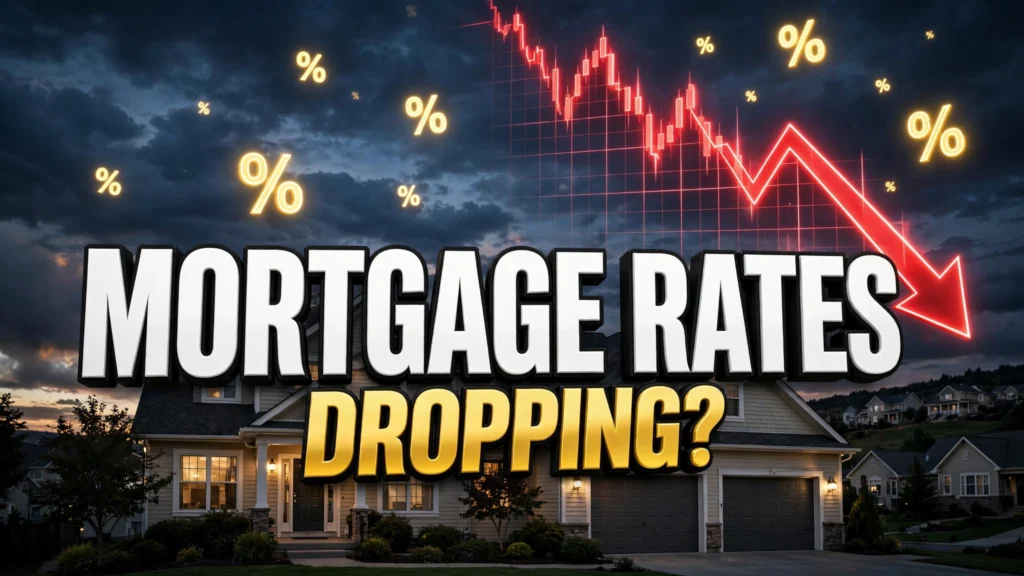
The Short Answer: No — They’re at Multi-Year Highs
If you’re asking “are mortgage rates dropping?” in October 2026, the honest answer is no. Freddie Mac’s weekly survey put the average 30-year fixed rate at 7.40% on October 8 — the highest since November 2023, up from 6.30% a year ago, and the seventh straight weekly increase. Anyone waiting for rates to fall back to the 5s or low 6s is, for now, waiting in vain.
But “rates are high” isn’t the whole story. What matters is what today’s rates mean for your decision — buying, refinancing, or sitting tight. This guide breaks down where rates stand as of October 2026, why they’re here, where forecasters think they’re headed, and the exact moves that save real money at 7%+ rates.
Where Mortgage Rates Stand Right Now (October 2026)
| Loan type | Average rate | vs. a year ago |
|---|---|---|
| 30-year fixed | 7.40% | 6.30% |
| 15-year fixed | 6.73% | 5.53% |
| FHA 30-year | ~8.1% | — |
| VA 30-year | ~7.2% | — |
| Jumbo 30-year | ~7.6% | — |
| 7/6 ARM | ~6.9% | — |
Sources: Freddie Mac Primary Mortgage Market Survey (Oct. 8, 2026); Money.com lender data (Oct. 9, 2026). Your actual rate depends on credit score, down payment, and loan type — these are national averages.
The market is already reacting: purchase applications are down 15% from a year ago, and refinance applications have collapsed 56% year-over-year, according to the Mortgage Bankers Association. Higher rates are squeezing first-time and FHA borrowers hardest.
Why Are Rates This High?
Mortgage rates don’t move on vibes — they track the bond market, especially the 10-year Treasury yield. Three forces are pushing yields (and your mortgage rate) up:
- A bond-market selloff. Investors are demanding higher yields to hold government debt, and the 10-year Treasury sits at its highest level in decades. Mortgage rates follow it almost mechanically.
- “Higher for longer” expectations. Markets now expect interest rates to stay elevated, with inflation proving stickier than hoped and the economy running hotter than forecast.
- The national debt. Heavy government borrowing means more bonds competing for buyers — which pushes yields up across the board.
The Fed’s September rate hike underscored the stance: policymakers aren’t riding to the rescue of borrowers any time soon.
Are Rates Going to Drop?
Here’s what forecasters actually say — not what rate-cut hopefuls want to hear:
- Zillow’s revised forecast expects the 30-year rate to average ~7.1% by year-end — lower than today, but still firmly in the 7s.
- Most economists see rates staying above recent-year norms for a while, drifting down only gradually — possibly toward 5.5–6% over several years, not months.
- Near-term volatility is the one near-certainty: rates have moved almost every week this fall.
Translation: if your life plans require buying in the next 6–12 months, plan around ~7% rates, not hope for 5%. The buyers thriving right now aren’t timing the market — they’re structuring around it.
What This Means If You’re Buying a Home
Let’s make it concrete. On a $400,000 loan, 7.40% versus 6.30% costs roughly $295 more per month — over $100,000 across a 30-year loan. That’s the math you’re working with. Here’s how smart buyers are adapting:
- Buy down the rate. Paying discount points (typically 1% of the loan per 0.25% rate reduction) can make sense if you’ll stay put long enough to break even — usually 5–7 years. Ask about temporary 2-1 buydowns too, where the seller funds a lower rate for the first two years.
- Consider an ARM — carefully. A 7/6 ARM near 6.9% buys meaningful monthly savings if you’ll sell or refinance within seven years. Just understand the reset risk.
- Put more down if you can. A larger down payment shrinks the loan, and crossing 20% kills PMI. Our guide to the average first-time buyer down payment shows what’s realistic in 2026.
- Sharpen your credit first. The gap between “good” and “excellent” credit pricing is hundreds per month at these rate levels. Even 90 days of cleanup can move your tier.
- Compare FHA vs. conventional. FHA rates are running near 8.1% on average, but FHA’s lower credit and down-payment thresholds still win for many first-timers. Run the full comparison in our FHA loans guide.
- Shop multiple lenders. Freddie Mac’s chief economist keeps repeating it because it’s true: getting several quotes can save you thousands over the loan’s life. Lender pricing varies enormously week to week right now.
And before you fall in love with a listing, check what you can actually carry — our breakdown of house affordability on a $60,000 salary shows the method works at any income.
What This Means If You’re Thinking About Refinancing
With refinance applications down 56% year-over-year, most existing homeowners should sit tight — especially anyone holding a sub-5% rate from 2020–2021. Refinancing from 4% to 7.4% is never the move.
Refinancing can still make sense if:
- Your current rate is 8%+ (2023-vintage buyers, this is you) — even a drop to the low 7s or high 6s may pencil out.
- You have an ARM about to reset upward.
- You need to tap equity and a cash-out refi beats a HELOC at ~8% — run both scenarios.
- You’re removing PMI or shortening term at a similar payment.
The rule of thumb: don’t refinance for less than about a 0.75–1 percentage-point improvement unless there’s a structural reason (ARM reset, PMI removal).
What This Means If You Already Own
Sitting on a low rate? Your mortgage is now one of your best financial assets — guard it. Think twice before any move that trades it away, and price home-equity borrowing honestly: HELOCs are averaging ~8% and home equity loans ~8.25%. At those levels, only high-return uses (necessary repairs, consolidating much higher-rate debt) make sense. Two alternatives worth knowing: recasting (a large lump-sum principal payment that lowers your monthly payment for a small fee, without refinancing) and simply directing extra cash to principal when you can — both cut total interest without touching your rate.
30-Year vs. 15-Year at Today’s Rates
The rate gap between loan terms is unusually meaningful right now. On a $400,000 loan:
- 30-year at 7.40%: roughly $2,770/month principal and interest; about $597,000 in total interest over the life of the loan.
- 15-year at 6.73%: roughly $3,535/month; about $236,000 in total interest.
The 15-year costs about $765 more per month but saves roughly $360,000 in interest and builds equity dramatically faster. If your budget can stretch to the higher payment — and your emergency fund stays intact — it’s the best wealth-building deal in today’s market. If it can’t, there’s no shame in the 30-year; you can always make extra principal payments when cash flow allows.
Should You Buy Points? The Break-Even Math
Paying “points” (prepaid interest, typically 1% of the loan amount per 0.25% rate reduction) is popular at high rates. Example on a $400,000 loan: paying 1 point ($4,000) to cut your rate from 7.40% to ~7.15% saves roughly $70/month — breaking even in about 5 years. Stay past that and you win; sell or refinance before and you lose. Only buy points if you’re confident you’ll keep the loan past the break-even point. Temporary 2-1 buydowns (often seller-paid, with steep discounts in years 1–2) can be even better if you expect to refinance within a couple of years.
Run Your Own Numbers
National averages are a starting point — your payment depends on your price, down payment, and rate. Plug your actual figures into our free mortgage calculator to see monthly payments, total interest, and how different rates change the picture. Then take the strongest quote you find from a lender and beat it against two more — at 7%+, that shopping is worth real money.
Frequently Asked Questions
Will mortgage rates drop below 6% in 2026?
Very unlikely. Forecasts cluster around ~7.1% by year-end. A sub-6% 30-year rate isn’t in any mainstream forecast for the next several months.
Is 7.4% high historically?
It’s the highest since November 2023 — but well below the 1980s peaks above 18%. Anyone who bought in the 1990s paid 7–9% routinely. High relative to 2021, normal-ish historically.
Should I wait to buy until rates drop?
Waiting is a bet that prices won’t rise faster than rates fall — and lower rates usually bring more competition and higher prices. If you find the right home and the payment works at today’s rate, buying now with a plan to refinance later is often the better math. Verify the payment fits with our mortgage calculator first.
What’s the difference between the rate and APR?
The rate is your note rate; APR folds in lender fees and points, which is why APRs above (e.g., 7.42% APR on a 7.40% rate) run slightly higher. Compare APRs when shopping lenders — it’s the truer cost measure.
What’s the difference between discount points and lender credits?
They’re mirror images: discount points are prepaid interest you pay to lower your rate, while lender credits are money the lender gives you toward closing costs in exchange for a slightly higher rate. Points win if you’ll hold the loan long past break-even; credits win if you expect to refinance soon. Ask every lender to quote both.