40 an Hour Is How Much a Year? The Full Salary Breakdown
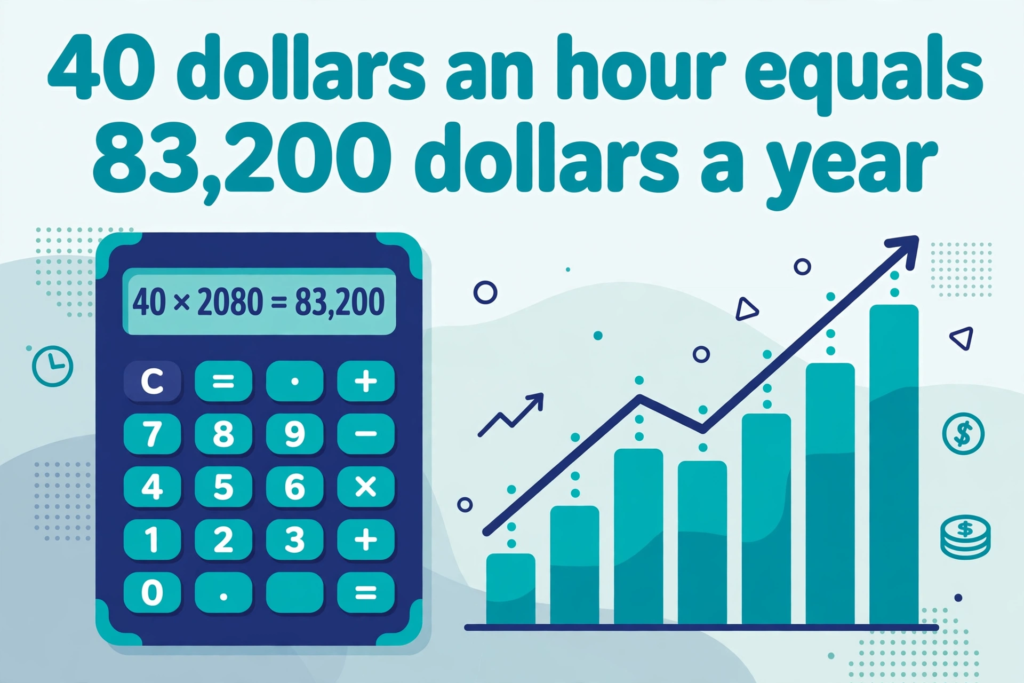
If you earn $40 an hour, you make $83,200 a year working full time.
That is the short answer, but it only holds if you work exactly 40 hours a week, all 52 weeks of the year, with no overtime, no unpaid time off, and no part-time schedule. Real life rarely looks that tidy. Your paycheck also depends on taxes, how often you get paid, whether you pick up extra shifts, and how many hours you actually work.
This guide walks through the full math, step by step: the annual, monthly, weekly, biweekly, and daily figures, what overtime does to your pay, what part-time hours pay at the same rate, and realistic after-tax estimates. Every worked number here is calculated from the same starting point: $40 an hour.
Quick answer
At $40 an hour, full-time work pays $83,200 a year before taxes. That is $40 times 40 hours a week times 52 weeks, or $1,600 a week and about $6,933 a month. Take-home pay will be lower after taxes, and part-time hours, overtime, and unpaid time off all change the total.
How the Salary Math Works
Salary math looks complicated only because employers talk about pay in different units. One job ad lists an hourly rate, another lists an annual salary, your bank account sees a biweekly deposit, and your rent is monthly. They are all describing the same pay, just sliced differently.
Start with the hours. A full-time week is usually 40 hours, made up of five 8-hour days, and a year has 52 weeks, so the standard full-time year is 2,080 working hours.
From there, each figure follows from the last:
- Daily pay: $40 multiplied by 8 hours equals $320 a day.
- Weekly pay: $40 multiplied by 40 hours equals $1,600 a week.
- Biweekly pay: $1,600 multiplied by 2 weeks equals $3,200 every two weeks.
- Monthly pay: $83,200 divided by 12 months equals $6,933.33 a month.
- Annual pay: $40 multiplied by 2,080 hours equals $83,200 a year.
Notice that monthly pay is not weekly pay multiplied by 4. That is one of the most common budgeting mistakes. Four weeks gives you $6,400, which understates your real monthly average by $533.33. The correct monthly average spreads all 52 weeks evenly across 12 months.
The same logic applies in reverse. If a job offers you $83,200 a year as a salary, divide by 2,080 hours to get the hourly equivalent: $40 an hour. Always compare offers on the same basis, hours included, not just the headline number.
40 Dollars an Hour: Pay by Period
It helps to see every pay period side by side, because each one answers a different question: weekly pay is what a week of work is worth, biweekly pay is what lands in your account on payday, and monthly pay is what you have to cover rent, bills, and groceries.
| Pay period | Calculation | Gross pay |
|---|---|---|
| Per hour | $40 | $40 |
| Per day (8 hours) | $40 times 8 | $320 |
| Per week (40 hours) | $40 times 40 | $1,600 |
| Every two weeks (80 hours) | $40 times 80 | $3,200 |
| Per month (average) | $83,200 divided by 12 | $6,933.33 |
| Per year (2,080 hours) | $40 times 2,080 | $83,200 |
If you are paid biweekly, you will receive 26 paychecks a year, not 24. That is why biweekly pay of $3,200 adds up to $83,200: $3,200 multiplied by 26 equals $83,200. Two months of the year, you will get three biweekly paychecks instead of two. It is not extra money, just the same annual salary arriving on a different calendar.
If you are paid semimonthly, meaning twice a month on fixed dates, your paycheck will be $83,200 divided by 24 paychecks, which equals $3,466.67 per paycheck. If you are paid monthly, you will see $6,933.33 per paycheck before deductions.
What About Taxes? Your Take-Home Pay
Gross pay is what you earn before deductions. Take-home pay, also called net pay, is what actually reaches your bank account after income tax, payroll taxes, and benefits you pay for, such as health insurance or retirement contributions.
Take-home pay varies a lot from person to person, depending on where you live, your filing status, your deductions, and your benefit contributions. There is no single correct after-tax figure for $40 an hour, so be cautious of any article that gives you one without explaining its assumptions.
Here are simple illustrations. These are estimates for illustration only, not tax advice and not a prediction of your paycheck. They apply a single flat effective rate to the full $83,200, which is a simplification, because real tax systems use brackets, deductions, and credits that change the result.
- At an illustrative effective rate of 15%: tax of $12,480, take-home pay of $70,720 a year, or about $5,893.33 a month.
- At an illustrative effective rate of 20%: tax of $16,640, take-home pay of $66,560 a year, or about $5,546.67 a month.
- At an illustrative effective rate of 25%: tax of $20,800, take-home pay of $62,400 a year, or $5,200 a month.
Check one line: $83,200 multiplied by 20% equals $16,640 in tax, leaving $66,560, or $5,546.67 a month. The other lines follow the same steps.
In practice, state income tax alone can move the result by thousands of dollars a year, and retirement contributions and health insurance premiums move it further. The most reliable way to know your figure is to look at a recent pay stub and multiply your actual net biweekly pay by 26, or your actual net monthly pay by 12. When comparing offers, compare take-home pay, not just gross pay: a job with cheaper health insurance or a better retirement match can beat a slightly higher hourly rate with expensive benefits.
Overtime: What Time-and-a-Half Adds
Overtime is where hourly pay pulls ahead of a flat salary. In many hourly jobs, hours worked beyond 40 in a week are paid at time-and-a-half, which means 1.5 times your normal rate. At $40 an hour, the overtime rate is $60 an hour, because $40 multiplied by 1.5 equals $60.
Here is what that looks like for a single week:
- A standard 40-hour week: 40 hours at $40 equals $1,600.
- A 45-hour week with 5 overtime hours: $1,600 plus 5 hours at $60, which is $300, equals $1,900 for the week.
- A 50-hour week with 10 overtime hours: $1,600 plus 10 hours at $60, which is $600, equals $2,200 for the week.
Now stretch that across a full year, assuming you worked the same overtime every week. Most people do not work overtime every single week of the year, so treat these annual overtime totals as upper-end illustrations.
- 45 hours every week for 52 weeks: $1,900 multiplied by 52 equals $98,800 a year. That is $15,600 more than the standard $83,200.
- 50 hours every week for 52 weeks: $2,200 multiplied by 52 equals $114,400 a year. That is $31,200 more than the standard $83,200.
A more realistic pattern: five overtime hours a week for 26 weeks, half the year, adds $300 multiplied by 26, which equals $7,800 on top of the base $83,200, for a total of $91,000 for the year.
Two cautions apply. First, overtime rules depend on your job, your employer, and your location. Not every hourly job pays time-and-a-half, and some roles are exempt, so check your offer letter before counting on overtime pay. Second, overtime income is still taxable, so your take-home gain will be smaller than the gross gain. If you are salaried rather than hourly, extra hours usually do not change your pay at all, which is one reason hourly workers sometimes prefer roles with reliable overtime.
Part-Time Hours at 40 Dollars an Hour
Not everyone working at $40 an hour works full time. Freelancers, part-time employees, parents fitting work around childcare, and students may all earn the same hourly rate for fewer hours, and the annual total changes directly with hours worked.
| Hours per week | Weekly pay | Monthly pay (average) | Annual pay |
|---|---|---|---|
| 20 hours | $800 | $3,466.67 | $41,600 |
| 25 hours | $1,000 | $4,333.33 | $52,000 |
| 30 hours | $1,200 | $5,200 | $62,400 |
| 32 hours | $1,280 | $5,546.67 | $66,560 |
| 35 hours | $1,400 | $6,066.67 | $72,800 |
| 40 hours | $1,600 | $6,933.33 | $83,200 |
Each line uses the same formula: $40 multiplied by hours per week multiplied by 52 weeks. For example, 30 hours a week gives $1,200 a week, and $1,200 multiplied by 52 equals $62,400 a year, or $5,200 a month.
Part-time work also changes benefits. In many jobs, working below a certain hours threshold means no employer health insurance, no paid time off, or no retirement match, so compare the full package, not just the hourly rate.
On the other side, part-time hours at a strong rate can match full-time hours at a lower rate. Twenty hours a week at $40 an hour pays $41,600 a year, exactly the same as 40 hours a week at $20 an hour, which also pays $41,600 a year. Doubling the rate and halving the hours gives the same annual pay, but very different lifestyles. The rate matters as much as the hours, and a high rate gives you the option to trade hours for time without giving up as much income.
Unpaid Time Off Changes the Annual Total Too
The 83,200-dollar figure assumes you are paid for all 52 weeks. If you take unpaid time off, your annual pay falls by $1,600 for every full week you miss, because each week of full-time work is worth $1,600 gross.
- Two weeks unpaid: $40 multiplied by 40 hours multiplied by 50 paid weeks equals $80,000, which is $3,200 less than $83,200.
- Four weeks unpaid: $40 multiplied by 40 hours multiplied by 48 paid weeks equals $76,800, which is $6,400 less than $83,200.
Paid vacation and paid holidays do not reduce your pay. A job at $40 an hour with three weeks of paid vacation still pays $83,200 a year, while the same rate with three weeks unpaid pays $78,400, because $40 multiplied by 40 hours multiplied by 49 paid weeks equals $78,400. Always ask whether time off is paid when you evaluate an hourly offer.
What a Raise Is Worth at 40 Dollars an Hour
Small hourly raises add up faster than most people expect, because every extra dollar per hour is multiplied by every hour you work in a year. At full time, one extra dollar an hour is worth $2,080 a year, because 1 dollar multiplied by 2,080 hours equals $2,080.
- A raise from $40 to $41 an hour: $2,080 more per year, for a new total of $85,280.
- A raise from $40 to $42 an hour: $4,160 more per year, for a new total of $87,360.
- A raise from $40 to $45 an hour: $10,400 more per year, for a new total of $93,600.
- A raise from $40 to $50 an hour: $20,800 more per year, for a new total of $104,000.
Check the last line: $50 multiplied by 2,080 hours equals $104,000. That is why negotiating even a small hourly increase is worth the effort. A 2-dollar-an-hour raise, which can sound modest in conversation, is worth $4,160 a year before taxes, or about $346.67 a month.
The reverse is also true. Dropping from $40 to $38 an hour costs $4,160 a year at full time, so weigh a job change for better hours or remote work against the hourly difference in annual terms, not just the hourly gap.
Budgeting on 83,200 Dollars a Year
Budget from your take-home pay, not your gross pay, because you never see all of it. Using the middle illustration from the tax section, a 20% effective rate gives take-home pay of $66,560 a year, or $5,546.67 a month. Here is how the common 50/30/20 budgeting split looks on that illustrative monthly figure:
- Needs, at 50%: $2,773.33 a month. This covers housing, utilities, groceries, transport, insurance, and minimum debt payments.
- Wants, at 30%: $1,664 a month. This covers dining out, entertainment, subscriptions, hobbies, and travel.
- Savings and extra debt payments, at 20%: $1,109.33 a month. This covers an emergency fund, retirement savings beyond any employer match, and extra payments toward debt.
Add those three lines together and you get $5,546.66, matching the monthly take-home figure within a cent of rounding.
Your real split will differ, and it should. Housing costs vary enormously by location, and in an expensive city, needs may take far more than 50% of take-home pay at this income. The point of the example is to show how to convert an annual salary into a monthly plan you can actually use: start from take-home pay, divide by 12, then allocate from there. Two habits help: set up an automatic transfer on payday so savings happens before spending, and treat the two three-paycheck months in a biweekly schedule as a chance to get ahead, not as free money.
Is 40 Dollars an Hour Good Pay?
Whether $40 an hour is good pay depends on context. An income of $83,200 a year before taxes can support a comfortable life in many parts of the country, especially for a single person or a household with two incomes. In a high-cost city, with high rent and childcare costs, the same income feels much tighter, especially for a single-income household supporting several people. What matters more than a national label is your own situation. Ask these questions:
- Does this income cover your housing, bills, food, transport, and debt payments with room left for savings?
- Are you building an emergency fund, or does every unexpected bill go on a card?
- Does the job offer paid time off, health insurance, and retirement benefits, or do you pay for those yourself?
- How stable are your hours? A rate of $40 an hour means little if your hours swing from 40 one week to 15 the next.
- What does career growth look like? A path from $40 to $50 an hour is worth more over time than a job stuck at $40.
Also consider the work itself. A job with a long commute, unpredictable shifts, or heavy physical strain costs you time and energy that do not show up in the salary math. A slightly lower rate with remote work, predictable hours, or genuine growth may be the better deal.
Jobs and Work That Commonly Pay Around 40 Dollars an Hour
Hourly rates near $40 show up across many fields, and the exact roles vary by location, experience, and employer. Skilled trades, experienced healthcare support roles, specialized administrative and technical work, and experienced freelance and contract work can all land in this range. Freelance and contract rates often look higher than employee rates because contractors usually pay their own taxes, insurance, and time off, so a contractor charging $40 an hour does not take home the same amount as an employee earning $40 an hour with benefits.
If you are aiming for this rate, experience and specialization are usually what get you there. Use the raise math above to price each option: every extra dollar an hour is $2,080 a year at full time.
Worked example: two weeks off changes the total
Example: take the same 40-dollar rate and 40-hour week, but with two weeks of unpaid time off. Instead of 52 paid weeks you have 50, so the math becomes $40 times 40 hours times 50 weeks, which is $80,000 a year. That is $3,200 less than the full $83,200, exactly one biweekly paycheck of $1,600 times two. This is why comparing an hourly rate to a salary only works when you know how many weeks are actually paid.
Common Mistakes When Converting Hourly Pay to Annual Pay
Several small errors turn a correct hourly rate into a wrong annual figure. Watch for these:
- Multiplying weekly pay by 4 for a monthly average. This understates monthly pay by $533.33 at this rate.
- Forgetting unpaid time off. Each unpaid full-time week costs $1,600 gross.
- Counting overtime at the normal rate instead of time-and-a-half. Each overtime hour is worth $60 here, not $40.
- Confusing biweekly pay with semimonthly pay. Biweekly means 26 paychecks of $3,200. Semimonthly means 24 paychecks of $3,466.67. Both total $83,200 a year.
- Budgeting from gross pay instead of take-home pay. Plan from net pay.
- Comparing a contractor rate with an employee rate as if they were equal. Contractors cover costs employees do not.
If you remember one rule, make it this one: always show your working. Write down the hours, the weeks, and the rate, and multiply them in order.
Pros and cons
Pros:
- The math is transparent: rate times hours times weeks gives the annual figure.
- Overtime at time-and-a-half can push earnings well above the base figure.
- Hourly work can be easier to compare across offers than a flat salary.
- Part-time schedules let you trade hours for time, with the cost spelled out.
Cons:
- The headline $83,200 is before taxes and assumes all 52 weeks are paid.
- Unpaid time off, part-time hours, and benefit costs all reduce the real total.
- Hours can vary, so weekly pay is not always steady.
- A higher hourly rate with weak benefits can be worth less than a lower rate with strong ones.
Frequently Asked Questions
How much is $40 an hour per week?
At 40 hours a week, $40 an hour pays $1,600 a week before taxes. At 20 hours a week, it pays $800 a week. At 30 hours a week, it pays $1,200 a week.
How much is $40 an hour per month?
The average monthly gross pay at full time is $6,933.33, calculated as $83,200 divided by 12 months. If you multiply weekly pay by 4, you get $6,400, but that understates the true monthly average.
How much is $40 an hour biweekly?
Biweekly gross pay at full time is $3,200, for 80 hours over two weeks. You will receive 26 such paychecks in a year, which totals $83,200.
How much is $40 an hour after taxes?
It depends on your location, filing status, deductions, and benefits. As an illustration only, a 20% effective rate on $83,200 gives take-home pay of $66,560 a year, or about $5,546.67 a month. Check a recent pay stub for your most accurate figure.
How much is $40 an hour part time?
At 20 hours a week, $40 an hour pays $41,600 a year. At 25 hours, it pays $52,000 a year. At 30 hours, it pays $62,400 a year. At 35 hours, it pays $72,800 a year. All figures are gross pay before taxes.
How much is $40 an hour with overtime?
With 5 overtime hours a week at time-and-a-half, weekly gross pay rises from $1,600 to $1,900, because the 5 overtime hours pay $300 at $60 an hour. With 10 overtime hours a week, weekly gross pay rises to $2,200.
Is $40 an hour the same as an 83,200-dollar salary?
Yes, if the salary assumes 2,080 working hours a year. A salaried job at $83,200 that expects far more than 40 hours a week pays less per hour in practice, so always check the expected hours before treating the two as equal.
The Bottom Line
At $40 an hour, full-time work pays $83,200 a year, $6,933.33 a month on average, $3,200 every two weeks, and $1,600 a week, all before taxes. Overtime at time-and-a-half adds $60 per extra hour, part-time hours scale the total directly, and unpaid time off subtracts $1,600 per missed full-time week.
Use the figure that matches your real schedule, budget from your take-home pay rather than your gross pay, and price any raise or job change in annual terms. One extra dollar an hour is $2,080 a year at full time, which is a useful number to carry into your next pay conversation.
Further reading: to see what that income buys, read what house you can afford on a 50k salary, what you can afford on a 60,000-dollar salary, and how much emergency fund you need. Outside Factaxy, the IRS Tax Withholding Estimator helps you estimate take-home pay, and the Bureau of Labor Statistics Occupational Outlook Handbook lists typical pay for common occupations.
Sources and methodology
The figures, rules, and rates in this guide come from the authoritative sources linked throughout the article, including irs.gov, bls.gov. Where a figure is an estimate or a worked example, the article says so.