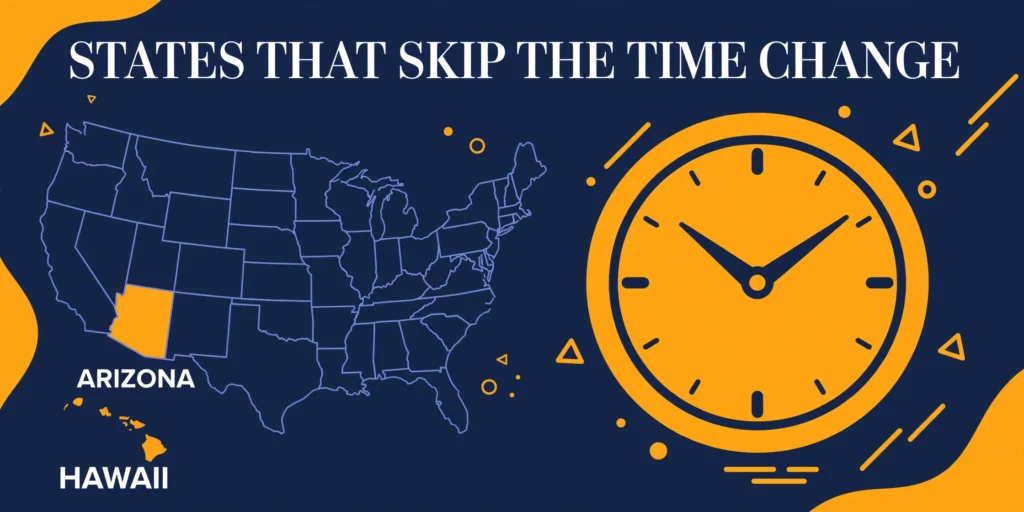
Twice a year, most Americans move their clocks and lose or gain an hour of sleep. But in a few places, nothing changes at all. The clocks stay put, the sunrise time drifts only a little, and residents watch the rest of the country spring forward and fall back without joining in.
If you have ever landed in Phoenix in summer and found it on the same time as Los Angeles, you have met one of the two exceptions. Only two states stay on standard time all year, for reasons that are practical and local.
Quick answer: Only two states do not observe daylight saving time: most of Arizona and Hawaii. Both stay on standard time all year. The five US territories of Puerto Rico, Guam, the US Virgin Islands, American Samoa, and the Northern Mariana Islands also stay on standard time year-round. Everywhere else in the United States, clocks change in spring and fall.
Which States Do Not Observe Daylight Saving Time?
The short list has just two names. Most of Arizona has not observed daylight saving time since 1968, and Hawaii has never taken part in the modern federal system. That is it. The other 48 states, plus the District of Columbia, all move their clocks forward in March and back in fall.
A handful of US territories also skip the change. They are not states, so they do not appear on most state lists, but travelers should know they stay on standard time all year too.
| Place | Observes daylight saving time? | Why |
|---|---|---|
| Arizona (most of the state) | No | Opted out in 1968 because extreme desert heat made later sunsets unwelcome, and earlier sunsets were preferred |
| Hawaii | No | Near the equator, sunrise and sunset barely shift across the year, so clock changes buy almost nothing |
| Puerto Rico | No | Stays on standard time year-round |
| Guam | No | Stays on standard time year-round |
| US Virgin Islands | No | Stays on standard time year-round |
| American Samoa | No | Stays on standard time year-round |
| Northern Mariana Islands | No | Stays on standard time year-round |
Why Arizona Opted Out in 1968
Arizona did try daylight saving time briefly, and residents disliked it enough that the state used its legal right to leave. The Uniform Time Act, the federal law that set the national system, allows a state to exempt itself and stay on standard time. Arizona took that exemption in 1968, and it has stayed out ever since.
The desert heat problem
The main reason was extreme desert heat. In a Phoenix summer, daytime temperatures regularly climb well past 100 degrees, and the coolest part of the day is after sunset. Daylight saving time would push sunset an hour later, which means brutal evening temperatures lasting later into the night. That raises energy use, because air conditioners run harder for longer, and it makes evening life outdoors less pleasant. Residents preferred earlier sunsets, and the state listened.
In most of the country, an extra hour of evening daylight is the whole point. In the Arizona desert, that extra hour is an extra hour of heat.
The famous time donut hole
Arizona has one major exception, and it creates one of the strangest time maps in the world. The Navajo Nation, which spans parts of Arizona, New Mexico, and Utah, does observe daylight saving time. It does so to keep one time across its three-state territory, so offices, schools, and services in the nation are not split between two clocks.
Inside that exception sits another one. The Hopi Reservation is entirely surrounded by the Navajo Nation, and the Hopi Reservation does not observe daylight saving time, just like the rest of Arizona around it. The result is often called a time donut hole: a driver crossing northern Arizona in summer can change time zones several times in a single trip, moving into daylight time in the Navajo Nation, back into standard time in Hopi land, and into daylight time again on the other side.
Why Hawaii Never Joined
Hawaii is the other full-time standard time state, and its reason is geography. Hawaii sits near the equator, where sunrise and sunset barely shift across the year. The difference between the longest and shortest days is small, so moving the clocks buys almost nothing. There is no dark winter morning problem to fix and no long summer evening to unlock.
Hawaii briefly had daylight saving time decades ago, but it never adopted modern DST under the federal framework. Staying on standard time also keeps Hawaii on a simple, steady offset from the mainland all year, even though that offset changes for mainland states when their clocks move. Hawaii is two hours behind Pacific Time in winter and three hours behind it in summer, a quirk travelers and anyone scheduling calls soon learn.
When Do the Clocks Change for Everyone Else?
For the 48 states that do observe it, daylight saving time ends on Sunday, November 1, 2026, when clocks go back one hour. It restarts on Sunday, March 14, 2027, and ends again on Sunday, November 7, 2027. Arizona and Hawaii do not move on any of those dates, so their gap with neighboring states grows and shrinks through the year.
For a full guide to the fall change, including how to prepare your sleep schedule and your home, see our companion guide to when daylight saving time ends in 2026.
What this means for travel and calls
- Arizona in winter: Arizona matches Mountain Time, so Phoenix and Denver share the same time.
- Arizona in summer: Arizona matches Pacific Time, so Phoenix and Los Angeles share the same time, while Denver is an hour ahead.
- Hawaii all year: Hawaii never moves, so its gap with every mainland city changes twice a year.
- Navajo Nation: In summer it follows daylight time, unlike the rest of Arizona, so check the exact location before assuming the time.
Could Daylight Saving Time Become Permanent?
The debate is live again in Congress. The Sunshine Protection Act of 2025, listed as H.R. 139, would make daylight saving time permanent nationwide. The US House passed it on July 14, 2026 by 308 to 117. That sounds decisive, but a bill needs both chambers and a signature to become law.
Here is the honest status as of October 2026: the Senate has not voted on it, so it is not law, and clocks still change. An earlier version passed the Senate in 2022 but died in the House, which is a useful reminder that passing one chamber is only half the journey. Until a final version clears both chambers and is signed, the current system stays in place.
What the states have done on their own
Roughly 20 states have passed their own permanent daylight saving time laws or resolutions. Those state measures sound final, but they cannot take effect unless federal law changes, because the Uniform Time Act lets states opt out to standard time, not opt in to permanent daylight time. So those laws sit waiting on Congress. If federal law changes, many states could switch quickly. If it does not, nothing changes for them.
For now, no new federal choice exists, and the twice-yearly change remains the rule for most of the country.
Frequently Asked Questions
How many states do not observe daylight saving time?
Two. Most of Arizona and Hawaii stay on standard time all year. The other 48 states observe daylight saving time. Five US territories, Puerto Rico, Guam, the US Virgin Islands, American Samoa, and the Northern Mariana Islands, also stay on standard time year-round, but they are territories, not states.
Does all of Arizona skip daylight saving time?
Almost all of it, with one famous exception. The Navajo Nation in the northeast of the state observes daylight saving time to keep one time across its territory in Arizona, New Mexico, and Utah. The Hopi Reservation, surrounded by the Navajo Nation, does not observe it, which creates the time donut hole.
Why does Arizona not observe daylight saving time?
Arizona opted out in 1968 under the Uniform Time Act exemption. The main reason was extreme desert heat. Later sunsets would push brutal evening temperatures later into the night and raise energy use, and residents preferred earlier sunsets instead.
Is daylight saving time ending permanently in 2026?
No. The Sunshine Protection Act of 2025 passed the House on July 14, 2026, but the Senate has not voted on it as of October 2026, so it is not law. Clocks still change as normal: daylight saving time ends on Sunday, November 1, 2026.
When does daylight saving time restart in 2027?
Daylight saving time restarts on Sunday, March 14, 2027, for the states that observe it, and ends again on Sunday, November 7, 2027. Arizona and Hawaii do not move their clocks on either date.