Most drivers only think about brakes when they hear a squeal, feel a shudder, or get a surprise quote. Knowing how long brakes last helps you plan for the cost, spot wear early, and avoid turning a routine pad change into a bigger repair.
The honest answer is that brake life varies a lot. The same pads can wear out in 25,000 miles in heavy city traffic or pass 70,000 miles on a mostly highway car. This guide gives typical ranges, a table by driving style, warning signs, and what replacement usually costs in 2026. All money figures are typical 2026 ranges in the United States, and they vary by vehicle, shop, and city.
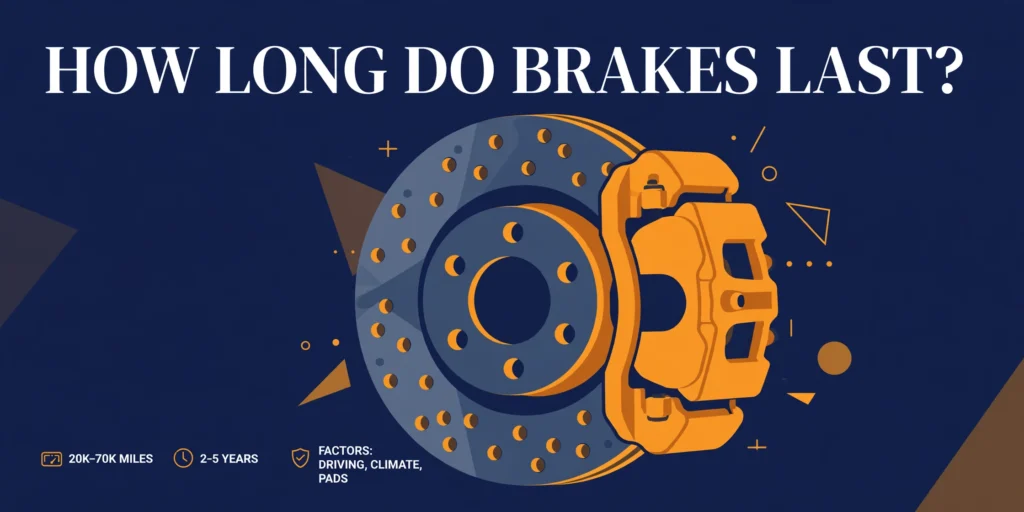
Quick answer: Brake pads typically last 30,000 to 70,000 miles, and rotors typically last 50,000 to 70,000 miles or longer. City drivers often need pads at 25,000 to 40,000 miles, while mostly highway drivers can reach 60,000 to 80,000 miles or more. In 2026, pads alone run about $150 to $300 per axle, and pads with rotors run about $300 to $600 per axle.
How Long Do Brake Pads and Rotors Last?
Every time you press the pedal, the pads squeeze the rotors and a thin layer of friction material wears away. Once it gets down to about 2 to 3 millimeters, the pads are done and need replacing before they damage the rotors.
Rotors are the metal discs the pads grip. They wear much more slowly, so rotors typically last 50,000 to 70,000 miles or longer. Many drivers replace them at every second pad change, but a shop should measure thickness and check for scoring first.
Pads versus rotors at a glance
- Brake pads: typically 30,000 to 70,000 miles, depending on driving style and pad material.
- Brake rotors: typically 50,000 to 70,000 miles or longer, often replaced at every second pad change.
- Calipers: no fixed life, but a sticking caliper can wear one pad set down far faster than the rest.
Pad material also matters. Ceramic pads tend to last longer and run quieter. Semi-metallic pads handle heat well and are common on trucks, but can wear rotors a little faster.
Brake Life by Driving Style
Where and how you drive is the biggest factor. A mile of stop-and-go traffic can wear pads more than twenty miles of steady highway driving.
| Driving style | Typical pad life | Why it differs |
|---|---|---|
| Heavy city stop-and-go driving | About 25,000 to 40,000 miles per pad set | Constant braking, traffic lights, and congestion |
| Mixed suburban driving | About 40,000 to 60,000 miles per pad set | A blend of local stops and longer steady stretches |
| Mostly highway driving | About 60,000 to 80,000 miles or more per pad set | Long distances with very little braking per mile |
| Electric vehicles with regenerative braking | Can stretch well past 100,000 miles in some cases | The electric motor does much of the slowing, so pads are used far less |
One-pedal driving in an electric vehicle is the exception. With regenerative braking, the motor slows the car, so friction brakes step in mainly for the final stop. Pad life can stretch well past 100,000 miles in some cases, although rotors can still rust.
Towing, mountain driving, heavy loads, and aggressive late braking also shorten life, and heavier vehicles work their brakes harder on every stop.
Signs Your Brakes Are Worn Out
Brakes usually warn you before they fail. Act on early warnings, when the repair is still cheap.
- Squealing: Most pads have a metal wear indicator that squeals when the pad gets thin. It is a built-in reminder, not a false alarm.
- Grinding: A harsh grinding noise usually means the pad material is gone and metal is cutting into the rotor. This needs attention right away.
- Longer stopping distances: If the car takes longer to stop, or the pedal feels soft or low, have the system inspected promptly.
- Vibration or a pulsing pedal: A shudder through the pedal or steering wheel when braking often points to warped or uneven rotors.
- Thin pads on a visual check: If the pad you can see through the wheel looks thinner than about a quarter inch, ask for a measurement.
- Brake warning light: This can signal low fluid, a worn pad sensor, or a more serious hydraulic problem.
What to do when you notice a sign
Book an inspection soon, and ask for the pad thickness in millimeters for each wheel. A good shop will also check rotor thickness, fluid, hoses, and calipers.
How Much Does Brake Replacement Cost in 2026?
Costs depend on whether you need pads only or pads and rotors, and what you drive. The table uses typical 2026 US ranges, including parts and labor.
| Job | Typical 2026 cost | Notes |
|---|---|---|
| Pads only, per axle | About $150 to $300 | Best case when rotors are still smooth and within thickness limits |
| Pads and rotors, per axle | About $300 to $600 | The most common brake job for many cars today |
| Full four-wheel pads and rotors | About $600 to $1,200 | Both axles done together, common on higher mileage vehicles |
Labor is a large part of the bill, so doing pads and rotors together can make sense when rotors are close to their limit. Paying labor twice often costs more.
Costs by vehicle class
- Economy sedans and small cars: Usually at the low end of the ranges above. Parts are widely available and the job is straightforward.
- Trucks and large SUVs: Higher in the range. Heavier vehicles wear brakes faster, and their larger pads and rotors cost more.
- Luxury and performance models: Roughly $800 to $1,500 or more per axle is common, thanks to bigger brakes, sensors, and pricier parts.
- Electric vehicles: Parts cost is similar to a comparable gas car, but service is needed far less often because regenerative braking does most of the work.
How to Save Money on Brake Work
Brake work is not a place to chase the lowest price, because quality matters for safety. Still, there are smart ways to avoid overpaying.
Get the measurement before you agree
Ask for the pad thickness measurement in millimeters before agreeing. New pads are often around 10 to 12 millimeters. At 3 millimeters or less, replacement is genuinely due soon.
Ask about resurfacing, with realistic expectations
Ask whether rotors can be resurfaced where that is still legal and the rotors are thick enough. Resurfacing is less common now because many modern rotors are thinner, cheaper to replace, and close to their minimum thickness by the time pads wear out.
Compare independent shops with dealer quotes
Compare a well-reviewed independent shop with the dealer quote for the same job. Independents often charge less for labor, while dealers use factory parts. Ask which pad and rotor brands are included.
Do not delay once grinding starts
Do not delay once grinding starts, because scored rotors and caliper damage can multiply the bill. A simple pad job can turn into pads, rotors, and a caliper after weeks of grinding.
How to Make Your Brakes Last Longer
Look ahead and coast early instead of braking late and hard. Keep a steady gap in traffic, use lower gears or regenerative settings on long hills instead of riding the brakes, and have brakes inspected at tire rotations so wear is caught while it is still cheap to fix.
Frequently Asked Questions
How long do brakes last in years, not miles?
For a driver covering 12,000 to 15,000 miles a year, pads often last about 3 to 5 years and rotors about 4 to 6 years or longer. Low mileage drivers should still get a yearly inspection, because rust and seized parts can cause problems even when pads look thick.
Should front and rear brakes be replaced at the same time?
Usually not. Front brakes do most of the work, so front pads wear out about twice as fast as rear pads. Replace each axle when its own measurements say it is due.
Can I replace brake pads without replacing rotors?
Yes, if rotors are still smooth, thick enough, and free of deep scoring or warping. If rotors are near their minimum thickness or causing vibration, new pads alone will wear unevenly and may squeal or pulse.
How do I know if a brake quote is fair?
Ask for pad and rotor thickness, the part brands included, and whether labor is included. Then compare that itemized quote with other shops. A fair 2026 quote for most cars falls inside the ranges above.
Why do my brakes squeak even though the pads are new?
Light squeaking can happen while new pads bed in, and some materials are noisier when cold or damp. Persistent squealing, grinding, vibration, or a soft pedal is not normal, so take the car back for a recheck.