Quick answer
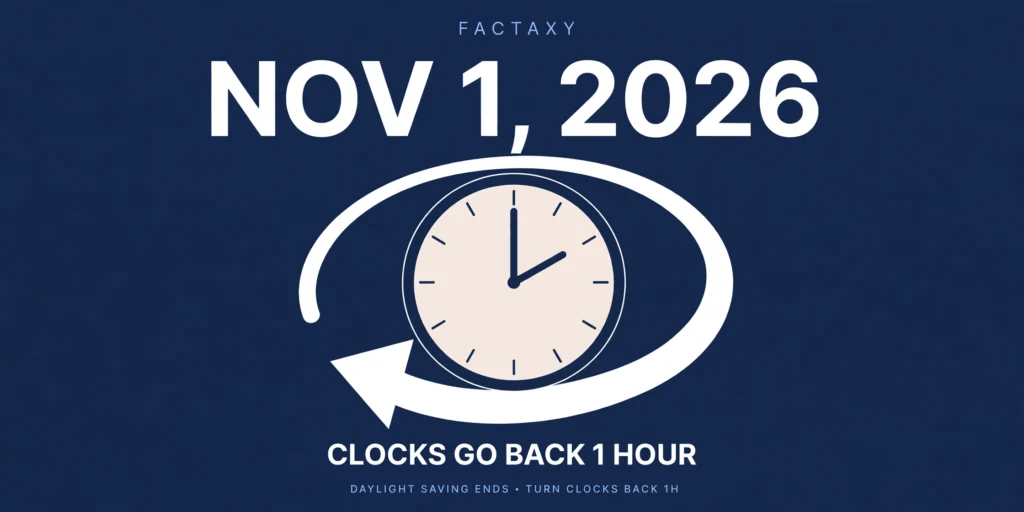
Clocks go BACK one hour. Daylight saving time in the United States ends on Sunday, November 1, 2026, at 2:00 a.m. local time. At that moment, clocks roll back to 1:00 a.m., the day becomes 25 hours long, and you gain an extra hour of sleep. This is the “fall back” change. The next change comes in spring, when clocks move forward again on Sunday, March 14, 2027.
What exactly happens on November 1, 2026
Daylight saving time (DST) is the period from the second Sunday in March to the first Sunday in November when most of the United States sets clocks one hour ahead of standard time. On November 1, 2026, that period ends. When your local time reaches 2:00 a.m., it instantly becomes 1:00 a.m. again, which means the hour from 1:00 to 2:00 a.m. happens twice that night.
The practical effect is simple. Sunday morning feels easier than a normal wake-up, sunrise comes earlier by the clock, and sunset lands noticeably earlier in the evening. Most phones, computers, and smartwatches update on their own overnight. Anything with a manual clock, from ovens and microwaves to car dashboards and wall clocks, needs a human to turn it back.
The 2026 and 2027 clock-change dates to know
- Sunday, March 8, 2026: DST began. Clocks moved forward one hour (“spring forward”).
- Sunday, November 1, 2026: DST ends. Clocks move back one hour at 2:00 a.m.
- Sunday, March 14, 2027: DST begins again. Clocks move forward one hour at 2:00 a.m.
- Sunday, November 7, 2027: DST ends. Clocks move back one hour at 2:00 a.m.
The pattern is fixed by federal law under the Uniform Time Act: DST starts on the second Sunday in March and ends on the first Sunday in November. Unless Congress changes the law, those are the weekends to plan around every year.
Which states and territories do not observe daylight saving time
Two states and all the major US territories skip the clock change entirely, so November 1 is a completely normal Sunday for them:
- Arizona stays on Mountain Standard Time all year. The one exception is the Navajo Nation in the northeast of the state, which does observe DST, so it matches the rest of the country in summer and matches Arizona in winter.
- Hawaii stays on Hawaii Standard Time year-round, which makes sense close to the equator where daylight barely changes between seasons.
- Puerto Rico, Guam, the US Virgin Islands, American Samoa, and the Northern Mariana Islands also stay on standard time all year.
If you live in one of these places, the main thing that changes for you is the time difference between you and the mainland. After November 1, for example, Phoenix is two hours behind New York instead of three.
Many other states have passed laws saying they want permanent daylight saving time, often called “locking the clock.” Under current federal law a state can choose permanent standard time on its own, like Arizona and Hawaii, but it cannot adopt permanent DST without an act of Congress. Bills to do that, including versions of the Sunshine Protection Act, have been debated repeatedly without becoming law, so the twice-yearly change stays for 2026 and 2027.
The sleep and health angle
Of the two clock changes, this is the kind one. Gaining an hour is far easier on the body than losing one in March, and many people wake up on November 1 feeling genuinely rested. Even so, the shift is not free of effects:
- Your body clock still notices. Your internal rhythm keys off light, and mornings get brighter while evenings get darker after the change. Waking up before your alarm for a few days is completely normal.
- Evening darkness changes habits and risk. Sunset arriving an hour earlier means more commuting, dog walking, and kids’ activities happen in the dark. Reflective gear and slower driving on the first few evenings are worth the small effort.
- Sleep debt gets a small repayment. If you have been running short on sleep, the extra hour is a chance to reset. Keeping your usual bedtime on Saturday night and simply enjoying the longer night works better than staying up late to “spend” the hour.
- Children and pets adjust slowly. Young kids and animals run on routine, not clocks, so expect a few early wake-ups while the household schedule drifts back into place.
Health researchers generally save their strongest criticism for the spring change, which is linked to a measurable jump in accidents and cardiac events in the following days. The fall change is milder, though some studies still find a small rise in evening traffic incidents in the first week simply because more travel happens after dark.
The money angle: night-shift workers and the 25-hour day
Here is the part most fall-back articles skip, and it matters to anyone working overnight on October 31 into November 1. When clocks roll back at 2:00 a.m., the hour between 1:00 and 2:00 a.m. happens twice. An employee on an eight-hour overnight shift who works through the change actually works nine hours, not eight.
Under the Fair Labor Standards Act, hourly (non-exempt) workers must be paid for every hour actually worked, including that repeated hour. An employer cannot simply pay the scheduled eight hours when nine were worked. The extra hour also counts toward the weekly total, so if it pushes a worker past 40 hours in the workweek, that hour is owed at the overtime rate of time and a half. Payroll systems that pre-load scheduled hours are a common source of quiet underpayment on this one night of the year, so overnight staff should check the November pay stub for the time-change shift specifically.
A few related points worth knowing:
- Salaried exempt workers are generally not owed extra pay for the longer night, since their salary covers all hours worked in the week.
- The reverse happens in spring. In March, the 2:00 a.m. hour disappears, and employers generally only pay for hours actually worked, though many choose to pay the full scheduled shift as a goodwill policy.
- Shift differentials still apply. If your night shift carries an hourly premium, the repeated hour earns it too, because it is a night hour actually worked.
- Keep your own record. A quick photo of the time clock or a note of your start and end times on that night makes any payroll conversation simple.
Businesses feel the change too. Bars and restaurants in many states gain an extra operating hour that night under local liquor rules, and delivery schedules shift by an hour relative to Arizona and Hawaii.
Your November 1 home checklist
The clock change has become the traditional twice-a-year reminder for small home jobs. While you are turning clocks back, run through this list:
- Smoke alarms and carbon monoxide detectors: Test every unit, and replace batteries in any that use replaceable ones. Fire departments have promoted “change your clocks, change your batteries” for decades because it works.
- Manual clocks: Oven, microwave, coffee maker, wall clocks, alarm clocks, and the car dashboard. The car is the one everyone forgets for a week.
- Thermostat schedules: Programmable thermostats that do not auto-update will run an hour off, heating an empty house. Smart thermostats update themselves but are worth a glance.
- Outdoor timers and sprinklers: Yard lighting, pool pumps, and irrigation timers often keep their own time and need a manual reset, or your lights will run at odd hours.
- Medical and care devices: Anything that doses or alerts on a schedule should be checked so the timing stays consistent.
- Safety kit: Check flashlight batteries and swap out expired items in your emergency supplies while you are in maintenance mode.
Frequently asked questions
Do clocks go forward or back on November 1, 2026?
Back. At 2:00 a.m. local time, clocks return to 1:00 a.m. standard time. Remember it as “fall back” in autumn and “spring forward” in March.
Will my phone change the time by itself?
Almost certainly yes. Phones, computers, tablets, and smartwatches get their time from the network and update automatically, as long as the automatic date and time setting is switched on. Manual clocks are the ones you need to handle yourself.
Do I gain or lose an hour of sleep?
You gain one. The night of October 31 into November 1 is 25 hours long, which is why this change is the popular one.
Why does the United States change the clocks at all?
Daylight saving time was adopted to shift an hour of daylight from early morning into the evening, when more people are awake to use it, originally for energy saving and farming-era schedules. Whether it still saves meaningful energy today is debated, which is why bills to end the change surface in Congress and state legislatures almost every year.
When does daylight saving time start in 2027?
Sunday, March 14, 2027, at 2:00 a.m., when clocks spring forward one hour and the day shrinks to 23 hours. If you work that overnight shift, check your hours the same way as in the fall.
Does every state change its clocks?
No. Arizona (except the Navajo Nation) and Hawaii stay on standard time all year, as do Puerto Rico, Guam, the US Virgin Islands, American Samoa, and the Northern Mariana Islands. Every other state observes the change.
Bottom line: before bed on Saturday, October 31, set your manual clocks back one hour, check your smoke alarm batteries, and enjoy the longest night of the year. Standard time runs from November 1, 2026 until March 14, 2027.