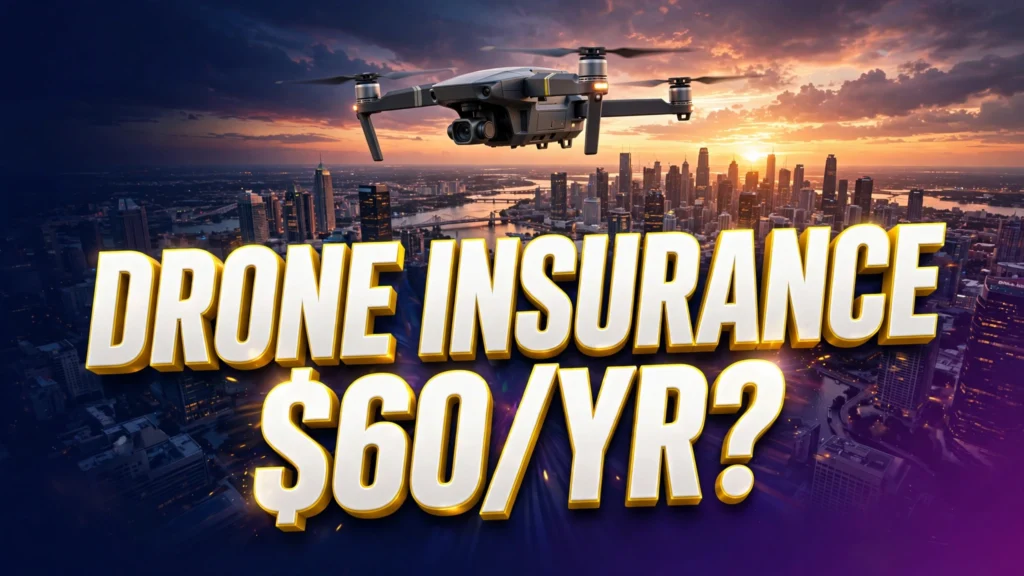
The Short Answer: $60–$100 a Year for Hobbyists, $500–$1,500+ for Commercial Pilots
Drone insurance is one of the cheapest specialty insurance products on the market. A recreational pilot flying a DJI Mini can typically get $1 million in liability coverage for $60–$100 per year. Commercial operators flying under an FAA Part 107 certificate pay more — usually $500–$1,500+ per year — because they fly more hours, carry more expensive equipment, and face real client-driven liability requirements.
The price you pay depends on three things: whether you fly for fun or for money, how much liability coverage you buy, and whether you also insure the drone itself (hull coverage). Here is the full breakdown.
Drone Insurance Cost: Recreational vs. Commercial (2026)
The recreational/commercial split is the single biggest cost driver. The FAA draws a hard line between the two, and insurers price them very differently.
| Recreational | Commercial (Part 107) | |
|---|---|---|
| Typical annual liability cost | $60–$100 for $1M | $500–$1,500+ for $1M |
| Hull coverage (the drone itself) | Often skipped or $50–$150 add-on | $150–$600+ depending on fleet value |
| Hourly on-demand option | Available, ~$6–$10/hour | Available, ~$10–$30/hour |
| Who needs it | Anyone who wants protection | Anyone flying for pay — and most clients |
Recreational coverage is cheap because the risk pool is enormous and claims are rare. Commercial coverage costs more because commercial pilots log far more flight hours, fly in riskier environments (construction sites, events, inspections), and — critically — their clients demand high liability limits before signing a contract.
Liability vs. Hull: What You’re Actually Paying For
Drone insurance has two parts, and understanding the split keeps you from overpaying.
Liability coverage (the important part)
Liability pays when your drone injures someone or damages someone else’s property — the classic scenario being a flyaway that lands on a car windshield or a crash into a wedding guest. A $1 million liability policy is the industry standard, and it is what clients, venues, and municipalities ask for. For recreational pilots this is the whole policy; the cost is $60–$100 a year.
Hull coverage (insuring the drone itself)
Hull covers your own drone against crashes, flyaways, and theft. A replacement DJI Mavic runs $1,000–$3,500, so hull coverage typically costs 5–10% of the drone’s value per year — roughly $50–$300 for most consumer drones. Many hobbyists skip hull entirely and self-insure: at $60–$100 a year for liability, replacing a $500 drone out of pocket every few years can be cheaper than insuring it.
Commercial pilots usually can’t skip hull. When your drone is the tool that earns your income, a week without it is lost revenue — and many commercial policies bundle hull with liability anyway.
Hourly On-Demand Drone Insurance: ~$6+/Hour
If you fly twice a year, an annual policy makes no sense. On-demand drone insurance lets you buy liability coverage by the hour through an app — typically $6–$10 per hour for recreational liability and $10–$30 per hour for commercial-grade limits.
The math is simple: if you fly fewer than about 8–10 hours a year, hourly coverage is cheaper than an annual policy. The trade-off is friction — you have to remember to activate coverage before every flight, and there is no hull coverage on most hourly plans. For a real-estate photographer who shoots one property a month, hourly coverage can cut the annual insurance bill from $800 to under $300.
The $79 AMA-Membership Liability Trick
Here is the cheapest liability coverage in American aviation, and most drone pilots have never heard of it: an Academy of Model Aeronautics (AMA) membership — about $79 a year — includes $2.5 million in liability coverage for recreational flying.
The catch is real, so read carefully: AMA coverage applies when you fly recreationally in accordance with AMA safety guidelines, and it is generally secondary/excess coverage — it kicks in after your homeowners or renters policy. It also does not cover commercial operations at all. But for a hobbyist who flies at parks and open fields, it is the best dollar-for-dollar liability deal in the hobby — $79 a year for $2.5 million in coverage is unmatched by any standalone policy.
The $1M Liability Requirement: Cost-of-Doing-Business Math
If you fly drones for money, “$1 million liability” will appear in nearly every client contract, venue agreement, and film permit. It is not negotiable — no certificate of insurance, no job.
Here is how to think about the cost: a $1,000-a-year commercial policy spread across 100 paid flights is $10 per flight. Real-estate shoots typically pay $200–$500, roof inspections $150–$400, and event coverage $500–$2,000+. Insurance is 2–5% of revenue — a rounding error compared to the cost of losing a client because you couldn’t produce a certificate of insurance on the spot.
Smart commercial pilots also learn to issue certificates of insurance naming the client as “additional insured” — most insurers do this free or for a nominal fee, and it is often the difference between winning and losing a bid.
What Raises (or Lowers) Your Drone Insurance Cost
- Flight hours: more hours in the air = more exposure = higher premiums. Be honest on the application; underreporting hours can void a claim.
- Drone weight and value: a 249-gram Mini is cheaper to insure than a 9-kg Matrice carrying a $6,000 camera.
- Where you fly: operations over crowds, near airports, or in cities cost more. Rural mapping missions are the cheapest commercial risk.
- Claims history: like auto insurance, one paid liability claim can raise your renewal 20–40%.
- FAA compliance: commercial pilots with a Part 107 certificate and a clean record get better rates than uncertificated operators — and flying commercially without Part 107 can void your policy entirely.
- Deductibles: raising your hull deductible from $250 to $1,000 can cut the hull portion of the premium noticeably.
Do You Legally Need Drone Insurance?
Federal law does not require drone insurance for recreational or Part 107 commercial pilots — with one practical exception: the market requires it. Clients, venues, cities issuing film permits, and some state and local rules effectively make $1 million in liability mandatory for commercial work. A few states have considered mandatory liability for certain drone operations, so check your state’s current rules.
For hobbyists, insurance is optional but cheap enough that skipping it is a false economy. One flyaway into a neighbor’s solar panels or a parked car can cost thousands — against a $60–$100 annual premium, the math isn’t close.
Frequently Asked Questions
Does homeowners insurance cover my drone?
Sometimes, partially. Many homeowners policies cover a recreational drone as personal property (theft, fire) up to a sublimit, and personal liability may extend to a hobby crash — but exclusions for “aircraft” are common, commercial use is virtually never covered, and filing a $1,200 drone claim against your homeowners policy risks a premium hike that dwarfs the claim. A standalone drone policy keeps your homeowners record clean.
How much does drone insurance cost per month?
Recreational annual policies break down to roughly $5–$9 per month. Commercial policies run $40–$125+ per month depending on limits and hull value. Monthly-billed drone policies exist but usually cost 10–20% more than paying annually.
Can I get drone insurance for one day?
Yes — on-demand hourly/daily liability policies are designed for exactly this. Expect $6–$30 per hour depending on limits, bought through an app minutes before you fly. This is the cheapest legal way to cover a single commercial shoot.
What does commercial drone insurance not cover?
Standard exclusions include intentional damage, flights beyond visual line of sight (unless waivered and endorsed), war and terrorism, wear and tear, and — critically — any commercial operation if you only bought a recreational policy. Misrepresenting commercial flights as recreational is the fastest way to have a claim denied.
The Bottom Line
Drone insurance is cheap protection against expensive mistakes: $60–$100 a year for hobbyists (or $79 via an AMA membership), $500–$1,500+ for commercial pilots, and ~$6+/hour on-demand for occasional flyers. If you fly for money, the $1 million liability certificate isn’t optional — it’s the price of admission to paying clients. Buy the liability limit your clients demand, insure the hull only if the drone earns its keep, and never fly a commercial job on a recreational policy.