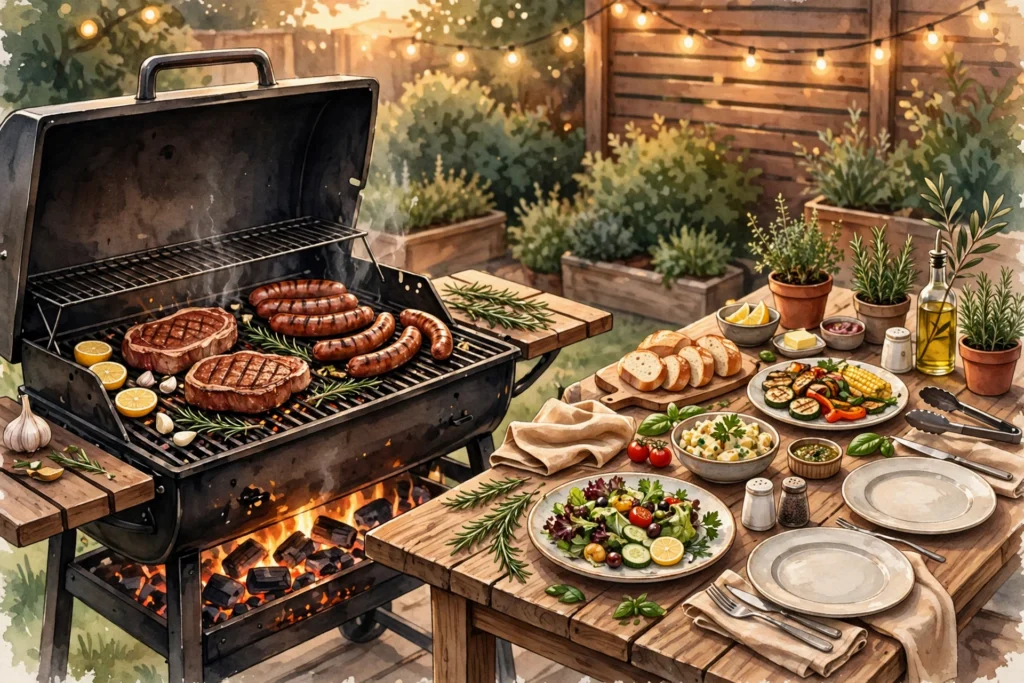
How Much Meat Per Person? Party and BBQ Planning Guide for Roast, Sausage, Cold Cuts, and Tri Tip
Running out of food at a party is embarrassing. Buying twice as much as anyone eats is expensive. The good news is that meat planning is mostly simple math once you know one key distinction: the weight you buy is not the weight people eat.
Raw meat loses water and fat during cooking, and bone-in cuts carry weight that never reaches a plate. Plan from the cooked, edible amount you want to serve, then work backward to the raw weight you need to buy. Do that, and you can feed a crowd generously without filling your freezer with expensive leftovers by accident.
This guide covers the four situations hosts ask about most: a roast dinner, a sausage-heavy BBQ, a cold cut sandwich party, and a tri tip cookout. All figures below are typical planning ranges, not guarantees. Appetites, side dishes, event length, and cooking method all move the real number up or down.
The Golden Rule: Start With Cooked Meat Per Person
For most adult guests at a main meal, plan on about one third to one half pound of cooked, edible meat per person. That is roughly 5 to 8 ounces.
Use the lower end when:
- There are several filling sides, such as potatoes, pasta salad, beans, bread, and macaroni and cheese
- Meat is one of several proteins, or appetizers are substantial
- The event is a shorter lunch rather than a long evening gathering
Use the higher end when:
- Meat is the star of the meal and sides are light
- Guests are known big eaters, teenagers, or a very active crowd
- The event runs for several hours and people will graze and go back for seconds
Children under about 12 typically eat about half an adult portion, while teenagers are usually best counted as adults. If you are unsure about your crowd, planning near the middle of the range, and adding a small buffer of about 10 percent, is a sensible compromise. A modest buffer is far cheaper than a second emergency trip to the store, and leftovers from a roast or BBQ are usually easy to use the next day.
The Formula That Prevents Overbuying and Underbuying
Once you pick a cooked target, use this simple formula:
Guests multiplied by cooked meat per person, divided by the cooked yield, equals raw meat to buy.
Cooked yield is the share of the raw weight that survives cooking and trimming as edible meat. A cut with a 50 percent yield needs twice as much raw weight as the cooked amount you want. A cut with a 75 percent yield needs about one third more.
Example: you are feeding 20 adults and want one half pound of cooked meat each. That is 10 pounds cooked in total. If you choose a cut with a 50 percent yield, you need about 20 pounds raw. If you choose a cut with a 75 percent yield, you need about 13 to 14 pounds raw. Same guest list, same plates, very different shopping list. That difference is where most party budgets go wrong.
Bone-In Versus Boneless: Why the Same Roast Feeds Fewer People
Bone adds weight but not edible meat. It also changes cooking: bone-in roasts often cook more gently and can stay juicier, but you must buy more raw weight to serve the same number of people.
As a typical planning guide:
- Boneless roasts and steaks: expect roughly 70 to 85 percent of the raw weight to become cooked, edible meat, depending on fat and doneness
- Bone-in roasts: expect roughly 60 to 70 percent, because bone and extra trim are removed
- Bone-heavy cuts such as ribs and wings: expect roughly 50 to 55 percent edible meat, sometimes less, because bone makes up a large share of the weight
That is why a bone-in roast that looks generous in the store can serve fewer people than a smaller boneless roast at the same price per pound. Compare cuts on cost per edible pound, not just cost per raw pound. Divide the price per raw pound by the expected yield to get a rough cost per cooked, edible pound. A cheaper bone-in cut is not always the cheaper meal once bone and shrinkage are counted.
How Much Meat Shrinks When You Cook It
Shrinkage varies a lot by cut and method. Lean meat cooked quickly loses less weight than fatty meat cooked low and slow for hours. Well-done meat generally loses more moisture than meat cooked to medium or medium-rare. Frozen meat that is thawed and then cooked may also lose a little more moisture than fresh meat, so a small buffer helps there too.
Typical cooked yield ranges used by party planners and catering guides:
| Cut or type | Typical cooked edible yield | What that means in plain terms |
|---|---|---|
| Boneless steak and roast beef | About 70 to 80 percent | Buy about 1.3 pounds raw for each pound cooked you want |
| Bone-in roast | About 60 to 70 percent | Buy about 1.5 pounds raw for each pound cooked you want |
| Tri tip | About 70 to 75 percent | Buy about 1.35 pounds raw for each pound cooked you want |
| Pulled pork from pork shoulder | About 50 to 60 percent | Buy about 1.8 to 2 pounds raw for each pound cooked you want |
| Brisket | About 50 to 55 percent | Buy about 1.9 pounds raw for each pound cooked you want |
| Sausages and hot dogs | About 85 to 95 percent | Buy close to the cooked amount you want |
| Cold cuts | About 100 percent | What you buy is what you serve, with no cooking loss |
| Bone-in ribs | About 50 to 55 percent edible meat | Buy about 1 pound raw per adult as a main course |
These are planning ranges, not exact results for any single cook. Trim, fat content, cooking temperature, resting time, and how generously you carve all shift the outcome.
How Much Roast Per Person
Roast beef, pork loin, and similar roasts are among the easiest party meats to plan, because the yield is relatively predictable and carving lets you control portions.
For a roast as the main course with sides, plan on:
- Boneless roast: about one half to three quarters pound raw per adult
- Bone-in roast: about three quarters to 1 pound raw per adult
- Children: about half the adult amount
For 20 adults, that works out to roughly 10 to 15 pounds of boneless roast, or roughly 15 to 20 pounds of bone-in roast. If you also want planned leftovers for sandwiches the next day, add about one quarter pound raw per person to the total, and say so on your shopping list so the extra is intentional rather than accidental.
A roast also stretches further when it is sliced thin and served with bread, gravy or sauce, and at least two substantial sides. Thick, generous carving at the table, on the other hand, can quietly raise consumption well above the plan. If you want control, carve in the kitchen and plate a consistent portion, then offer seconds from what remains.
Cost tip: roast is often where the per-guest math matters most, because it is sold by the pound and bought in large pieces. Before you choose between a boneless and a bone-in roast, estimate both totals. Multiply the raw pounds needed by the price per pound for each option, then divide by the number of guests. The lower total cost per guest, not the lower sticker price per pound, is the number that matters for your budget.
How Much Sausage Per Person
Sausage is the most forgiving BBQ meat to plan. Most sausages lose only a little weight during cooking, especially precooked smoked sausage, and links are naturally portioned, which makes counting easy.
As a typical guide:
- Sausage as one meat among several: 1 link, or about 4 ounces, per adult
- Sausage as the main meat: 2 links, or about one quarter to one half pound, per adult
- Sausage as an appetizer or side item: about 1 link per two guests, or roughly 2 ounces per person, is often enough
- Children: about 1 link, or half the adult main-course amount
For 20 adults with sausage as the main BBQ meat, plan on about 40 links, or roughly 10 pounds if each link is about one quarter pound. If sausage shares the menu with burgers or chicken, 20 links may be plenty, because most guests will take one sausage plus something else rather than a full portion of each.
Sausage also makes a smart budget stretcher. Because it is usually cheaper per cooked pound than steak or brisket, and because it loses so little weight, adding sausage to a menu lets you offer variety without buying a full portion of every premium meat. Just be careful not to add sausage on top of full portions of everything else. When you add a meat, reduce the other meats, or the total will balloon.
How Much Cold Cuts Per Person
Cold cuts have no cooking loss at all, which makes them the simplest party meat to calculate. The only real question is the occasion: a light platter, a sandwich lunch, or a build-your-own sandwich bar.
Typical planning amounts per adult:
- Cold cuts as an appetizer or finger-food platter: about 2 to 3 ounces per person
- Cold cuts for pre-made sandwiches: about 3 to 4 ounces per sandwich, or about 4 ounces per person if most guests eat one sandwich
- Cold cuts for a build-your-own sandwich bar: about 4 to 6 ounces per person, because guests serve themselves more generously
- Cheese to go with the meat: about 1 to 1.5 ounces per person
For 20 adults at a sandwich lunch, that is roughly 5 to 7.5 pounds of cold cuts in total. For 50 adults, it is roughly 12.5 to 18.75 pounds, depending on whether guests build one sandwich or two. Splitting the total across two or three varieties, such as turkey, ham, and roast beef, usually pleases more guests than buying one huge pile of a single meat.
Two practical details make a cold cut party work better. First, ask for thin slices. Thin slices cover bread better, look more generous, and let guests build a sandwich without one thick slice dominating it. Second, keep cold cuts refrigerated until serving and return leftovers to the fridge promptly. As general food safety guidance, perishable foods should not sit at room temperature for long periods, and a common rule of thumb is to limit that time to about two hours, less in hot weather.
How Much Tri Tip Per Person
Tri tip is a popular BBQ choice because it cooks faster than brisket, slices well, and has a relatively good yield for beef. It is a boneless, triangular cut from the bottom sirloin, usually sold whole at around 2 to 3 pounds each, though sizes vary.
For tri tip as the main course, plan on:
- About two thirds to three quarters pound raw per adult, which yields roughly one half pound cooked
- About one third pound raw per adult when tri tip is one of two or three meats
- About one quarter pound raw per child, or half the adult amount
For 20 adults with tri tip as the only meat, that is roughly 13 to 15 pounds raw, or about five to seven whole tri tips depending on their size. For 20 adults with tri tip plus sausage and chicken, about 7 pounds of raw tri tip is a reasonable starting point, because guests will split their half pound of cooked meat across the menu.
Slice tri tip thinly and against the grain for the best texture, and remember that the grain changes direction partway through the cut. Resting the meat before slicing also helps keep juices in the meat rather than on the cutting board, which protects both flavor and yield. Because tri tip is leaner than brisket or pork shoulder, overcooking it dries it out faster, so a thermometer and a rest period are worth more than guesswork.
Party Size Cheat Sheet
The table below uses the standard planning target of about one half pound of cooked, edible meat per adult, with children counted at half portions. Adjust up for big eaters and long events, and down for heavy sides and appetizers.
| Guests | Roast, boneless, raw | Roast, bone-in, raw | Tri tip, raw | Sausage, main meat | Cold cuts, sandwich lunch |
|---|---|---|---|---|---|
| 10 adults | 7 to 8 pounds | 10 pounds | 7 to 8 pounds | 20 links, about 5 pounds | 2.5 to 3.75 pounds |
| 20 adults | 13 to 15 pounds | 20 pounds | 13 to 15 pounds | 40 links, about 10 pounds | 5 to 7.5 pounds |
| 30 adults | 20 to 23 pounds | 30 pounds | 20 to 23 pounds | 60 links, about 15 pounds | 7.5 to 11.25 pounds |
| 50 adults | 33 to 38 pounds | 50 pounds | 33 to 38 pounds | 100 links, about 25 pounds | 12.5 to 18.75 pounds |
For mixed menus, do not add full portions together. Instead, keep the total cooked target at about one half pound per adult and divide it. For example, a two-meat menu for 20 adults might be about 5 pounds cooked of each meat, or roughly 7 pounds raw tri tip plus 10 pounds raw pork shoulder, after adjusting each for its own yield. A three-meat menu divides the same total three ways. This single habit is the difference between a generous spread and a grocery bill for twice as many people as you invited.
Cost Per Guest: The Number Worth Calculating Before You Shop
Meat is usually the largest food cost at a party, so a two-minute calculation before shopping can save more than any coupon after it. Use this method, with your own local prices:
- Choose your cooked target per person, for example one half pound.
- Divide by the expected yield to get raw pounds per person.
- Multiply raw pounds per person by the price per raw pound.
- Multiply by the number of guests for the total meat cost.
- Divide the total by the number of guests to check the cost per guest.
As an illustrative example only, not a current price claim: if a cut costs 6 dollars per raw pound and yields 50 percent, the cooked cost is about 12 dollars per cooked pound, or about 6 dollars per guest at one half pound cooked each. If another cut costs 8 dollars per raw pound but yields 75 percent, the cooked cost is about 10.67 dollars per cooked pound, or about 5.33 dollars per guest at the same portion. The cut with the higher sticker price can be the cheaper plate. Run the same comparison with the actual prices at your store, because prices vary by region, season, and cut.
Other ways to control cost without making guests feel shortchanged include serving filling, inexpensive sides, offering bread and sauces, choosing one premium meat plus one value meat such as sausage, and buying larger roasts when the per-pound price is lower. Avoid the false economy of buying a bone-heavy cut purely because its raw price looks low, unless you have run the edible-pound math above.
Common Mistakes That Blow Up the Budget
The most common error is planning from raw weight as if it were cooked weight. A 10 pound pork shoulder does not serve 20 people at one half pound each, because after cooking it may yield only about 5 to 6 pounds. The second error is adding full portions for every meat on a mixed menu. Guests do not eat a full portion of each; they sample across the table.
The third error is forgetting who is actually coming. A guest list of 20 adults, 10 teenagers, and 5 small children is not a 35-adult party, but it is also not a 20-person party. Count teenagers as adults, children at half, and anyone who does not eat meat separately, then add a meat-free option so those guests are fed without inflating the meat order.
Finally, remember that a buffet invites larger portions than plated service. If guests serve themselves, plan toward the higher end of the range or accept that seconds may run short. If you plate portions, you can plan closer to the middle and still be generous.
FAQ
How much meat per person for a BBQ?
Plan on about one half pound of cooked meat per adult for a standard BBQ with sides, or about one third pound if sides are heavy and appetizers are substantial. Then convert to raw weight using the yield for each cut, because smoked meats such as brisket and pork shoulder can lose close to half their raw weight.
How much tri tip do I need for 20 people?
For tri tip as the only meat, plan on roughly 13 to 15 pounds raw for 20 adults, which yields about 10 pounds cooked. If tri tip is one of several meats, about 7 pounds raw is a reasonable starting point, with the rest of the cooked total coming from the other meats.
How much sausage per person at a party?
Plan on 1 link, about 4 ounces, per adult when sausage is part of a mixed menu, and 2 links, about one quarter to one half pound, per adult when sausage is the main meat. Sausage loses little weight in cooking, so the raw and cooked amounts are close.
How much cold cuts per person for sandwiches?
Plan on about 4 to 6 ounces of cold cuts per adult for a build-your-own sandwich lunch, and about 2 to 3 ounces per person if cold cuts are only an appetizer platter. Add about 1 to 1.5 ounces of cheese per person for sandwiches.
How do I avoid buying too much meat?
Pick a cooked target first, divide by the yield for each cut, and do not add full portions together on a mixed menu. Keep the total at about one half pound cooked per adult and divide it across the meats. A buffer of about 10 percent covers appetite variation without doubling the order.
The Bottom Line
How much meat per person comes down to three steps: choose a cooked portion, adjust for bone and cooking loss, and divide the total across your menu instead of stacking full portions. Roast and tri tip need roughly two thirds to three quarters pound raw per adult as a main course, sausage needs about 1 to 2 links depending on its role, and cold cuts need about 4 to 6 ounces per adult for sandwiches. Run the cost per guest calculation with your local prices before you shop, and you will serve a generous party without paying for a second party nobody ate.