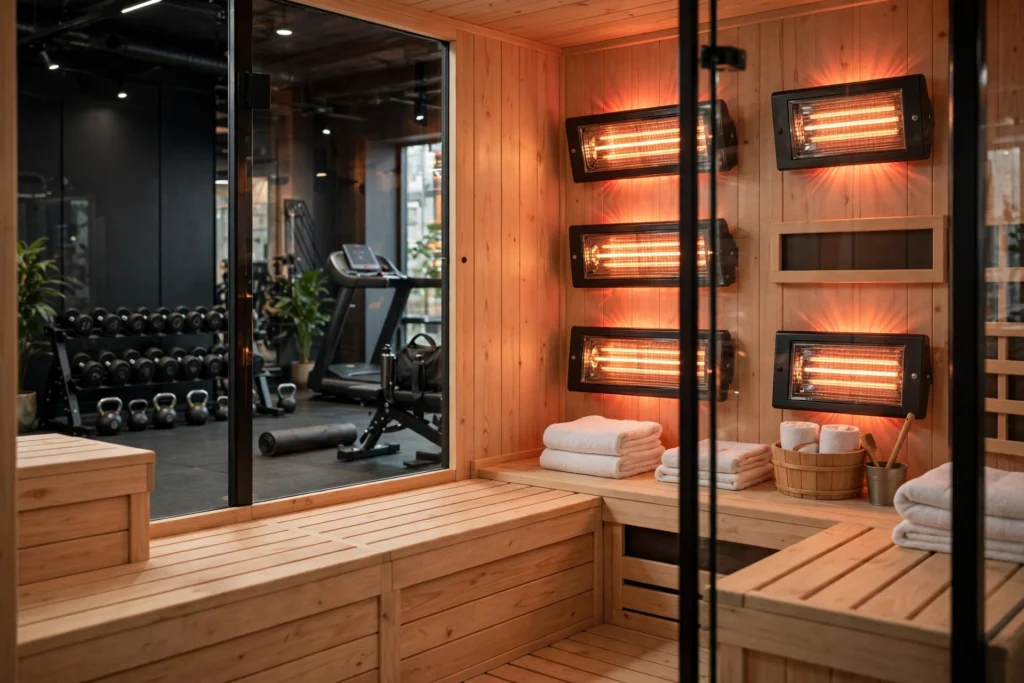
Searching for gyms with an infrared sauna near me sounds simple, but the answer is rarely as simple as a chain name. One location of a big gym brand may have a modern infrared cabin, the next location may have only a traditional dry sauna, and a third may have no sauna at all. Membership tiers add another layer: the cheapest advertised plan is not always the plan that unlocks the recovery area.
This guide explains how to search locally, which types of gyms commonly offer infrared saunas, what membership tiers typically cost, and how to verify a specific club before you sign a contract. Prices below are reported ranges and typical examples, not guarantees. Gym pricing varies by city, club, promotion, and plan, so always confirm the price and the sauna access in writing for your exact location.
Start With the Right Search
The phrase “near me” does a lot of work in a search engine, but it does not check amenities for you. A gym can rank for sauna searches because its brand offers saunas somewhere, because a review mentioned a sauna, or because it has a different kind of heat room entirely. Use several searches, not just one:
- “infrared sauna gym” plus your city or ZIP code
- The gym name plus “infrared sauna” plus your city, for example “Crunch infrared sauna” plus your city name
- “recovery gym infrared sauna” plus your city
- “infrared sauna studio” plus your city, if you want sauna-only access rather than a full gym
Then open the page for the exact club, not the national homepage. Look for an amenities list, a recovery section, or photos of the locker room and wellness area. If the page only says “spa” or “wellness,” that is not proof of an infrared sauna. A spa label can cover massage chairs, tanning, red light booths, hydro massage, or a traditional sauna.
Google Maps and review sites can help you build a shortlist, but treat them as leads, not proof. A review from two years ago may describe a sauna that has since been removed, replaced, or closed for repair. The club itself is the final source.
What an Infrared Sauna Is, and How It Differs From a Traditional Sauna
An infrared sauna uses radiant panels to warm your body directly, while the air around you stays comparatively cool. A traditional sauna, often called a Finnish sauna, heats the air in the room with a heater and stones, and you may add water to the stones for a burst of steam.
That difference changes the feel of a session. Typical reported ranges are:
| Feature | Infrared sauna | Traditional sauna |
|---|---|---|
| How it heats | Radiant panels warm the body directly | Heater warms the air, which warms the body |
| Typical air temperature | About 110 to 150 degrees Fahrenheit | About 150 to 195 degrees Fahrenheit |
| Humidity | Dry, no steam | Dry, or humid if water is added to stones |
| Warm-up time | Often about 10 to 15 minutes | Often about 30 to 45 minutes |
| Comfortable session length | Often about 20 to 45 minutes | Often about 15 to 20 minutes |
| Feel | Gentler, easier to stay in longer | More intense, hotter air |
Neither type is automatically better for everyone. Some people prefer the gentler heat of an infrared cabin, especially if intense heat feels uncomfortable. Others prefer the hotter, steam-capable traditional room. If heat tolerance, a heart condition, pregnancy, or another health concern applies to you, check with a clinician before using any sauna. This article is general information only, not medical advice.
Also learn to spot lookalikes. A red light booth, a tanning bed, a steam room, and a massage chair are not infrared saunas, even when they sit in the same recovery area. When a gym says “wellness suite” or “relax and recover,” ask exactly which equipment is in that room.
Which Gyms Commonly Offer Infrared Saunas
No national chain guarantees an infrared sauna at every club. Availability is a location decision, shaped by the size of the building, the age of the club, recent remodels, and the local market. Still, some types of facilities are more likely to have one than others.
Large and mid-size gym chains
Chains that have added recovery areas in newer clubs include Crunch Fitness, 24 Hour Fitness, Chuze Fitness, VASA Fitness, and Anytime Fitness at selected locations. Crunch, for example, has rolled out newer club designs with a Relax and Recover suite that can include an infrared sauna, hydro massage, and other recovery equipment, but older clubs may not match the new design. Chuze and VASA also list infrared saunas at some, not all, locations.
At 24 Hour Fitness, sauna access has historically been tiered: lower tiers may not include it, while higher tiers do. That is a common pattern across the industry. The lesson is not to memorize one chain’s tiers, but to ask, for your club, “Which exact plan includes the infrared sauna, and is that access included every day the club is open?”
Premium clubs and athletic clubs
Premium clubs such as Life Time and Equinox, plus many independent athletic clubs and country clubs, are more likely to have extensive spa and recovery areas, sometimes including both traditional and infrared options. The trade-off is price. Premium memberships are often priced well above a budget gym, and the sauna may be only one part of a much larger package that includes pools, classes, courts, childcare, and spa services. If the sauna is your main reason for joining, compare the full monthly cost against how often you will realistically use it, not just against the cheapest gym in town.
Infrared studios and recovery studios
Studios built around infrared heat, such as HOTWORX, offer a different model: short infrared workouts in heated rooms, plus sauna-style sessions, rather than a full weight floor. Recovery studios such as Restore Hyper Wellness and similar local studios often sell infrared sauna sessions, contrast therapy, and red light sessions by the visit or by monthly membership. These are worth pricing if you want sauna access without a full gym, or if your local gyms do not offer one.
Budget gyms: check carefully
Budget chains keep prices low by limiting amenities. Planet Fitness, for example, does not list a traditional dry sauna as a standard chain-wide amenity. Some individual clubs offer recovery features such as hydro massage, massage chairs, or a red light booth for eligible members, but those are not the same as an infrared sauna room. Do not assume a low-cost club has one. If a budget club near you does advertise an infrared sauna, verify it in person, because that would be the exception rather than the rule.
Local gyms, YMCAs, and community centers
Independent gyms, YMCAs, and community recreation centers sometimes have saunas, and some have infrared cabins. Their prices and rules vary widely, and eligibility, guest rules, and hours can differ from commercial gyms. They are worth including in a local search, especially if you want a lower price or a family membership, but the same verification rule applies: check the exact location.
What Membership Tiers Typically Cost
Sauna access is usually bundled into a gym membership, not sold as a separate line item at a big-box gym. That means the real question is: how much does the tier that includes the sauna cost, and what else does that tier add?
Reported typical ranges from recent gym guides, which vary by location and promotion, include:
| Gym type or example | Typical monthly range reported | Sauna note |
|---|---|---|
| Budget gym, basic tier | About 10 to 30 dollars | Sauna often not included, or not offered |
| Mid-size chain, standard tier | About 25 to 50 dollars | Infrared sauna at some locations, often on a higher tier |
| Mid-size chain, premium or recovery tier | About 30 to 70 dollars | More likely to include sauna and other recovery amenities |
| Infrared studio membership | About 50 to 60 dollars | Infrared workouts and sauna-style sessions are the core product |
| Premium club | Often 100 dollars or more, and can be much higher | Extensive spa and recovery areas, but you pay for the whole package |
These figures are illustrative, not quotes. A club in a high-cost city can charge more than a club in a smaller market, and a promotion can cut the first month while leaving the regular rate unchanged. Always calculate the 12-month cost, not just the advertised monthly rate.
The 12-month cost test
Before you join, add up:
- The monthly rate for the tier that includes the infrared sauna, multiplied by 12
- Any joining or enrollment fee
- Any annual fee, maintenance fee, or facility fee
- Any upgrade fee required to move from a basic tier to the sauna tier
- Any reservation fee, towel fee, or guest fee you expect to pay regularly
Then divide by the number of sauna visits you realistically expect in a year. A 40-dollar plan used for sauna visits twice a week is a very different value from the same plan used twice a month. If you will use the gym for training as well, the sauna is a bonus. If you will join only for the sauna, compare the gym total against a sauna studio membership or a pay-per-visit studio in your area.
Hidden fees and contract traps to check
- Tier gating: The advertised price may be for a basic plan that excludes the recovery area. Confirm the sauna tier by name.
- Annual fees: Some chains charge an annual fee on top of the monthly rate, often once a year. Ask when it is charged and how much it is.
- Joining fees: A low monthly rate can hide a joining fee of 50 dollars or more, though promotions often waive it.
- Cancellation terms: Ask whether the plan is month to month, requires notice, or locks you in for a term. Ask how cancellation works in practice, not just in theory.
- Peak-time limits: Some recovery areas require reservations, limit session length, or restrict access at busy times.
- Age and guest rules: Saunas often have minimum age rules, and a guest pass may not include sauna access.
- Maintenance closures: A sauna listed on a website may be out of order for weeks. Ask about current status and recent closures.
Get the key answers in writing, by email or in the membership agreement, before you pay. A verbal promise from a sales tour is hard to rely on later.
How to Verify a Specific Location Before Joining
This is the most important section in this guide. A chain name is not verification. A website amenities list is a start, not proof. Use this five-step check:
1. Check the exact club page
Open the official page for the club you would actually attend. Look for the words “infrared sauna,” not just “sauna” or “spa.” If the page lists amenities by location, screenshot or save the relevant section, with the date, so you have a record of what was advertised.
2. Call and ask precise questions
Call the front desk and ask:
- Do you have an infrared sauna at this location, as opposed to a traditional sauna or a steam room?
- Is it working right now, and what are its hours?
- Which membership tier includes it, and is there an extra fee?
- Do members need a reservation, and how long can a session last?
- Is it in the locker room, in a shared recovery area, or in a separate room?
- Are there age limits, dress rules, or time limits I should know?
If the person on the phone is unsure, ask them to check with a manager or to confirm by email. Vague answers are a warning sign.
3. Tour the club and see the sauna
Take a tour before you enroll, and ask to see the actual sauna room. Check that it is an infrared cabin with panels, not a traditional room with a heater and stones, and not a red light booth. Note whether it looks clean, maintained, and in use, and whether there is a wait or a booking sheet. A tour also lets you judge the locker room, parking, class schedule, and crowding at the time you would normally visit.
4. Try a day pass or guest pass first
If the club offers a day pass or a free trial, use it for a real visit at your usual time, not just a quick tour. Test the full routine: check in, change, use the sauna, shower, and leave. Confirm that the pass actually includes sauna access, because some trial passes exclude premium amenities. If a day pass is not available, a single-visit studio session can still tell you whether you enjoy infrared heat before you commit to a monthly contract.
5. Read the agreement before you sign
Read the membership terms, not just the price on the sign-up page. Confirm the tier name, the monthly rate, the annual fee, the contract length, and the cancellation process. If the sauna is your main reason for joining, consider asking for the sauna access to be noted on your agreement or in a confirmation email. If the club will not put it in writing, weigh that carefully.
Infrared Sauna Etiquette and Practical Tips
Gym saunas are shared spaces, so a little preparation makes sessions smoother for everyone:
- Bring a towel, and sit on it. Many clubs require it.
- Shower before entering if the club asks you to, and rinse off after.
- Drink water before and after your session. Do not rely on a sauna to replace fluids lost in training.
- Start with shorter sessions and lower temperatures, especially if you are new to heat. Build up gradually.
- Leave phones and electronics outside unless the club clearly allows them, and keep conversation low.
- Wipe down surfaces you used, and follow any posted time limits so others can use the room.
- Skip the sauna if you feel dizzy, unwell, or overheated, and tell staff if you need help. If you have a medical condition, take medication that affects heat tolerance, or are pregnant, ask a clinician first.
These are general practical tips, not medical guidance. Every club has its own posted rules, and those rules govern the room you are using.
Cheaper Alternatives If No Nearby Gym Has One
If no gym near you offers an infrared sauna, or if the only option requires a premium tier you do not want, consider:
- A sauna studio membership: Pay-per-visit sessions are often reported in the range of about 35 to 70 dollars for a standalone infrared session, while contrast sessions at recovery studios are often reported at about 25 to 65 dollars. A monthly studio plan can beat a premium gym if you visit often and do not need a weight floor.
- A day pass at a spa or hotel: Useful for an occasional session, but rarely the cheapest route for regular use. Reported day-pass prices vary widely by city and property.
- A community center or YMCA: Worth checking for a lower-cost sauna, even if it is traditional rather than infrared.
- A home infrared sauna: A home cabin is a larger upfront purchase, often reported in the low thousands of dollars, plus electricity and space. It only makes financial sense if you will use it often for years, and it removes the commute, the wait, and the shared-room rules. Compare the total home cost against two or three years of gym or studio fees before deciding.
Do the same 12-month math for each option. The cheapest advertised price is rarely the cheapest real cost once fees, travel time, and actual usage are included.
A Simple Decision Checklist
Use this checklist to compare your top two or three options side by side:
- Does this exact location have an infrared sauna, confirmed by a visit or by written confirmation?
- Which tier includes it, and what is the full 12-month cost of that tier?
- What are the joining fee, annual fee, contract length, and cancellation terms?
- Are reservations required, and what are the sauna hours and session limits?
- How far is the club, and will you realistically go at the times the sauna is available?
- Does the club also fit your training, or are you paying for a gym you will not use?
- Is a studio, community center, or home sauna cheaper for your expected number of visits?
If a club cannot answer the first three questions clearly, it is not yet a verified option, no matter how good its advertised price looks.
Frequently Asked Questions
Do all locations of a gym chain have infrared saunas?
No. Sauna availability varies by location, even within the same chain. Newer or larger clubs are more likely to have a recovery area, while older or smaller clubs may not. Always verify the exact club you plan to attend.
How much does a gym with an infrared sauna typically cost?
It depends on the tier that includes the sauna. Budget plans often start around 10 to 30 dollars per month but may not include a sauna. Mid-size chain plans that include recovery amenities are often reported in the range of about 30 to 70 dollars per month, while premium clubs can cost considerably more. Add joining and annual fees to get the true yearly cost.
Is an infrared sauna better than a traditional sauna?
It depends on what you prefer. Infrared cabins use lower air temperatures and warm the body directly, which many people find gentler and easier to stay in longer. Traditional saunas use hotter air and can add steam, which some people prefer for a more intense session. Research on traditional saunas goes back further, while infrared research is newer and smaller in scale. Comfort, heat tolerance, and personal preference matter as much as the type.
Can I just buy a day pass to use the sauna?
Sometimes, but not always. Some gyms and studios sell day passes that include sauna access, while others restrict premium amenities to members or to higher tiers. Confirm before you travel to the club, and confirm whether the day pass covers the infrared sauna specifically, not just general gym entry.
What should I ask before signing up for a gym with an infrared sauna?
Ask whether the sauna is infrared or traditional, whether it is currently working, which tier includes it, whether reservations are required, what the full 12-month cost is including fees, and how cancellation works. If possible, tour the club, see the sauna room, and get the key answers in writing before you commit.